


President Ma Ying-jeou (馬英九), reflecting on his tenure that ends in May next year, said he believes history would view his administration more favorably than his low approval ratings that have been reflected in polling.
In an interview at his offices in Taipei on Thursday, Ma said if he had worried too much about his poll numbers, he would not have been able to push forward the policies he believes Taiwan needs.
The most contentious among those has been his embrace of economic ties with China, which has sparked protests including a three-week occupation of Taiwan’s legislature by students opposed to a services trade pact.
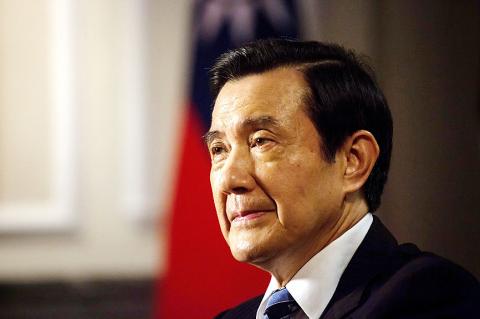
Photo: Bloomberg
“Taiwan is a society where political opposition is very intense,” Ma said. “Sometimes, no matter what I say or how nice I make it sound, I can’t obtain support, but it is because I know this that I’m not afraid to do what I should.”
While Ma’s declining popularity has not dissuaded him from endeavors such as seeking the first meeting with a Chinese president in seven decades, it has contributed to waning support for his Chinese Nationalist Party (KMT) ahead of the January elections to pick his successor.
A Nov. 8 poll by broadcaster TVBS found Democratic Progressive Party Chairperson (DPP) Tsai Ing-wen (蔡英文) leading the KMT’s Eric Chu (朱立倫) by a margin of 43 percent to 27 percent.
“Actually, there are many good policies the public doesn’t understand because we haven’t communicated them enough,” Ma said.
“I pay attention, but I’m not concerned, because if you are overly concerned, then a lot of reforms you just can’t push,” he said of polls.
That tack is something the DPP and Tsai have highlighted on the campaign trail.
They accuse Ma of practicing an opaque form of policymaking that they have taken to calling a “black box.”
When Ma’s office surprised the world earlier this month by announcing he would be meeting Chinese President Xi Jinping (習近平) in Singapore, Tsai was quick to question why the planning was kept secret.
Taiwan has become economically dependent on China while militarily focused on defending itself against China.
The resulting discourse of how to interact with China dominates political debate, with the KMT advocating stronger ties and the DPP backing a more cautious stance.
Ma has been unwavering in his support for closer ties.
It was his pledge to increase economic links with China that helped Ma win the presidency in 2008 with more than 58 percent of the popular vote, the highest total since Taiwan began direct elections in 1996.
“Globally, no country can ignore China,” Ma said on Thursday. “You might not like their rules, you might not support some of their undemocratic practices, but in terms of economics, this is a very real and cruel reality.”
While closer links opened markets for Taiwanese companies, it has also resulted in the loss of manufacturing jobs as factory owners moved their operations to China. About 40 percent of Taiwan’s exports are bound for China.
More recently, those links to the world’s second-largest economy have adversely affected Taiwan. Slowing growth in China means less demand for Taiwan’s goods, prompting the first quarterly contraction since 2009 in the three month period that ended Sept. 30.
Economic links also have not greatly increased wage growth.
Household incomes rose an average 0.63 percent annually from 2008 through last year during Ma’s tenure, compared with a 0.3 percent pace from 2000 to 2007. Both rates fall far short of the 1990s, when Taiwanese households saw income gains clocking 7.54 percent.
Ma’s support had begun to slide by 2012, when he defeated the DPP’s Tsai to win re-election with a thinner 51.6 percent of the popular vote. A poll by TVBS in May this year, the seventh anniversary of Ma’s presidency, put his approval rating at 16 percent, which represented an increase from a low of 11 percent in 2013.
Opposition to Ma’s China policies reached a climax in March last year, when students opposed to a services trade agreement his administration signed with China stormed and occupied parliament so it could not be approved.
When they later tried to also take the Executive Yuan compound, police cleared them with water cannons and batons.
Three weeks after those clashes, the students also ended their occupation of the parliament. The services trade pact has yet to be approved.
“I regret that we weren’t able to engage in a rational discussion about it,” Ma said about the students, adding that he sympathizes with their motivations as he was also once a student activist. “We should seize opportunities to strengthen our services industries to help Taiwan.”
As the interview drew to a close, he also noted his affinity for the philosophy of Chinese scholar Luo Jialun (羅家倫), a leader of the May 4 Movement in 1919, in which students championed nationalism, science and democracy, as well as the use of vernacular written Chinese.
Ma recited a line from Luo’s book A New View on Life that says: “A strong man is constituted by three elements: a savage body, a civilized mindset and an uncompromising will.”

The military has spotted two Chinese warships operating in waters near Penghu County in the Taiwan Strait and sent its own naval and air forces to monitor the vessels, the Ministry of National Defense (MND) said. Beijing sends warships and warplanes into the waters and skies around Taiwan on an almost daily basis, drawing condemnation from Taipei. While the ministry offers daily updates on the locations of Chinese military aircraft, it only rarely gives details of where Chinese warships are operating, generally only when it detects aircraft carriers, as happened last week. A Chinese destroyer and a frigate entered waters to the southwest
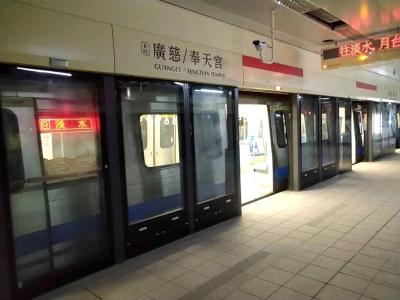
The eastern extension of the Taipei MRT Red Line could begin operations as early as late June, the Taipei Department of Rapid Transit Systems said yesterday. Taipei Rapid Transit Corp said it is considering offering one month of free rides on the new section to mark its opening. Construction progress on the 1.4km extension, which is to run from the current terminal Xiangshan Station to a new eastern terminal, Guangci/Fengtian Temple Station, was 90.6 percent complete by the end of last month, the department said in a report to the Taipei City Council's Transportation Committee. While construction began in October 2016 with an
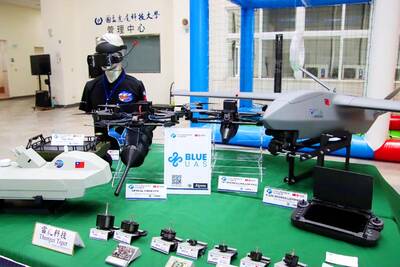
NON-RED SUPPLY: Boosting the nation’s drone industry is becoming increasingly urgent as China’s UAV dominance could become an issue in a crisis, an analyst said Taiwan’s drone exports to Europe grew 41.7-fold from 2024 to last year, with demand from Ukraine’s fight against Russian aggression the most likely driver of growth, a study showed. The Institute for Democracy, Society and Emerging Technology (DSET) in a statement on Wednesday said it found that many of Taiwan’s uncrewed aerial vehicle (UAV) sales were from Poland and the Czech Republic. These countries likely transferred the drones to Ukraine to aid it in its fight against the Russian invasion that started in 2022, it said. Despite the gains, Taiwan is not the dominant drone exporter to these markets, ranking second and fourth

Japanese Prime Minister Sanae Takaichi’s comment last year on Tokyo’s potential reaction to a Taiwan-China conflict has forced Beijing to rewrite its invasion plans, a retired Japanese general said. Takaichi told the Diet on Nov. 7 last year that a Chinese naval blockade or military attack on Taiwan could constitute a “survival-threatening situation” for Japan, potentially allowing Tokyo to exercise its right to collective self-defense. Former Japan Ground Self-Defense Force general Kiyofumi Ogawa said in a recent speech that the remark has been interpreted as meaning Japan could intervene in the early stages of a Taiwan Strait conflict, undermining China’s previous assumptions


 RSS
RSS