


Chinese Nationalist Party (KMT) headquarters is getting impatient with unilateral discourse on China issues from presumptive party presidential candidate Hung Hsiu-chu (洪秀柱) and plans to speak with her soon, party sources said.
During a TV interview on Thursday, Hung said her “one China, same interpretation” formula aims to have Beijing recognize the existence of the “government” of the Republic of China (ROC), rather than the “existence” of the ROC, which would constitute a “two-state theory.”
Hung’s formula is apparently at odds with the so-called “1992 consensus” — a supposed tacit understanding between the KMT and Beijing that both sides of the Taiwan Strait acknowledge there is “one China,” with each side having its own interpretation of what “China” means.
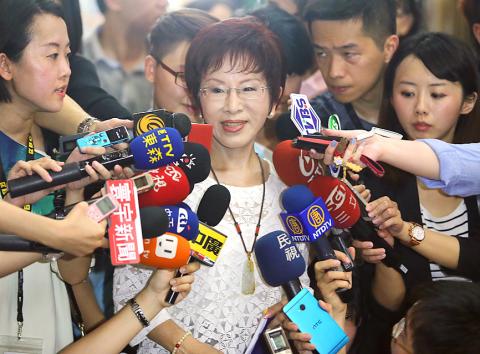
Photo: CNA
KMT Secretary-General Lee Shu-chuan (李四川) has said that the “1992 consensus” is entrenched in draft amendments to KMT policy guidelines that seek to realize a “five-point vision” put forward by former vice president and then-KMT chairman Lien Chan (連戰) and then-Chinese president Hu Jintao (胡錦濤) in 2005.
The five-point vision proposal includes the promotion of cross-strait economic exchanges, the termination of cross-strait animosity and the establishment of regular party-to-party communications platforms.
The draft amendments — pending approval at the party’s national congress scheduled for July 19 — would be the central platform on which all KMT candidates must base their election campaigns, Lee said.
Hung’s campaign office spokesperson Jack Yu (游梓翔) said that her policies — despite being worded differently — “are completely aligned with the ‘1992 consensus’ and the five-point vision as stipulated in the draft amendments.”
Hung has called on Beijing to recognize the existence of the ROC, a position espoused by President Ma Ying-jeou (馬英九) without being highlighted as Hung has done, Yu said.
The KMT has reportedly been urging Hung to tone down her speeches and put less emphasis on cross-strait relations to avoid controversies, while focusing her campaign on garnering support at the grassroots level.
Hung, rather than exposing her vulnerability with the “one China, same interpretation” formula, should base her position on the “1992 consensus” and exploit the Democratic Progressive Party’s (DPP) perceived weakness in its China policy — a strategy formulated by KMT Mainland Affairs Department director Kao Koong-lian (高孔廉) that Hung promised to maintain, but apparently has failed to do, party sources said.
The KMT caucus and a KMT think tank have set up a task force to assist Hung’s campaign, but the party is at a loss to help her with her repeated mistakes, the sources added.
A number of KMT legislators representing districts in central and southern Taiwan have raised concerns over Hung’s controversial remarks, party sources said, adding that Hung had called for a KMT caucus meeting to clarify her stance, but the initiative might not succeed, as the Legislative Yuan is in recess.
“The election is not an academic seminar, nor where a party’s direction is put to debate,” a pan-blue camp critic said, adding that Hung has sacrificed a winning hand against the DPP by throwing the KMT’s China policy into disorder and creating confusion among neutral voters.
The former DPP administration radicalized its cross-strait narrative in its final term in office, which — coupled with its failed administrative efforts — contributed to its defeat in the 2008 presidential and legislative elections, the critic said, asking whether the KMT could afford to repeat that mistake.

NATIONAL SECURITY: Authorities are working to confirm the identities of the military personnel involved and investigating possible illegal conduct and regulatory violations Authorities are probing possible national security implications after Kinmen police and immigration officers on Sunday found a Chinese woman allegedly posing as a tourist while engaging in prostitution involving more than 10 military personnel. The woman, surnamed Chen (陳), has since been deported, authorities said, adding that investigators are still working to confirm the identities of those implicated, as the records only listed code names and aliases. The case stemmed from a report received by the Kinmen District Prosecutors’ Office on Friday last week from the Jinhu Precinct of the Kinmen County Police Bureau. On Sunday, police, along with the National Immigration

GLOBALGIVING: ‘ Caving to external pressure is not acceptable for an organization that has cultivated justice reform and human rights for 30 years,’ one NGO said A slew of non-government organizations (NGOs) have withdrawn from the GlobalGiving fundraising platform after it announced it would use “Chinese Taipei” instead of “Taiwan” from next month. The Taiwan Good Rice Association wrote on Facebook on Friday that it was informed on April 28 via a teleconference call of the change, which was made because the platform wanted to operate in China. Taiwan Good Rice is to terminate all cooperative relationships with GlobalGiving in response to the platform’s “unilateral and non-negotiable” decision to remove references to Taiwan, the NGO said. “Taiwan is in the official name of Taiwan Good Rice Association and the

HEAVY WEATHER: Typhoon Jangmi is due to crash straight into the Ryukyus as airlines look to shift flights to larger aircraft or cancel flights to Okinawa entirely Taiwan’s international air carriers announced flight adjustments over the weekend as Typhoon Jangmi is forecast to hit the Ryukyu Islands today and tomorrow. The Central Weather Administration (CWA) upgraded Jangmi from a tropical storm to a typhoon at 8am yesterday, with the eye located 580km south of Naha city. It was moving north at 19kph. Today, China Airlines’ CI-120, CI-121, CI-122 and CI-123 flights between Taoyuan and Naha, Okinawa, have been canceled as well as CI-132 and CI-133 between Kaohsiung and Naha. EVA Air’s BR-112, BR-113, BR-186 and BR-185 flights between Taoyuan and Naha are also canceled. Low-cost carrier Tigerair Taiwan canceled IT-230,
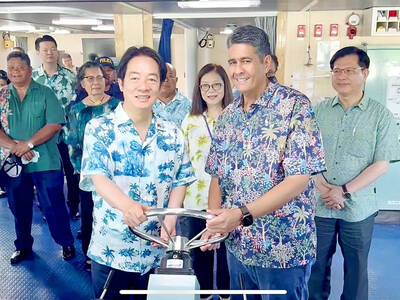
MULTIPRONGED APPROACH: China has sought to pressure Palau across a number of fronts, but the island nation has staunchly resisted overtures to ditch Taiwan Palau has been firm in backing Taiwan despite Chinese pressure that uses tourism economics, cyberattacks and criminal infiltration as tools to threaten the Pacific ally into renouncing its recognition of Taiwan as a sovereign state. The Presidential Office yesterday announced that Vice President Hsiao Bi-khim (蕭美琴) would visit Palau from Saturday to Wednesday next week at the invitation of Palauan President Surangel Whipps Jr. Whipps in April said in an interview that China had outspokenly asked Palau to “denounce Taiwan.” “And we have said: ‘We have no enemies, but nobody tells us who our friends are,’” he said. Whipps has told reporters multiple times


 RSS
RSS