


Democratic Progressive Party (DPP) Legislator Chen Chi-mai (陳其邁) on Saturday questioned whether President Ma Ying-jeou (馬英九) is intentionally pushing forward China-leaning policies after the government commissioned mostly pro-China academics for research projects on South China Sea issues.
For instance, National Chengchi University Institute of International Relations research fellow Liu Fu-kuo (劉復國) and Chinese National Institute for South China Sea Studies president Wu Shicun (吳士存) cohosted a project that produced policy proposals urging Taiwan and China to join forces to protect the territory of “one China” and the implementation of cross-strait military and political cooperation in the South China Sea, Chen said.
Chen said Liu also proposed cross-strait coadministration of reefs in the South China Sea and unifying the administration of the Pratas Islands (Dongsha Islands, 東沙群島) and Itu Aba Island (Taiping Island, 太平島) in China’s newly developed Sansha City on Woody Island (Yongxing Island, 永興島).
Liu said that he no longer holds any position at any Chinese institution, adding that he would not further comment on the issue.
Chen said that the Mainland Affairs Council (MAC) also commissioned Academia Sinica Institute of European and American Studies research fellow Song Yann-huei (宋燕輝) to conduct research on the impact of South China Sea disputes on cross-strait relations. Chen said the study called for cross-strait collaboration under the “one China” framework, “since the South China Sea has historically been Chinese territorial waters.”
Song’s research even proposed cross-strait cooperation to defend against US intervention in the South China Sea, Chen said.
Chen also panned the MAC for classifying the research report.
The MAC said that all proposals by academics are evaluated based on the government’s position, and therefore there would be no cross-strait cooperation on the issue under the “one China” framework.
Song said that his research was mostly an analysis of the US’ South China Sea policy with no mention of cross-strait issues. However, he said that he could disclose no further information, as the project was commissioned with the condition that he not share its content.
Chen also questioned why the Ministry of Foreign Affairs endorsed Liu, who clearly has a pro-China stance, to represent the government at the Shangri-La Dialogue.
Ministry spokesperson Anna Kao (高安) said that all participants were invited by forum organizers, and that the ministry did not endorse the participation of any specific individual.

More than half of the bamboo vipers captured in Tainan in the past few years were found in the city’s Sinhua District (新化), while other districts had smaller catches or none at all. Every year, Tainan captures about 6,000 snakes which have made their way into people’s homes. Of the six major venomous snakes in Taiwan, the cobra, the many-banded krait, the brown-spotted pit viper and the bamboo viper are the most frequently captured. The high concentration of bamboo vipers captured in Sinhua District is puzzling. Tainan Agriculture Bureau Forestry and Nature Conservation Division head Chu Chien-ming (朱健明) earlier this week said that the
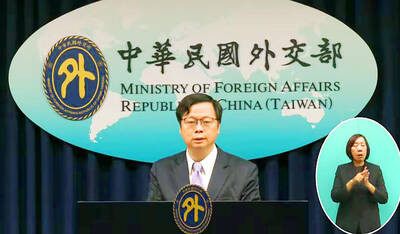
NAMING SPAT: The foreign ministry called on Denmark to propose an acceptable solution to the erroneous nationality used for Taiwanese on residence permits Taiwan has revoked some privileges for Danish diplomatic staff over a Danish permit that lists “Taiwan” as “China,” Eric Huang (黃鈞耀), head of the Ministry of Foreign Affairs’ Department of European Affairs, told a news conference in Taipei yesterday. Reporters asked Huang whether the Danish government had responded to the ministry’s request that it correct the nationality on Danish residence permits of Taiwanese, which has been listed as “China” since 2024. Taiwan’s representative office in Denmark continues to communicate with the Danish government, and the ministry has revoked some privileges previously granted to Danish representatives in Taiwan and would continue to review
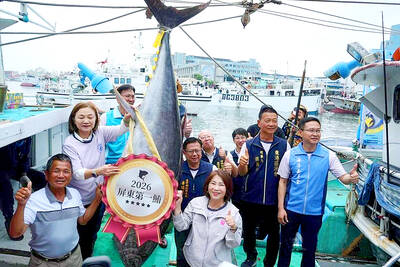
The first bluefin tuna of the season, brought to shore in Pingtung County and weighing 190kg, was yesterday auctioned for NT$10,600 (US$333.5) per kilogram, setting a record high for the local market. The auction was held at the fish market in Donggang Fishing Harbor, where the Siaoliouciou Island-registered fishing vessel Fu Yu Ching No. 2 delivered the “Pingtung First Tuna” it had caught for bidding. Bidding was intense, and the tuna was ultimately jointly purchased by a local restaurant and a local company for NT$10,600 per kilogram — NT$300 ,more than last year — for a total of NT$2.014 million. The 67-year-old skipper

China has reserved offshore airspace over the Yellow Sea and East China Sea from March 27 to May 6, issuing alerts that are usually used to warn of military exercises, although no such exercises have been announced, the Wall Street Journal (WSJ) reported on Sunday. Reserving such a large area for 40 days without explanation is an “unusual step,” as military exercises normally only last a few days, the paper said. The alerts, known as notice to air missions (NOTAMs), “are intended to inform pilots and aviation authorities of temporary airspace hazards or restrictions,” the article said. The airspace reserved in the alert


 RSS
RSS