


The Executive Yuan’s decision to hold a series of events beginning on July 7 to commemorate the nation’s victory over Japan in the Second Sino-Japanese War, the “reclamation” of Taiwan and the nation’s economic takeoff in the early 1960s were questioned by Academia Sinica researcher Chen Yi-shen (陳儀深), who said that the events are not only absurd, but also demonstrate the government’s China-centric historical outlook.
It is difficult to understand what exactly the President Ma Ying-jeou (馬英九) administration hopes to accomplish by seeking to claim “legitimacy” over who won in the Second Sino-Japanese War, Chen said.
The war raged across China from 1937 to 1945 between the Republic of China (ROC) and Imperial Japan.
Although it was later deemed a part of the Pacific theater of World War II, the Second Sino-Japanese War began before Japan entered WWII by bombing Pearl Harbor, and was largely fought between China and Japan, with Allied forces offering materiel and financial aid.
While China plans a large military parade to commemorate the anniversary, the Ma administration’s decision to hold seminars on the event constitutes an offer of goodwill to Beijing, Chen said.
While the Chinese Nationalist Party (KMT) helped in the winning of the Second Sino-Japanese War, it later lost territory in China to the Chinese Communist Party, Chen said.
“Is the KMT intending to reclaim China by holding on to claims of legitimacy over who spearheaded the victory in the war?” Chen asked, adding that “the trend of thought was no longer feasible in modern times.”
The government should seek to emphasize what the ROC government in Taiwan has done for Taiwan, instead of “making a large fuss” about the 70th anniversary of the Second Sino-Japanese War, Chen said, adding that the government’s actions showed that it was still clinging to a “Great China” historical view.
In defense of the planned activities, Executive Yuan spokesperson Sun Lih-chyun (孫立群) said that the nation could not allow China to change or wipe out history, adding that the events are being planned to emphasize the role of the ROC government during the war.
Events are to be held on such a grand scale this year due to the 70th anniversary, Sun said, adding that the Executive Yuan also sought to connect the events to post-war Taiwanese development after the KMT came to Taiwan in 1949.
The government intends to hold international academic seminars, inviting domestic and foreign experts, to emphasize historical accuracy, Sun said, adding that from Aug. 14 to December, the Academia Historica and the Armed Forces Museum are set to hold special exhibitions on documents, pictures and other archived items from the Second Sino-Japanese War period.
The museums plan to display footage of the ROC government receiving the instrument of surrender from Imperial Japan in Nanjing, China, Sun said.
The Ministry of National Defense said that it would hold several seminars in which academics would discuss the significance of the Second Sino-Japanese War.
The ministry intends to hold a talk for Taiwanese compatriots and the war in December, inviting the Lin family (林) in Wufeng (霧峰) as well as the progeny of Chiu Feng-jia (丘逢甲).
The Lin family are descendants of Lin Shuang-wen (林爽文), best known for his attempted rebellion against the Qing Dynasty in 1786.
Chiu resisted the Japanese occupation of Taiwan after the First Sino-Japanese War in 1895. Chiu also supported rebellion against the Qing Dynasty and witnessed the birth of the ROC in 1912.
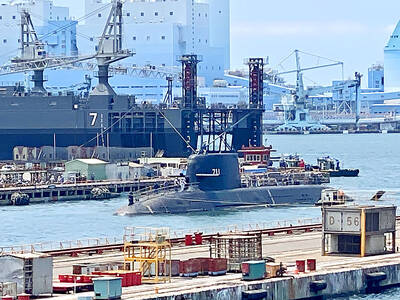
AGING: While Japan has 22 submarines, Taiwan only operates four, two of which were commissioned by the US in 1945 and 1946, and transferred to Taiwan in 1973 Taiwan would need at least 12 submarines to reach modern fleet capabilities, CSBC Corp, Taiwan chairman Chen Cheng-hung (陳政宏) said in an interview broadcast on Friday, citing a US assessment. CSBC is testing the nation’s first indigenous defense submarine, the Hai Kun (海鯤, Narwhal), which is scheduled to be delivered to the navy next month or in July. The Hai Kun has completed torpedo-firing tests and is scheduled to undergo overnight sea trials, Chen said on an SET TV military affairs program. Taiwan would require at least 12 submarines to establish a modern submarine force after assessing the nation’s operational environment and defense

Yangmingshan National Park authorities yesterday urged visitors to respect public spaces and obey the law after a couple was caught on a camera livestream having sex at the park’s Qingtiangang (擎天崗) earlier in the day. The Shilin Police Precinct in Taipei said it has identified a suspect and his vehicle registration number, and would summon him for questioning. The case would be handled in accordance with public indecency charges, it added. The couple entered the park at about 11pm on Thursday and began fooling around by 1am yesterday, the police said, adding that the two were unaware of the park’s all-day live
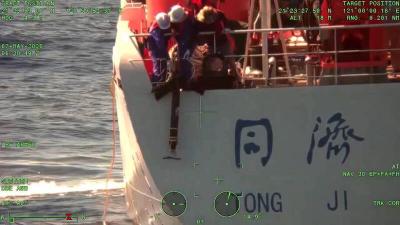
The coast guard today said that it had disrupted "illegal" operations by a Chinese research ship in waters close to the nation and driven it away, part of what Taipei sees a provocative pattern of China's stepped up maritime activities. The coast guard said that it on Thursday last week detected the Chinese ship Tongji (同濟號), which was commissioned only last year, 29 nautical miles (54km) southeast of the southern tip of Taiwan, although just outside restricted waters. The ship was observed lowering ropes into the water, suspected to be the deployment of scientific instruments for "illegal" survey operations, and the coast

A former soldier and an active-duty army officer were yesterday indicted for allegedly selling classified military training materials to a Chinese intelligence operative for a total of NT$79,440. The Taipei District Prosecutors’ Office indicted Chen Tai-yin (陳泰尹) and Lee Chun-ta (李俊達) for contravening the National Security Act (國家安全法) and the Anti-Corruption Act (貪污治罪條例). Chen left the military in September 2013 after serving alongside then-staff sergeant Lee, now an army lieutenant, at the 21st Artillery Command of the army’s Sixth Corps from 2011 to 2013, according to the indictment. Chen met a Chinese intelligence operative identified as “Wang” (王) through a friend in November


 RSS
RSS