


The Taipei District Prosecutors’ Office yesterday said it would not prosecute student activists who were involved in a heated protest outside the Presidential Office Building in 2013 during which 27 police officers were injured.
On Oct. 10, 2013, Double Ten National Day, student protesters Lin Fei-fan (林飛帆), Chen Wei-ting (陳為廷) and Dennis Wei (魏揚) protested against President Ma Ying-jeou (馬英九), whom they claimed had bugged Legislative Speaker Wang Jin-pyng’s (王金平) office as part of a power struggle.
The protesters gathered at a site across from the Presidential Office Building and tried to interrupt the National Day celebration that took place across the street, prosecutors said. The move was prevented by police officers and a violent conflict ensued, as some officers tried to forcibly stop a protester’s car that was heading toward the Presidential Office Building, they added.

Photo: Chu Pei-hsiung, Taipei Times
In the aftermath, 27 officers were injured, who later presented certified injury reports that showed their injuries were caused during the fracas with the crowd, the prosecutors’ office said.
The police filed obstructing official business charges against Lin, Chen and Wei, as well as Wang Yueh-shu (王曰舒) — the driver of the car who police said intentionally hit officers — the office said.
However, the prosecutors’ office said that video supplied by the police did not support their allegation that Lin and the others attacked the officers, adding that Wang was driving slowly and did not demonstrate any intent to run into police officers.
The video also showed that Lin had twice negotiated with officers and calmed the crowd, so prosecutors decided that there was insufficient evidence to indict Lin and the others, the office said.
Meanwhile, Lin said on Monday that he would begin his military service tomorrow and would not be discharged until January next year.
Lin said that he had been encouraged to make use of his political leverage for several legislative reforms expected this year. However, he said it would be hard for him to contribute until he had finished his military service, so it would be better for him to meet his obligations as soon as possible.

Yangmingshan National Park authorities yesterday urged visitors to respect public spaces and obey the law after a couple was caught on a camera livestream having sex at the park’s Qingtiangang (擎天崗) earlier in the day. The Shilin Police Precinct in Taipei said it has identified a suspect and his vehicle registration number, and would summon him for questioning. The case would be handled in accordance with public indecency charges, it added. The couple entered the park at about 11pm on Thursday and began fooling around by 1am yesterday, the police said, adding that the two were unaware of the park’s all-day live

Fast food chain McDonald's is to raise prices by up to NT$5 on some products at its restaurants across Taiwan, starting on Wednesday next week, the company announced today. The prices of all extra value meals and sharing boxes are to increase by NT$5, while breakfast combos and creamy corn soup would go up by NT$3, the company said in a statement. The price of the main items of those meals, if ordered individually, would remain the same. Meanwhile, the price of a medium-sized lemon iced tea and hot cappuccino would rise by NT$3, extra dipping sauces for chicken nuggets would go up
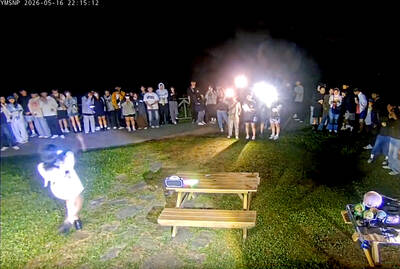
Yangmingshan National Park’s Qingtiangang (擎天崗) nature area has gone viral after a park livestream camera observed a couple in the throes of intimate congress, which was broadcast live on YouTube, drawing large late-night crowds and sparking a backlash over noise, bright lights and disruption to wildlife habitat. The area’s livestream footage appeared to show a couple engaging in sexual activity on a picnic table in the park on Friday last week, with the uncensored footage streamed publicly online. The footage quickly spread across social media, prompting a tide of visitors to travel to the site to “check in” and recreate the

Minister of Digital Affairs Lin Yi-ching (林宜敬) yesterday cited regulatory issues and national security concerns as an expert said that Taiwan is among the few Asian regions without Starlink. Lin made the remarks on Facebook after funP Innovation Group chief executive officer Nathan Chiu (邱繼弘) on Friday said Taiwan and four other countries in Asia — China, North Korea, Afghanistan and Syria — have no access to Starlink. Starlink has become available in 166 countries worldwide, including Ukraine, Malaysia, the Philippines and Vietnam, in the six years since it became commercial, he said. While China and North Korea block Starlink, Syria is not


 RSS
RSS