


The Ministry of National Defense yesterday announced a series of commemorative events planned for the coming months to mark the 70th anniversary of the end of World War II.
The ministry is organizing observances, concerts and calendar and book publications, along with “Family Day” programs where selected military bases are to be open to the public.
“This year is the 70th anniversary of our nation’s victory in the war of resistance against Japan and the retrocession of Taiwan to the Republic of China [ROC],” ministry spokesman Major General David Lo (羅紹和) told a press conference.
“These special events are to commemorate the bravery and daunting efforts of our troops and those who sacrificed their lives for the nation,” Lo said.
“We are not looking to revive past enmity between warring nations, but rather to face history in earnest. That way people can learn from history and not repeat the same mistakes again,” Lo said.
“Family Day” programs will be held at two army bases, one naval base and two air force bases nationwide from September to October,” said Major General Yu Tsung-chi (余宗基), head of the Cultural and Psychological Operations Division of the ministry’s Political Warfare Bureau.
These events are designed to promote interactions between military personnel and the public, with weaponry, armored vehicles and other hardware on display, accompanied by soldier training and skill demonstrations, he said.
There will be an academic conference in July, where Taiwanese and foreign military experts and historians will present their research papers on the Second Sino-Japanese War from 1937 to 1945, along with discussions on maritime disputes in East Asia and in the South China Sea.
A major war history exhibition, scheduled to run from August to November, is being prepared by the Armed Forces Museum and Academia Historica to showcase wartime documents, souvenirs, artifacts and photographs, Yu said.
The Second Sino-Japanese War was part of World War II, fought between Allied and Axis powers. It involved the Chinese Nationalist Army, later joined by the Chinese Workers’ and Peasants’ Red Army — which later became the People’s Liberation Army — and US military support, fighting against the Imperial Japanese Army.
In the Asia-Pacific region, the war ended when Japanese troops in China formally surrendered on Sept. 9, 1945. However, the US cites an earlier date, when Japan’s official surrender was signed aboard the battleship USS Missouri on Sept. 2, 1945.
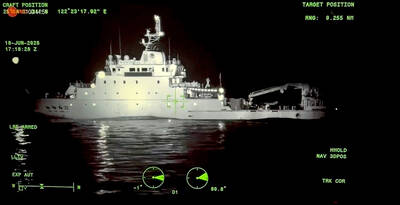
EXCUSES: Beijing is using government and research vessels as a pretext to harass the nation and enter its EEZ, and engage in ‘hegemonic expansion,’ the coast guard said The Coast Guard Administration yesterday said it drove away Chinese oceanographic research vessel Xiang Yang Hong 22 (向陽紅33) from restricted waters after warning it that it was in Taiwan’s exclusive economic zone (EEZ). The Chinese vessel entered restricted waters off the coast of Yilan County’s Suao (蘇澳) at 11:35pm on Thursday, the coast guard said, adding that it dispatched the Lanyu patrol vessel and the boat PP-10077 to shadow the Chinese ship and issue radio warnings ordering it to leave. China has no sovereignty over waters off Taiwan’s east coast, Lanyu’s crew told Xiang Yang Hong 22 over the radio, and demanded
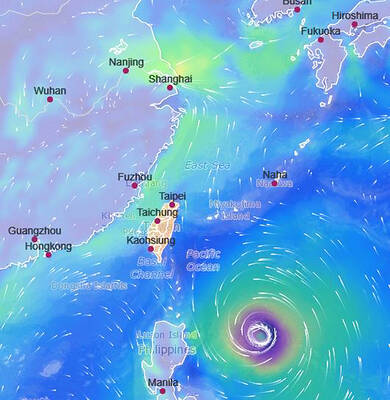
Typhoon Mekkhala is likely to come closest to Taiwan on Thursday, according to the Central Weather Administration (CWA), which forecast localized rain or thundershowers in western and northeastern parts of the country for that day. As of 2pm yesterday, the eye of the storm was 770km southeast of Oluanpi (鵝鑾鼻), the southernmost point of Taiwan, as it continued to move toward waters east of the Philippines, the agency said. Mekkhala was expected to become a severe typhoon last night, CWA forecaster Lai Hsin-kuo (賴欣國) said. A severe typhoon has maximum wind speeds of more than 184kph, compared with 118kph to 183kph for a
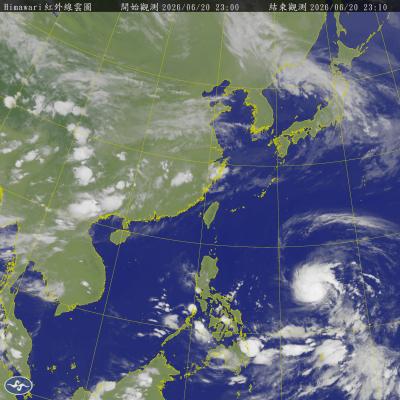
Tropical Storm Mekkhala is forecast to strengthen into a typhoon tomorrow and could come close enough to Taiwan later in the week to prompt a sea warning, the Central Weather Administration (CWA) said yesterday. As of 2 pm, the storm was located 1,870 kilometers southeast of Taiwan's southern tip and moving west- northwest at 23 km per hour. CWA forecaster Cheng Chieh-jen (鄭傑仁) said Mekkhala is expected to continue moving west-northwest through Tuesday under the influence of the Pacific high- pressure system before gradually turning north toward waters east of Taiwan or south of the Ryukyu Islands. The timing and angle of the

RISING POPULARITY: Enhanced flight connectivity and a visa waiver trial program are among the motivations that have boosted travel to Taiwan by Filipinos, the agency said The Tourism Administration said yesterday that it is stepping up efforts to attract tourists from the Philippines following strong growth during the first quarter. The agency’s data showed the nation welcomed 210,000 Filipino visitors from January to March, marking a 43 percent increase compared with the same period last year. The Philippines is Taiwan’s top source of inbound tourists among the Southeast Asian nations, data showed. With a population of 116 million and national median age of 26, the Philippines boasts a young demographic with strong travel potential, the Tourism Administration said. Outbound travel demand in the Philippines continues to rise amid robust


 RSS
RSS