


One of the lesser-known Taipei mayoral candidates has been gaining a lot of attention, especially from young netizens, after his life story sparked a dispute on social networks in the past few days.
Chao Yen-ching (趙衍慶), an octogenarian who came to Taiwan after the Chinese Civil War, now lives in a park and often visits charity groups’ stands that hand out food to homeless people.
Web media platform Watchout was arguably first to bring Chao to the public’s attention. In its report on Oct. 31, it quoted Chao’s neighbor as saying the reason that Chao is running in the election is that he “wants his existence to be highlighted.”
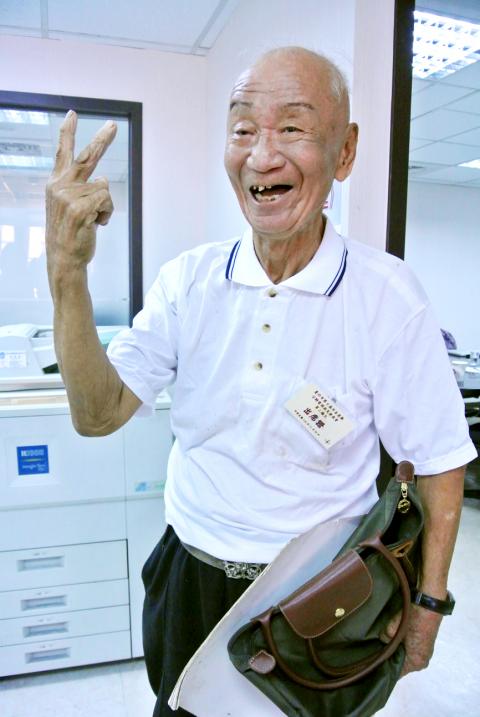
Photo: Chiu Shao-wen, Taipei Times
Watchout reported that it is not the first time Chao has entered an electoral race. In 2009, he participated in the legislative by-election in Daan District (大安) with a platform that included several policies, including “using the legislator’s government-issued salary to provide public meals for those who cannot afford them after a day earning money from collecting waste paper in Daan District.”
However, it was not until Chiang Ping-lun (江昺崙), a Taiwanese literature student at National Taiwan University, also picked up on the story and published an article on Thinking Taiwan on Nov. 18, which was widely shared, that the veteran was thrust into the spotlight.
Chiang said a tragedy of the White Terror Era instantly came to his mind when he read Chao’s resume on the election bulletin, which described him as having studied at Shandong’s United High School in China and Yuanlin Experimental Junior High School in Taiwan as an “exiled student.”
It was the so-called Penghu 713 Incident that Chiang was referring to.
In 1949, Shandong United High School principal Chang Min-chih (張敏之) took more than 8,000 students to Penghu to escape from Chinese Communist Party troops. Waiting for the Chinese Nationalist Party (KMT) regime to arrange for the students to study in Taiwan, the male students were conscripted by Penghu military commander Li Chen-ching (李振清).
Chang refused to comply and was framed as a communist spy. He and several students were later executed, while scores of others were imprisoned.
The female and younger male students were later transferred to Yuanlin Experimental High School in 1953.
A memorial of the incident was not established in Penghu until 2007.
In his article, Chiang fictionalized Chao’s role in the incident and, to add some dramatic flavor, wrote a few quotes that he believed Chao might utter when talking about the incident.
The article, in which Chao was one of the students who were forced by the KMT regime to join the army, was criticized by some netizens, who accused Chiang of “making up Chao’s life history and manipulating the election.”
Netizen Hsu He-chun (許和鈞) countered that he himself had interviewed Chao last month and had confirmed that Chao was not forced to join the army by the KMT.
“He only went to [a military school] and became a soldier when he came of age in 1958, which shows that Chao did not have a grudge against the army,” Hsu said.
Chiang later posted his reflections on Facebook and thanked those who provided historical assistance.
“I intended to share the drama of the 713 Incident,” he said, acknowledging that some of the article is fiction.
“It has been confirmed by Chao that he was indeed in Penghu when the 713 Incident took place, but was too young to be conscripted by the army,” Chiang said.
A netizen, in an act of encouragement, commented: “I believe Chao would understand. After all, [your article] has educated tens of thousands of Taiwanese about the Penghu 713 Incident.”
Japanese footwear brand Onitsuka Tiger today issued a public apology and said it has suspended an employee amid allegations that the staff member discriminated against a Vietnamese customer at its Taipei 101 store. Posting on the social media platform Threads yesterday, a user said that an employee at the store said that “those shoes are very expensive” when her friend, who is a migrant worker from Vietnam, asked for assistance. The employee then ignored her until she asked again, to which she replied: "We don't have a size 37." The post had amassed nearly 26,000 likes and 916 comments as of this
US President Donald Trump said "it’s up to" Chinese President Xi Jinping (習近平) what China does on Taiwan, but that he would be "very unhappy" with a change in the "status quo," the New York Times said in an interview published yesterday. Xi "considers it to be a part of China, and that’s up to him what he’s going to be doing," Trump told the newspaper on Wednesday. "But I’ve expressed to him that I would be very unhappy if he did that, and I don’t think he’ll do that," he added. "I hope he doesn’t do that." Trump made the comments in
Tourism in Kenting fell to a historic low for the second consecutive year last year, impacting hotels and other local businesses that rely on a steady stream of domestic tourists, the latest data showed. A total of 2.139 million tourists visited Kenting last year, down slightly from 2.14 million in 2024, the data showed. The number of tourists who visited the national park on the Hengchun Peninsula peaked in 2015 at 8.37 million people. That number has been below 2.2 million for two years, although there was a spike in October last year due to multiple long weekends. The occupancy rate for hotels

Taiwanese can file complaints with the Tourism Administration to report travel agencies if their activities caused termination of a person’s citizenship, Mainland Affairs Council Minister Chiu Chui-cheng (邱垂正) said yesterday, after a podcaster highlighted a case in which a person’s citizenship was canceled for receiving a single-use Chinese passport to enter Russia. The council is aware of incidents in which people who signed up through Chinese travel agencies for tours of Russia were told they could obtain Russian visas and fast-track border clearance, Chiu told reporters on the sidelines of an event in Taipei. However, the travel agencies actually applied


 RSS
RSS