


Hsu Kui-piao (許貴標), 82, recently donated a papier-mache scrapbook that seemed like an ordinary item at first glance. However, Hsu’s gift embodied the persecution and sacrifice suffered by Taiwanese during the White Terror era and the remarkable friendship among condemned political prisoners.
“This is the 55th year since I was released from prison. I have the good fortune to share my story here, but my heart is stirred up with strong emotions,” Hsu said as he presented the book to the Preparatory Office of the National Human Rights Museum on Tuesday last week.
The former prisoner said that informants falsely accused him of “failing to report known Communist spy activities to the authorities” in 1954, which led to a seven-year jail sentence.
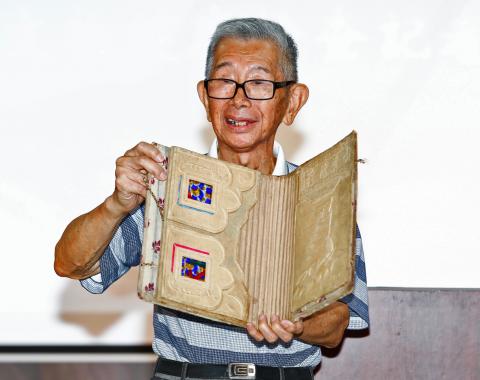
Photo: Wang Yi-sung, Taipei Times
The White Terror era refers to the Chinese Nationalist Party (KMT) regime’s persecution of political dissidents in Taiwan for nearly four decades until the lifting of martial law in 1987.
Hsu said the papier-mache book was made by two fellow prisoners, Wu Peng-tsan (吳鵬燦) and Lien Te-en (連德恩), when they were incarcerated at the military prison on Qingdao E Road in Taipei. The Taipei Sheraton Hotel now occupies the site.
Locked up on sedition charges, Wu and Lien understood that they had little chance of coming out alive, given that death sentences were meted out for sedition during the Martial Law era. Seeing that Hsu had the chance to be freed after serving his sentence, Wu and Lien decided to dedicate a gift to him, Hsu said.
With stones and empty cans collected during their brief times in the prison courtyard, the two condemned political prisoners secretly made small razors.
Using the razors and other improvised tools, they made papier-mache materials by cutting up packaging papers from parcels and clothing items given by family members during prison visits. The glue was made by soaking rice from leftover meals in water, Hsu said.
Wu and Lien made the book in secret and under difficult conditions, away from the prying eyes of the prison wardens who were on regular patrols, Hsu said.
“It took them three months to finish. With painstaking efforts, they embossed my name on it, along with an embossed picture of a ship sailing out on the sea,” Hsu said.
“Each time that I see this sailing ship, my mind always contemplates whether my two friends were giving me their blessing to sail on with success in my endeavors after getting out of prison, or whether they wanted to express the feeling that ‘We are bound by fate on the same ship?’” he said.
Not long after Wu and Lien completed their task and presented the book to Hsu, they were executed.
“With my own eyes, I saw Wu and Lien being marched out by guards, taken away to be executed. I could only watch and bid farewell to my friends with streams of tears,” Hsu said, choked with emotion.
Hsu stressed that “our democracy and freedom were won with the lives, blood and tears of many who went before us.”
“This ordinary-looking book is soaked with the blood and sacrifice of two outstanding young men. It is an eyewitness to the horrible atrocities of White Terror era,” Hsu said. “It is my hope that all 23 million Taiwanese can truly live in a free and democratic society.”
The papier-mache book had always been Hsu’s most treasured possession, where he kept the original indictment papers and the court ruling documents on his case.
Hsu said he decided to donate it “so Taiwanese can preserve the memories of the White Terror era and it will not be forgotten through the passage of time.”

The Centers for Disease Control (CDC) yesterday reported the first case of a new COVID-19 subvariant — BA.3.2 — in a 10-year-old Singaporean girl who had a fever upon arrival in Taiwan and tested positive for the disease. The girl left Taiwan on March 20 and the case did not have a direct impact on the local community, it said. The WHO added the BA.3.2 strain to its list of Variants Under Monitoring in December last year, but this was the first imported case of the COVID-19 variant in Taiwan, CDC Deputy Director-General Lin Ming-cheng (林明誠) said. The girl arrived in Taiwan on

South Korea is planning to revise its controversial electronic arrival card, a step Taiwanese officials said prompted them to hold off on planned retaliatory measures, a South Korean media report said yesterday. A Yonhap News Agency report said that the South Korean Ministry of Foreign Affairs is planning to remove the “previous departure place” and “next destination” fields from its e-arrival card system. The plan, reached after interagency consultations, is under review and aims to simplify entry procedures and align the electronic form with the paper version, a South Korean ministry official said. The fields — which appeared only on the electronic form

The Ministry of Foreign Affairs (MOFA) is suspending retaliation measures against South Korea that were set to take effect tomorrow, after Seoul said it is updating its e-arrival system, MOFA said today. The measures were to be a new round of retaliation after Taiwan on March 1 changed South Korea's designation on government-issued alien resident certificates held by South Korean nationals to "South Korea” from the "Republic of Korea," the country’s official name. The move came after months of protests to Seoul over its listing of Taiwan as "China (Taiwan)" in dropdown menus on its new online immigration entry system. MOFA last week
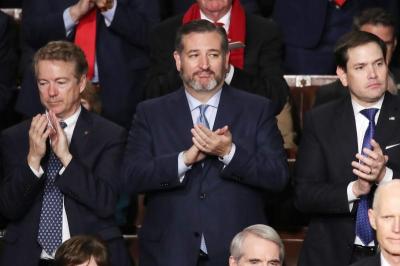
A bipartisan group of US senators has introduced a bill to enhance cooperation with Taiwan on drone development and to reduce reliance on supply chains linked to China. The proposed Blue Skies for Taiwan Act of 2026 was introduced by Republican US senators Ted Cruz and John Curtis, and Democratic US senators Jeff Merkley and Andy Kim. The legislation seeks to ease constraints on Taiwan-US cooperation in uncrewed aerial systems (UAS), including dependence on China-sourced components, limited access to capital and regulatory barriers under US export controls, a news release issued by Cruz on Wednesday said. The bill would establish a "Blue UAS


 RSS
RSS