


The Democratic Progressive Party (DPP) yesterday announced two youth-oriented programs aimed at encouraging the young to participate in politics, which it says is crucial to deepening Taiwan’s democracy and reforming the party.
The first program, Youth Power, encourages people aged 23 to 40 to participate in the November elections for township councilors and borough and village wardens.
The second program, the Youth Council, aims to bring young people together to discuss a wide range of political issues and include those opinions in the DPP’s policymaking process.

Photo: CNA
“The key to launching these programs is to raise public awareness, in particular after the Sunflower movement, that Taiwan’s democracy should be deepened and to see whether the DPP could work with society once again,” DPP Chairperson Tsai Ing-wen (蔡英文) told a press conference yesterday.
Noting that Taiwan’s 38 years of Martial Law ended on the same day 27 years ago — July 15, 1987 — Tsai said that Taiwan’s democratization was a product of the dedication and struggle of many young and fearless politicians who are now senior DPP members.
That is why the DPP has to “reinvest” the resources that society has given the party back to the young people, she said.
Tsai added that political participation does not necessarily mean running in elections, because all forms of activities that improve people’s livelihood and civil society are just as important.
The DPP will provide candidates who pass the preliminary screening with a subsidy of NT$30,000 (US$993) as well as consultation and training in campaign strategy and agenda-setting, the DPP’s Democracy Institute deputy director Wu Pei-yi (吳沛憶) said.
In return, the candidates have to pledge that they will not buy votes and, if elected, work to ensure transparency in all their community works and promote grassroots democracy, Ho said.
The party did not set a goal on how many young candidates it would train and sponsor.
The Youth Council will serve as a longstanding platform for the DPP to exchange ideas with young people, DPP Department of Youth Development director Fu Wei-che (傅偉哲) said.
The first meeting of the council is scheduled to be held in Greater Taichung on July 26, with follow-up meetings in Greater Kaohsiung, Taoyuan County and New Taipei City, among other places, taking place every other Saturday.
Fu said the DPP plans to gather public opinions online before every meeting and present the conclusions and recommendations to the party’s Central Standing Committee — its highest decisionmaking body — for reference and further discussion.
“We are not trying to incorporate or neutralize young people’s voices with the platform. Quite the contrary, our aim is to highlight their voices and make young people the forefront of the DPP,” Fu said.
Fu and Ho, both student movement leaders, were among Tsai’s “prize recruits.” The party leader pledged a youthful movement as part of her party reform when she assumed the two-year DPP chairmanship in May, about one month after the Sunflower movement.

Taiwan has received more than US$70 million in royalties as of the end of last year from developing the F-16V jet as countries worldwide purchase or upgrade to this popular model, government and military officials said on Saturday. Taiwan funded the development of the F-16V jet and ended up the sole investor as other countries withdrew from the program. Now the F-16V is increasingly popular and countries must pay Taiwan a percentage in royalties when they purchase new F-16V aircraft or upgrade older F-16 models. The next five years are expected to be the peak for these royalties, with Taiwan potentially earning
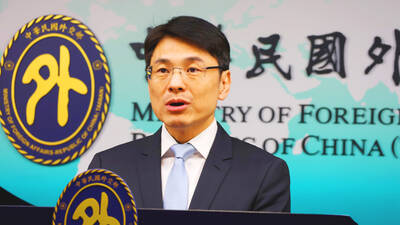
STAY IN YOUR LANE: As the US and Israel attack Iran, the ministry has warned China not to overstep by including Taiwanese citizens in its evacuation orders The Ministry of Foreign Affairs (MOFA) yesterday rebuked a statement by China’s embassy in Israel that it would evacuate Taiwanese holders of Chinese travel documents from Israel amid the latter’s escalating conflict with Iran. Tensions have risen across the Middle East in the wake of US and Israeli airstrikes on Iran beginning Saturday. China subsequently issued an evacuation notice for its citizens. In a news release, the Chinese embassy in Israel said holders of “Taiwan compatriot permits (台胞證)” issued to Taiwanese nationals by Chinese authorities for travel to China — could register for evacuation to Egypt. In Taipei, the ministry yesterday said Taiwan
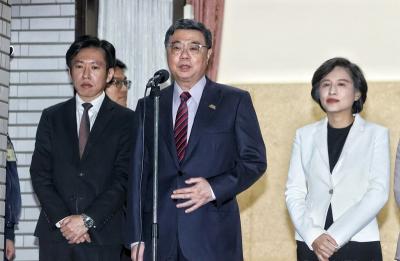
Taiwan is awaiting official notification from the US regarding the status of the Agreement on Reciprocal Trade (ART) after the US Supreme Court ruled US President Donald Trump's global tariffs unconstitutional. Speaking to reporters before a legislative hearing today, Premier Cho Jung-tai (卓榮泰) said that Taiwan's negotiation team remains focused on ensuring that the bilateral trade deal remains intact despite the legal challenge to Trump's tariff policy. "The US has pledged to notify its trade partners once the subsequent administrative and legal processes are finalized, and that certainly includes Taiwan," Cho said when asked about opposition parties’ doubts that the ART was
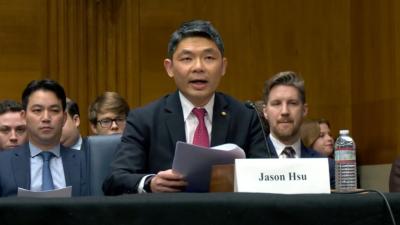
If China chose to invade Taiwan tomorrow, it would only have to sever three undersea fiber-optic cable clusters to cause a data blackout, Jason Hsu (許毓仁), a senior fellow at the Hudson Institute and former Chinese Nationalist Party (KMT) legislator, told a US security panel yesterday. In a Taiwan contingency, cable disruption would be one of the earliest preinvasion actions and the signal that escalation had begun, he said, adding that Taiwan’s current cable repair capabilities are insufficient. The US-China Economic and Security Review Commission (USCC) yesterday held a hearing on US-China Competition Under the Sea, with Hsu speaking on


 RSS
RSS