


The future of Taiwan is a decision to be made by its 23 million people, three Chinese Nationalist Party (KMT) mayors said yesterday in response to controversial comments made by a China’s Taiwan Affairs Office (TAO) spokesperson.
Taipei City Mayor Hua Lung-bin (郝龍斌), New Taipei City Mayor Eric Chu (朱立倫) and Greater Taichung Mayor Jason Hu (胡志強) were welcoming a planned visit to Taiwan by China’s Taiwan Affairs Office Director Zhang Zhijun (張志軍).
TAO spokesperson Fan Liqing (范麗青) was reported to have said on Wednesday that the future of Taiwan “must be decided by all Chinese people, including Taiwanese compatriots.”
When asked to respond to the comment, Hau said that the future of Taiwan being decided by the 23 million Taiwanese is “as simple as it is” and “an indisputable fact.”
Zhang is scheduled to visit Taiwan on June 23, following a visit by Mainland Affairs Council (MAC) Minister Wang Yu-chi (王郁琦) to China in February during which they met in Nanjing and Shanghai.
During his four-day stay, Zhang plans to visit Chu, Hu and Greater Kaohsiung Mayor Chen Chu (陳菊), in addition to meeting Wang in New Taipei City.
Hau met with Zhang in July last year when he attended the Taipei-Shanghai City Forum.
Hau yesterday said that it seemed to him an “understandable arrangement” that Taipei was not on Zhang’s scheduled itinerary because Wang did not visit Beijing during his trip in February.
Zhang’s trip is being made “on the principle of reciprocity,” Hau said.
Asked separately by media about Fan’s remarks, Chu said yesterday: “The Republic of China [ROC] possesses sovereignty of Taiwan. Of course the future of Taiwan is up to the ROC’s citizens, the 23 million people in Taiwan.”
Organized in consultation with the MAC and the New Taipei City Council, Zhang’s itinerary has been planned to include visits to borough community centers, Aboriginal villages in Wulai District (烏來) and site tours of public infrastructure, Chu said.
Meanwhile, in Greater Taichung, Hu said yesterday that he welcomed a visit by Zhang.
People on both sides of the strait need to understand each other better, Hu said.
“I hope that Zhang can gain a better understanding of Taiwan [after the visit],” he said.
When questioned at a meeting of the council, by City Councilor Tsai Ya-ling (蔡雅玲) of the Democratic Progressive Party (DPP) and her party colleagues about the TAO’s comments, Hu said that he has repeatedly made his position clear that the future of Taiwan is in the hands of its 23 million people.
“I would not change my position,” Hu said.
Hu said he has considerable experience dealing with cross-strait affairs, adding that when it comes to issues in relation to sovereignty, he knows what to do to safeguard the sovereignty of the ROC and the dignity of Taiwanese.

In a historic first, Taiwanese officials participated in this year’s Riga Strategic Communications Dialogue in Latvia from Wednesday to Friday last week, which debuted a breakout session focused on Taiwan The event organizer, the NATO Strategic Communications Center of Excellence, displayed Taiwan’s national flag and the officials’ formal titles on their Web site. Taiwanese attendees included National Security Council (NSC) Deputy Secretary-General Lin Fei-fan (林飛帆) and deputy head of the Taipei Representative Office in the UK, Chiang Ya-chi (江雅綺). In addition to the session discussing Taiwan titled “Taiwan: Navigating Strategic Communication in a Tense Environment,” the dialogue also included sessions
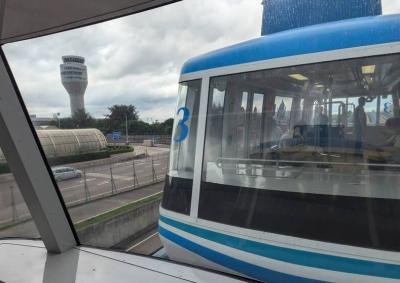
Taiwan Taoyuan International Airport is to suspend its automated Skytrain service connecting Terminal 1 and Terminal 2 starting on July 1 to facilitate connection works for the upcoming Terminal 3, the airport operator said today. Passengers and staff who need to travel between the two terminals after the suspension can instead use the Taoyuan MRT or the airport's 24-hour shuttle bus service, Taoyuan International Airport Corp said. The Taoyuan MRT Airport Line directly links the two terminals, while the shuttle buses are to operate around the clock, the company added. The Skytrain provides free transportation between the airport’s two terminals for travelers and
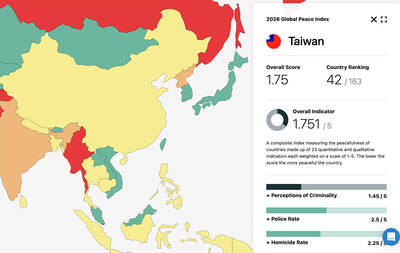
Taiwan ranked 42nd in terms of peacefulness among 163 countries, down five places from last year, according to this year’s Global Peace Index. With an overall score of 1.751, Taiwan dropped from 37th last year, the report published by the global Institute for Economics and Peace showed. The overall score measures a country’s level of peacefulness using 23 quantitative and qualitative indicators across three domains — ongoing domestic and international conflict, societal safety and security, and militarization. While Taiwan ranked 42nd worldwide, it was listed in ninth place among the 19 Asian-Pacific countries in the report, after New Zealand, Singapore, Japan, Malaysia,

TOKYO-MANILA DELIMITATION TALKS: Beijing is attempting to use this opportunity to normalize patrols and law enforcement in the waters east of Taiwan, MOFA said China has no law enforcement authority over the waters east of Taiwan, the Ministry of Foreign Affairs (MOFA) said yesterday, accusing China of undermining regional peace and stability. The Chinese Ministry of Transport on Saturday evening announced that it had launched a “special maritime law enforcement operation” in the waters east of Taiwan, dispatching coast guard vessels to engage in illegal enforcement activities, the ministry said. State-run Xinhua news agency said the operation was “a necessary action taken in response to Japan and the Philippines unilaterally announcing the initiation of maritime boundary delimitation negotiations in the waters east of China’s Taiwan island,


 RSS
RSS