


Taiwan and China on Friday reached a consensus on proposals to improve the implementation of nine of 19 agreements they have signed to date.
The consensus came after a two-day meeting in China’s Changsha between the intermediary bodies handling negotiations for the two countries in the absence of official ties — the Straits Exchange Foundation (SEF) and the Beijing-based Association for Relations Across the Taiwan Straits (ARATS).
The Changsha meeting was held to review the implementation and impact of the 19 cross-strait pacts signed since 2008 when President Ma Ying-jeou (馬英九) set in motion a more conciliatory approach toward China.
During the review, consensus was reached on improving the implementation of accords covering cooperation in the fields of finance, air transportation, sea transportation, healthcare, crime fighting, food safety, investment protection, fishing crews and agricultural quarantines.
The most notable progress came when Beijing agreed to study the feasibility of allowing transit stops by Chinese travelers in Taiwan, SEF Vice Chairman Chang Hsien-yao (張顯耀) said.
The foundation welcomed the response and hoped China would outline plans for discussion, Chang said.
Other concrete results included Beijing’s agreement to be more active in helping Taiwan track down several fugitives at large in China, including former legislator Lo Fu-chu (羅福助), who was convicted in 2012 of money laundering and insider trading, and sentenced to four years in prison.
China also agreed to deepen cross-strait financial exchanges through a cooperation and monitoring platform and to study Taiwan’s proposal to launch “express delivery by sea” between the two sides, according to the foundation.
Meanwhile, Chang announced that ARATS Chairman Chen Deming (陳德銘) is to meet with Mainland Affairs Council Minister Wang Yu-chi (王郁琦) after the 10th round of SEF-ARATS talks in Taipei on Wednesday and Thursday.
He added the two organizations have agreed to complete negotiations on a proposed merchandise trade deal and a planned dispute-resolving mechanism as early as possible.

NATIONAL SECURITY: Authorities are working to confirm the identities of the military personnel involved and investigating possible illegal conduct and regulatory violations Authorities are probing possible national security implications after Kinmen police and immigration officers on Sunday found a Chinese woman allegedly posing as a tourist while engaging in prostitution involving more than 10 military personnel. The woman, surnamed Chen (陳), has since been deported, authorities said, adding that investigators are still working to confirm the identities of those implicated, as the records only listed code names and aliases. The case stemmed from a report received by the Kinmen District Prosecutors’ Office on Friday last week from the Jinhu Precinct of the Kinmen County Police Bureau. On Sunday, police, along with the National Immigration

GLOBALGIVING: ‘ Caving to external pressure is not acceptable for an organization that has cultivated justice reform and human rights for 30 years,’ one NGO said A slew of non-government organizations (NGOs) have withdrawn from the GlobalGiving fundraising platform after it announced it would use “Chinese Taipei” instead of “Taiwan” from next month. The Taiwan Good Rice Association wrote on Facebook on Friday that it was informed on April 28 via a teleconference call of the change, which was made because the platform wanted to operate in China. Taiwan Good Rice is to terminate all cooperative relationships with GlobalGiving in response to the platform’s “unilateral and non-negotiable” decision to remove references to Taiwan, the NGO said. “Taiwan is in the official name of Taiwan Good Rice Association and the
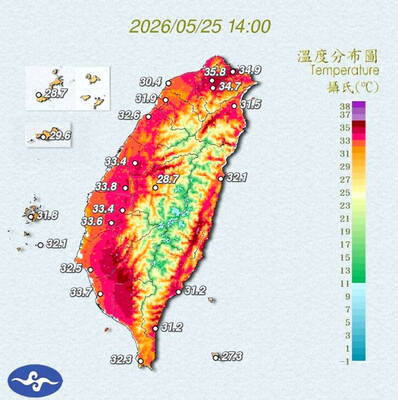
STAY COOL: The HPA recommended that people stay hydrated, use air-conditioning or fans while indoors, wear loose-fitting clothes and walk in the shade while outdoors Employers must implement measures such as installing cooling equipment, and providing drinking water and rest breaks for outdoor workers starting from Monday next week, the Taipei Department of Labor said on Sunday. Employers who fail to comply could face fines of NT$30,000 to NT$300,000 under the Occupational Safety and Health Act (職業安全衛生法), the department said. Businesses in Taipei employing fewer than 100 workers, as well as registered self-employed workers with labor insurance coverage, could receive on-site assessments and guidance from occupational safety consultants to help them apply for central government subsidies to implement or improve heat-protection measures, it said. Under the Ministry of

Chinese Nationalist Party (KMT) Chairwoman Cheng Li-wun (鄭麗文) yesterday briefed her party’s Central Standing Committee regarding her scheduled visit to the US between Monday next week and June 16, saying that her purpose would be to persuade the US that the Republic of China (ROC) Constitution was a “one China” constitution that would foster stable and peaceful cross-strait relations. The ROC Constitution is the most important defense for all Taiwanese citizens, as it upholds our democracy and has contributed to our robust economy, which aligns with international and US interests, she said. “We would not be troublemakers and drag the US under,”


 RSS
RSS