


Anti-nuclear groups announced that they will hold a “Run Away From Nuclear” event on March 29 in Taipei as they performed a skit yesterday on Ketagalan Boulevard in which they pretended to flee radiation leaked from a nuclear power plant.
With the sound of nuclear alarm sirens in the background, performers wearing radiation suits put radioactive hazard trefoil stickers on signs with Taipei’s famous landmarks drawn on them to signify that all of Taipei could be contaminated if an accident occurred at one of the nuclear power plants in northern Taiwan.
Taiwan has three operational nuclear power plants — the Jinshan Nuclear Power Plant in Shihmen District (石門), New Taipei City (新北市), Guosheng Nuclear Power Plant in Wanli District (萬里), New Taipei City, and Ma-anshan Nuclear Power Plant in Ma-anshan (馬鞍山), Pingtung County.
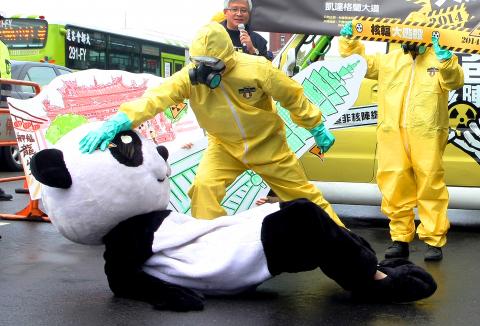
Photo: CNA
The skit also included a person dressed in a panda costume to mimic the Taipei Zoo’s panda cub Yuan Zai (圓仔) and a person holding a picture of President Ma Ying-jeou (馬英九), with a voice-over saying that even they could not escape from the radiation should an accident happen.
Anti-nuclear Alliance of Fathers convener Liou Gin-show (劉俊秀), a professor at National Chiao Tung University, said that according to his calculation, the occurrence rate of a nuclear disaster is about 1 in 500 — which is higher than the rate of winning NT$200 in the bimonthly Uniform-Invoice Lottery.
“If a nuclear disaster occurs at one of the plants, between 4 million and 5 million people would have to be evacuated from the Greater Taipei area, and that is only based on an evacuation ranging between 20km and 30km from the plants, not to say the 80km radius evacuation zone recommended by the US, and we do not even have the ability to evacuate 4 or 5 million people,” he said.
Anti-nuclear Alliance of Fathers executive director Kobe Chih (池國平) said the group decided to hold a run because fleeing is the first thing people would do in a nuclear accident, but “we also want the government to know that it is impossible to mount an effective response to a disaster when so many people are trying to flee at the same time.”
Taiwan Environmental Protection Union member and National Taiwan University’s atmospheric sciences professor Gloria Hsu (徐光蓉) said Taiwan is not short of power, because electricity generated by nuclear power accounts for only 6 percent of the total power supply, and can be replaced by improving electrical transmission efficiency or energy-conservation measures.
The groups urged the government to retire the three operational nuclear power plants as planned and stop constructing the Fourth Nuclear Power Plant in Gongliao (貢寮), New Taipei City, to provide a safe, nuclear-free living environment for everyone.
The 7km running event will begin at 7am and start from Ketagalan Boulevard.

FUKUOKA SITUATION: Japanese media reported that the pathogen is expected to be identified by the summer, while the CDC downplayed the idea that it was hMPV A “mysterious cold-like illness” reported in Japan’s Fukuoka Prefecture does not seem to be a new disease, but Japanese authorities have been asked about the situation, the Centers for Disease Control (CDC) said yesterday. The Fukuoka Prefectural Medical Association on Wednesday told a news conference that a “mystery cold” that has become a hot topic on social media is “highly likely to be caused by some kind of viral infection,” Japan’s KBC News reported. “Many people are experiencing symptoms starting with a sore throat, followed by a runny nose, phlegm and a severe cough,” KBC News reported, citing association officials. Health authorities are

Nvidia Corp CEO Jensen Huang (黃仁勳) arrived in Taiwan yesterday ahead of upcoming AI and technology events, saying he plans to meet with clients and Taiwan Semiconductor Manufacturing Co Chairman C.C. Wei (魏哲家) during his visit. After landing at Taipei Songshan Airport, Huang posed for photos with fans and handed out Yakult drinks to reporters and supporters waiting at the scene, saying he has “a lot to do” during the trip. Asked about reports that Nvidia’s planned headquarters site in Taipei’s Beitou Shilin Technology Park could break ground on May 27, Huang said that if the company holds an event, he would

The Ministry of Finance this afternoon announced the winning numbers for the March-April uniform invoice lottery. The winning number for the NT$10 million (US$318,060) special prize is 19531471, and the winning number for the NT$2 million grand prize is 85941329. Three numbers were drawn for the NT$200,000 first prize: 07225810, 20231230 and 83518781. Those with receipts matching the last seven digits of any of the first-prize numbers will win the NT$40,000 second prize, while those matching the last six digits will win the NT$10,000 third prize. Those whose receipts match the last five digits of the first-prize numbers can claim the NT$4,000 fourth prize,
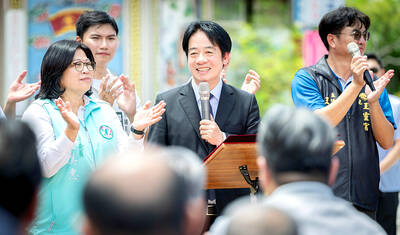
SIX SUBSIDIES: The monthly allowance for older farmers is to increase to NT$10,000, and NT$5,000 is to be given to homemakers under the national pension system, Lai said The government is to implement major welfare policies for disadvantaged groups, including raising the monthly allowance for older farmers to NT$10,000 and providing homemakers with NT$5,000 per month, President William Lai (賴清德) said yesterday. Lai made the remarks during a visit to Wangling Temple in Chiayi County, saying that the planned increases were being introduced amid economic growth and an increase in tax revenue. Touting a policy, in which the government plans to provide a monthly allowance of NT$5,000 for every child under the age of 18 in a bid to address Taiwan’s low birthrate, Lai said that if received for the


 RSS
RSS