


Political issues may be unavoidable for Taiwan and China as the two sides conduct economic exchanges, former Chinese Nationalist Party (KMT) chairman Wu Poh-hsiung (吳伯雄) said yesterday, stressing that Taiwan should address political issues according to the public’s needs.
“‘Economic issues first and political ones later’ has been the principle guiding the handling of cross-strait relations. However, difficult political issues may come up during economic exchanges and we need to address them if the public deems it necessary,” he said at the opening ceremony of the ninth Cross-Strait Economic, Trade and Culture Forum held in Nanning, in China’s Guangxi Province.
The annual forum is held so the KMT and the Chinese Communist Party can meet to discuss cross-strait developments. Wu is attending the two-day forum as the envoy of President Ma Ying-jeou (馬英九), who also serves as KMT chairman.
Wu reiterated the president’s description of cross-strait ties as not being state-to-state relations and said that the so-called “1992 consensus” remains the foundation of the cross-strait relationship.
The “1992 consensus” refers to a disputed cross-strait agreement reached by the KMT and China on the meaning of the “one China” policy, under which both sides of the Taiwan Strait agree on the existence of “one China,” but each has its own interpretation of what “China” means.
“We should cement political trust between the two sides of the Taiwan Strait and continue to define cross-strait relations under the ‘one China’ framework... Cross-strait relations are special relations,” he said.
Regarding Chinese President Xi Jinping’s (習近平) recent calls for Taiwan to bridge the cross-strait political division so it would not be “passed on from generation to generation,” Wu said bilateral ties are the warmest they have been for the past 50 years, adding that this generation’s efforts to promote peace across the Strait and seek win-win situations should be recognized.
Yu Zhengsheng (俞正聲), chairman of the National Committee of the Chinese People’s Political Consultative Committee, reiterated China’s opposition to Taiwanese independence and said he expected the two sides would soon hold follow-up negotiations for the Economic Cooperation Framework Agreement (ECFA), as well as implement cross-strait agreements.
The two-day forum is to end today. The cross-strait service trade agreement and the proposed establishment of representative offices on either side of the Strait were expected to be on the agenda at the event.
Separately yesterday, Mainland Affairs Council Minister Wang Yu-chi (王郁琦) said that Beijing should grant Taiwanese personnel the right to visit Taiwanese prisoners in China as part of the negotiations on the establishment of reciprocal representative offices.
“We believe that if China really values how Taiwanese feel and wishes to improve mutual political trust between the two sides, it will grant Taiwanese representative office personnel the right to visit [inmates] for humanitarian reasons,” Wang said in a speech to university students at the opening of a three-day seminar in Taipei on China policies.
Visitation rights are an important issue for the public and for all political parties in Taiwan, where freedom and human rights are highly regarded, Wang said, adding that China’s unwillingness to grant these rights has been the main obstacle impeding negotiations between Taipei and Beijing on the offices.
China has refused to move on the issue, on the grounds that such visits are not permissible under its laws, Wang said.
Matters such as the issuance of travel documents and visitation rights may be politically sensitive, but both sides should handle them wisely and practically during talks since they are issues that pertain to the rights and welfare of Taiwanese citizens in China, he said.
Additional reporting by CNA
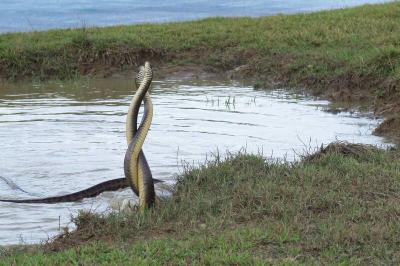
Kenting National Park service technician Yang Jien-fon (楊政峰) won a silver award in World Grand Prix Photography Awards Spring Season for his photograph of two male rat snakes intertwined in combat. Yang’s colleagues at Kenting National Park said he is a master of nature photography who has been held back by his job in civil service. The awards accept entries in all four seasons across six categories: architectural and urban photography, black-and-white and fine art photography, commercial and fashion photography, documentary and people photography, nature and experimental photography, and mobile photography. Awards are ranked according to scores and divided into platinum, gold and
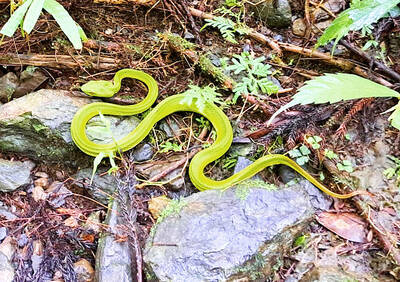
More than half of the bamboo vipers captured in Tainan in the past few years were found in the city’s Sinhua District (新化), while other districts had smaller catches or none at all. Every year, Tainan captures about 6,000 snakes which have made their way into people’s homes. Of the six major venomous snakes in Taiwan, the cobra, the many-banded krait, the brown-spotted pit viper and the bamboo viper are the most frequently captured. The high concentration of bamboo vipers captured in Sinhua District is puzzling. Tainan Agriculture Bureau Forestry and Nature Conservation Division head Chu Chien-ming (朱健明) earlier this week said that the
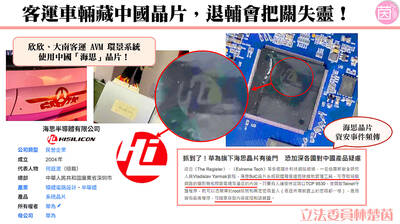
BREACH OF CONTRACT: The bus operators would seek compensation and have demanded that the manufacturer replace the chips with ones that meet regulations Two bus operators found to be using buses with China-made chips are to demand that the original manufacturers replace the systems and provide compensation for breach of contract, the Veterans Affairs Council said yesterday. Democratic Progressive Party Legislator Michelle Lin (林楚茵) yesterday said that Da Nan Bus Co and Shin-Shin Bus Co Ltd have fielded a total of 82 buses that are using Chinese chips. The bus models were made by Tron-E, while the systems provider was CYE Electronics, Lin said. Lin alleged that the buses were using chips manufactured by Huawei subsidiary HiSilicon Co, which presents a national security risk if the

The National Immigration Agency has banned two Chinese from returning to Taiwan, after they published social media content it described as disrespectful to national sovereignty. The agency imposed a two-month ban on a Chinese man surnamed Liang (梁) and a permanent ban on a woman surnamed Yang (楊), an influencer with 23 million followers, in October last year and last week respectively. Minister of the Interior Liu Shyh-fang (劉世芳) yesterday said on the sidelines of a legislative meeting that Chinese visitors to Taiwan are required to comply with the rules and regulations governing their entry permits. The government has handled the ban and


 RSS
RSS