


It would be a “huge mistake” and “naive” for Washington to reduce arms sales to Taiwan, former US government official Randy Schriver told a conference on Thursday.
He was speaking following reports in the Chinese press that the US may form a task force with China to discuss weapons sales to Taiwan along with other issues.
The reports were based on remarks attributed to Chinese Rear Admiral Guan Youfei (關友飛), director of the Foreign Affairs Office of China’s Ministry of National Defense, following Pentagon talks on Monday between Chinese Minister of National Defense Chang Wanquan (常萬全) and US Secretary of Defense Chuck Hagel.
Pentagon sources told the Taipei Times on Thursday there was no new agreement to discuss arms sales to Taiwan with China, and that sales would continue under the terms of the Taiwan Relations Act (TRA) and the “six assurances.”
Schriver told a conference — organized by the Atlantic Council Brent Scowcroft Center on International Security — that some experts believe that Taiwan is now less of a focal point for Chinese militarization than it once had been.
Schriver served as US deputy assistant secretary of state for East Asia from 2003 to 2005, and is now president and chief executive officer of the Project 2049 Institute.
For many years, Taiwan served as a “single focal point” for the People’s Liberation Army (PLA), allowing it to get “very good, very quickly,” he said.
Yet, a “lot of people” were now pointing to improved cross-strait relations under President Ma Ying-jeou (馬英九) and questioning the need for continued arms sales, he added.
However, despite the economic, diplomatic and political improvements, the PLA has not “removed a single missile, a single military unit,” he said.
“They have done nothing to reduce the posture opposite Taiwan in a way that reduces their military capability and presence,” he added.
In fact, the Chinese military buildup opposite Taiwan has “continued apace” while Taiwan’s own military budgets have fallen, Schriver said.
“Perhaps the PLA and the PRC [the People’s Republic of China] leadership is not confident in the ultimate trajectory of Taiwan,” he said. “Perhaps they understand some things that a lot of Americans miss.”
He said that based on the new agreements and improvements Taipei has negotiated with Beijing, the US had become “complacent” about the direction of Taiwan.
“But if you look at the PRC’s true strategic objective, you could argue they are further away not closer to achieving that objective — even after a term and a half of Ma Ying-jeou,” he added.
Schriver said polls showed that Taiwanese overwhelmingly support the political “status quo” and that while the proportion in favor of independence at a later date was growing, the ratio of those favoring unification with China was shrinking.
The Chinese military buildup opposite Taiwan could continue “to prevent” Taipei moving towards independence if the Democratic Progressive Party returned to power, he said.
“Having that deterrent capability to use military options against Taiwan at some point in the future, if Taiwan’s defenses continue to atrophy, may be why the buildup opposite Taiwan may continue,” Schriver said.
He said that diplomatic and economic breakthroughs with China would not lead to a major reduction in Chinese forces opposite Taiwan.
If there were to be talks between the US and China about Taiwan, they should start with discussions about the security environment in the Taiwan Strait, he said.
“Why doesn’t China recognize that the situation is changing and that the security dynamic is different, and unilaterally reduce the buildup?” Schriver asked.
Ultimately, he said, China was concerned about the political direction of Taiwan and wanted to keep a military option, not only for coercion, but for actual military operations, if, in the future they “think they need to do it.”
China’s ultimate objective for Taiwan — unification — “is not getting closer, it’s getting further away,” Schriver said.
Asked about Chinese reports of talks with Washington about arms sales to Taiwan, US Department of State spokesperson Jennifer Psaki said on Thursday that arms sales would continue consistent with US commitments under the TRA.
“We believe this long-standing policy contributes to the maintenance of peace and stability across the Taiwan Strait, but there is no change to our ‘one China’ policy, which is based on the three joint communiques and the Taiwan Relations Act,” she said.
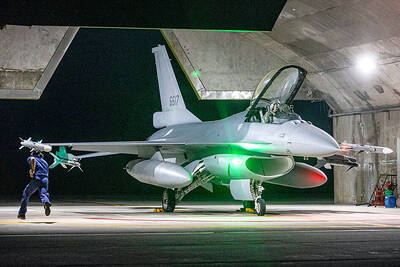
Taiwan has received more than US$70 million in royalties as of the end of last year from developing the F-16V jet as countries worldwide purchase or upgrade to this popular model, government and military officials said on Saturday. Taiwan funded the development of the F-16V jet and ended up the sole investor as other countries withdrew from the program. Now the F-16V is increasingly popular and countries must pay Taiwan a percentage in royalties when they purchase new F-16V aircraft or upgrade older F-16 models. The next five years are expected to be the peak for these royalties, with Taiwan potentially earning
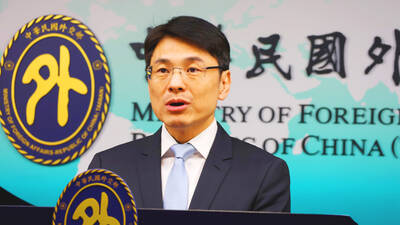
STAY IN YOUR LANE: As the US and Israel attack Iran, the ministry has warned China not to overstep by including Taiwanese citizens in its evacuation orders The Ministry of Foreign Affairs (MOFA) yesterday rebuked a statement by China’s embassy in Israel that it would evacuate Taiwanese holders of Chinese travel documents from Israel amid the latter’s escalating conflict with Iran. Tensions have risen across the Middle East in the wake of US and Israeli airstrikes on Iran beginning Saturday. China subsequently issued an evacuation notice for its citizens. In a news release, the Chinese embassy in Israel said holders of “Taiwan compatriot permits (台胞證)” issued to Taiwanese nationals by Chinese authorities for travel to China — could register for evacuation to Egypt. In Taipei, the ministry yesterday said Taiwan
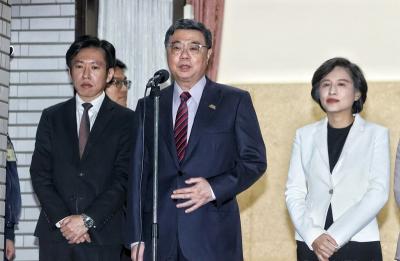
Taiwan is awaiting official notification from the US regarding the status of the Agreement on Reciprocal Trade (ART) after the US Supreme Court ruled US President Donald Trump's global tariffs unconstitutional. Speaking to reporters before a legislative hearing today, Premier Cho Jung-tai (卓榮泰) said that Taiwan's negotiation team remains focused on ensuring that the bilateral trade deal remains intact despite the legal challenge to Trump's tariff policy. "The US has pledged to notify its trade partners once the subsequent administrative and legal processes are finalized, and that certainly includes Taiwan," Cho said when asked about opposition parties’ doubts that the ART was
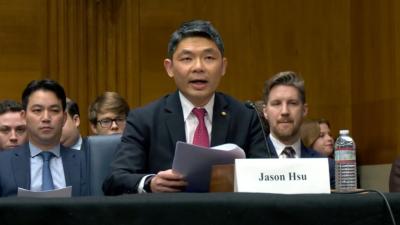
If China chose to invade Taiwan tomorrow, it would only have to sever three undersea fiber-optic cable clusters to cause a data blackout, Jason Hsu (許毓仁), a senior fellow at the Hudson Institute and former Chinese Nationalist Party (KMT) legislator, told a US security panel yesterday. In a Taiwan contingency, cable disruption would be one of the earliest preinvasion actions and the signal that escalation had begun, he said, adding that Taiwan’s current cable repair capabilities are insufficient. The US-China Economic and Security Review Commission (USCC) yesterday held a hearing on US-China Competition Under the Sea, with Hsu speaking on


 RSS
RSS