


An advocacy group focusing on opposition to the so-called “one China” principle and the erosion of Taiwan’s sovereignty under President Ma Ying-jeou’s (馬英九) administration is set to be established on Monday, the group’s founding members told a press conference yesterday.
The Anti-One China Principle Union is a non-partisan group cofounded by Democratic Progressive Party (DPP) Legislator Mark Chen (陳唐山), Taiwan Solidarity Union (TSU) Legislator Hsu Chung-hsin (許忠信) and former DPP lawmaker Chai Trong-rong (蔡同榮).
Acknowledgement of the “one China” principle — the core strategy of China’s Taiwan policy — could jeopardize Taiwan’s sovereignty, democracy, freedom and human rights, they said.
“However, the Ma administration’s pro-Beijing stance and the DPP’s failure to monitor the administration and its tendency to move to a more China-friendly position have aroused concern over the gradual erosion of sovereignty,” Chen said.
Chai will serve as the president of the union, with Chen and Hsu as vice presidents, Hsu said, adding that other notable members include former premier Yu Shyi-kun (游錫堃) and former Examination Yuan president Yao Chia-wen (姚嘉文). Former vice president Annette Lu (呂秀蓮) and former presidential adviser Peng Ming-min (彭明敏) are to serve as consultants.
Chai and Chen criticized former premier Frank Hsieh (謝長廷) for his “pro-Beijing position.”
Responding to the criticism yesterday afternoon in a radio interview with Cheng Hong-yi (鄭弘儀), Hsieh denied that he “had betrayed Taiwan’s independence movement” and said that “closer engagement with China did not mean surrender.”
Hsieh, who advocates a moderate China policy with his initiative of “constitutions with different interpretations,” described himself as a “pragmatic idealist” and very different from the “hardliners” of the pro-independence wing, such as Chai and Chen.
“They insist on their belief, while I’m an idealist who focuses on reality. We should work together to strive for Taiwan’s dignity,” Hsieh said.

Taiwan has received more than US$70 million in royalties as of the end of last year from developing the F-16V jet as countries worldwide purchase or upgrade to this popular model, government and military officials said on Saturday. Taiwan funded the development of the F-16V jet and ended up the sole investor as other countries withdrew from the program. Now the F-16V is increasingly popular and countries must pay Taiwan a percentage in royalties when they purchase new F-16V aircraft or upgrade older F-16 models. The next five years are expected to be the peak for these royalties, with Taiwan potentially earning
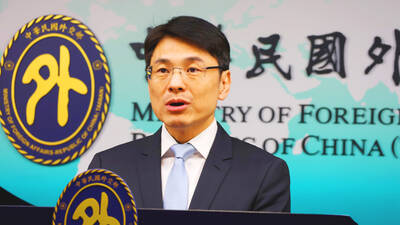
STAY IN YOUR LANE: As the US and Israel attack Iran, the ministry has warned China not to overstep by including Taiwanese citizens in its evacuation orders The Ministry of Foreign Affairs (MOFA) yesterday rebuked a statement by China’s embassy in Israel that it would evacuate Taiwanese holders of Chinese travel documents from Israel amid the latter’s escalating conflict with Iran. Tensions have risen across the Middle East in the wake of US and Israeli airstrikes on Iran beginning Saturday. China subsequently issued an evacuation notice for its citizens. In a news release, the Chinese embassy in Israel said holders of “Taiwan compatriot permits (台胞證)” issued to Taiwanese nationals by Chinese authorities for travel to China — could register for evacuation to Egypt. In Taipei, the ministry yesterday said Taiwan
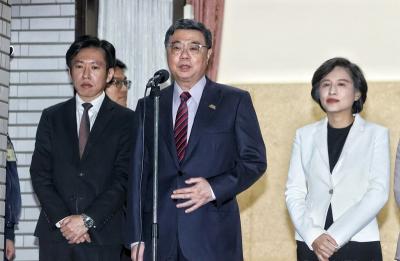
Taiwan is awaiting official notification from the US regarding the status of the Agreement on Reciprocal Trade (ART) after the US Supreme Court ruled US President Donald Trump's global tariffs unconstitutional. Speaking to reporters before a legislative hearing today, Premier Cho Jung-tai (卓榮泰) said that Taiwan's negotiation team remains focused on ensuring that the bilateral trade deal remains intact despite the legal challenge to Trump's tariff policy. "The US has pledged to notify its trade partners once the subsequent administrative and legal processes are finalized, and that certainly includes Taiwan," Cho said when asked about opposition parties’ doubts that the ART was
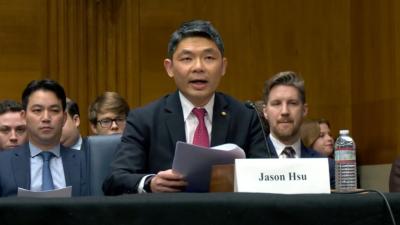
If China chose to invade Taiwan tomorrow, it would only have to sever three undersea fiber-optic cable clusters to cause a data blackout, Jason Hsu (許毓仁), a senior fellow at the Hudson Institute and former Chinese Nationalist Party (KMT) legislator, told a US security panel yesterday. In a Taiwan contingency, cable disruption would be one of the earliest preinvasion actions and the signal that escalation had begun, he said, adding that Taiwan’s current cable repair capabilities are insufficient. The US-China Economic and Security Review Commission (USCC) yesterday held a hearing on US-China Competition Under the Sea, with Hsu speaking on


 RSS
RSS