


Human rights activists welcomed the support of 100,000 French who signed a petition asking Taiwan’s government to spare the life of death-row prisoner Chiou Ho-shun (邱和順), while calling on the government to abolish capital punishment.
“In a ‘signature marathon’ campaign organized by Amnesty International in December last year, as many as 105,495 signatures were collected from French citizens calling for a stop to the execution of Chiou, who was sentenced to death based on a confession obtained through torture, and demanding a new legal process for him,” Amnesty International France said in a press statement in French released on Wednesday.
“The signatures will be officially presented to the Taipei Representative Office in Paris on Feb. 14 at 3pm,” it said.
Chiou was selected as one of Amnesty International’s highlighted cases, for which the organization calls for urgent action from its members worldwide, in 2011 when his death sentence was finalized.
Other than petitions and letters to President Ma Ying-jeou (馬英九) and Minister of Justice Tseng Yung-fu (曾勇夫), Chiou has also received 2,000 letters of support from across the world.
Chiou was convicted and sentenced to death for the murder of a nine-year-old boy in 1987, though there was no direct hard evidence proving his involvement.
Instead, a confession — which Chiou claims to have made after he was tortured — was the basis of the conviction.
The findings of a Control Yuan investigation support his claim.
“On one hand, I think this is excellent to hear, however, on the other hand, it’s saddening,” Amnesty International Taiwan chairman Freddy Lim (林昶佐) told the Taipei Times via telephone on hearing the news.
“It’s saddening, because, after more than 20 years since the democratization of Taiwan, human rights abuses that require attention from activists within and outside of the country still exist,” he said.
Lin Hsin-yi (林欣怡), executive director of the Taiwan Alliance to End the Death Penalty, welcomed the news, though she urged the public to pay as much attention to all 56 inmates on death row.
“Besides Chiou’s case, there are also many other cases among the 56 death-row prisoners that are problematic — the case of Cheng Hsing-tse [鄭性澤] is one,” Lin said.
Cheng was sentenced to death after being convicted of the murder of a police officer, though there was no hard evidence supporting the conviction and Cheng insists that the confession he made during police interrogation was the product of torture.
“I would say that capital punishment is a very ‘unsafe’ penalty, because it’s irreversible and the quality of legal procedure is notoriously poor in Taiwan,” Lin said. “It’s time to abolish the death penalty.”
Asked for comment, Deputy Minister of Justice Wu Chen-huan (吳陳鐶) said that he could not comment on individual cases and that each case would be handled fairly according to the law.
Department of European Affairs Director-General Hsu Mien-sheng (徐勉生) at the Ministry of Foreign Affairs said he had yet to receive any information from the representative office in France.
“I need to look into it before deciding how the ministry will handle the petition,” Hsu said.

NATIONAL SECURITY: Authorities are working to confirm the identities of the military personnel involved and investigating possible illegal conduct and regulatory violations Authorities are probing possible national security implications after Kinmen police and immigration officers on Sunday found a Chinese woman allegedly posing as a tourist while engaging in prostitution involving more than 10 military personnel. The woman, surnamed Chen (陳), has since been deported, authorities said, adding that investigators are still working to confirm the identities of those implicated, as the records only listed code names and aliases. The case stemmed from a report received by the Kinmen District Prosecutors’ Office on Friday last week from the Jinhu Precinct of the Kinmen County Police Bureau. On Sunday, police, along with the National Immigration

GLOBALGIVING: ‘ Caving to external pressure is not acceptable for an organization that has cultivated justice reform and human rights for 30 years,’ one NGO said A slew of non-government organizations (NGOs) have withdrawn from the GlobalGiving fundraising platform after it announced it would use “Chinese Taipei” instead of “Taiwan” from next month. The Taiwan Good Rice Association wrote on Facebook on Friday that it was informed on April 28 via a teleconference call of the change, which was made because the platform wanted to operate in China. Taiwan Good Rice is to terminate all cooperative relationships with GlobalGiving in response to the platform’s “unilateral and non-negotiable” decision to remove references to Taiwan, the NGO said. “Taiwan is in the official name of Taiwan Good Rice Association and the

HEAVY WEATHER: Typhoon Jangmi is due to crash straight into the Ryukyus as airlines look to shift flights to larger aircraft or cancel flights to Okinawa entirely Taiwan’s international air carriers announced flight adjustments over the weekend as Typhoon Jangmi is forecast to hit the Ryukyu Islands today and tomorrow. The Central Weather Administration (CWA) upgraded Jangmi from a tropical storm to a typhoon at 8am yesterday, with the eye located 580km south of Naha city. It was moving north at 19kph. Today, China Airlines’ CI-120, CI-121, CI-122 and CI-123 flights between Taoyuan and Naha, Okinawa, have been canceled as well as CI-132 and CI-133 between Kaohsiung and Naha. EVA Air’s BR-112, BR-113, BR-186 and BR-185 flights between Taoyuan and Naha are also canceled. Low-cost carrier Tigerair Taiwan canceled IT-230,
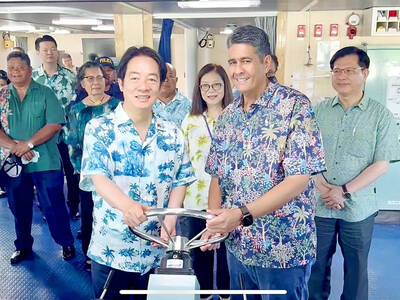
MULTIPRONGED APPROACH: China has sought to pressure Palau across a number of fronts, but the island nation has staunchly resisted overtures to ditch Taiwan Palau has been firm in backing Taiwan despite Chinese pressure that uses tourism economics, cyberattacks and criminal infiltration as tools to threaten the Pacific ally into renouncing its recognition of Taiwan as a sovereign state. The Presidential Office yesterday announced that Vice President Hsiao Bi-khim (蕭美琴) would visit Palau from Saturday to Wednesday next week at the invitation of Palauan President Surangel Whipps Jr. Whipps in April said in an interview that China had outspokenly asked Palau to “denounce Taiwan.” “And we have said: ‘We have no enemies, but nobody tells us who our friends are,’” he said. Whipps has told reporters multiple times


 RSS
RSS