


The government is negotiating with Japan over the nation’s fishing rights in the waters surrounding the disputed Diaoyutai Islands (釣魚台), President Ma Ying-jeou (馬英九) said yesterday, adding that he hoped this could yield substantial results in the near future.
Accompanied by Council of Agriculture Minister Chen Bao-ji (陳保基), Chinese Nationalist Party (KMT) legislators Su Ching-chuan (蘇清泉), Wang Chin-shih (王進士), Chiu Wen-yen (邱文彥) and Chien Tung-ming (簡東明), Ma made the remark during a visit to the Coast Guard Administration’s (CGA) inspection office in Donggang Township (東港) in Pingtung County.
After listening to a brief report on the office’s administrative achievements last year, Ma attended a luncheon with coast guard personnel, during which he touted the agency’s efforts in safeguarding the safety of Taiwanese fishermen operating in waters near the Diaoyutais, also known as the Senkakus in Japan.
“Amid increasing tensions in the South China Sea, the CGA was able to offer timely assistance to a group of Taiwanese fishermen heading from Suao [蘇澳], Yilan County, to the Diaoyutai Islands [in September] last year in an effort to assert the nation’s sovereignty over the disputed archipelago,” Ma said.
Its assistance not only helped bring the privately initiated mission, which triggered an exchange of water-cannon fire between Taiwanese and Japanese patrol vessels, to a peaceful end, but also earned plaudits from Taiwanese fishermen, Ma said.
“It is a nation’s obligation to guarantee the safety and rights of its fishermen, which is something the CGA has been doing through non-military means since its establishment 17 years ago,” Ma said.
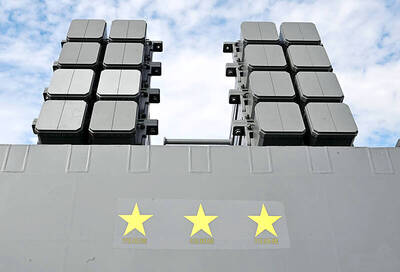
UPGRADE: The Kang Ding-class frigate is replacing its Chaparall missiles with Tien Chien II and Hua Yang VLS, which would provide it with long-range, 360° air defense Taiwan plans to produce 1,200 to 1,376 Hai Chien II missiles (海劍二, Sea Sword II) — also known as TC-2N — to serve as the standard air defense system of the navy’s surface combatant fleet, a source said yesterday. Last week, the Hai Chien II, the naval version of the Tien Kung II missile (天劍二, Sky Sword II), completed a live-fire test in waters off the National Chungshan Institute of Science and Technology’s Jiupeng facility (九鵬) in Pingtung County’s Manjhou Township (滿州). The MIM72 Chaparral and other dated air defense missiles that currently arm Taiwanese ships have inadequate range to combat Chinese

REASONS FOR TRAVEL: An assistant professor said that proposed amendments to penalize drivers if they used drugs overseas would not deter people from traveling People who operate a motor vehicle under the influence of marijuana would have their driver’s license revoked, even if they used the substance while overseas, the Ministry of Transportation and Communications said yesterday, citing proposed amendments to the Road Traffic Management and Penalty Act (道路交通管理處罰條例). The amendments would also authorize the government to revoke the licenses of people determined to have used Category 1 or Category 2 narcotics, even if they were not operating a vehicle while under the influence of drugs, as well as ban them from taking the license test for three years, the ministry said. People aged 18 or

HEAVY WEATHER: Typhoon Jangmi is due to crash straight into the Ryukyus as airlines look to shift flights to larger aircraft or cancel flights to Okinawa entirely Taiwan’s international air carriers announced flight adjustments over the weekend as Typhoon Jangmi is forecast to hit the Ryukyu Islands today and tomorrow. The Central Weather Administration (CWA) upgraded Jangmi from a tropical storm to a typhoon at 8am yesterday, with the eye located 580km south of Naha city. It was moving north at 19kph. Today, China Airlines’ CI-120, CI-121, CI-122 and CI-123 flights between Taoyuan and Naha, Okinawa, have been canceled as well as CI-132 and CI-133 between Kaohsiung and Naha. EVA Air’s BR-112, BR-113, BR-186 and BR-185 flights between Taoyuan and Naha are also canceled. Low-cost carrier Tigerair Taiwan canceled IT-230,
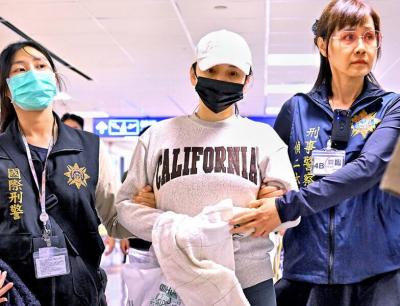
Johanne Liou (劉喬安), a Taiwanese woman who shot to unwanted fame during the Sunflower movement protests in 2014, returned to Taiwan last night after being deported from the US. She is to stand trial in Taiwan for charges involving embezzlement, fraud and drug crimes. The Criminal Investigation Bureau (CIB) said it took her into custody at Taiwan Taoyuan International Airport and would first question her before transferring her to the New Taipei District Prosecutors’ Office. She was arrested upon disembarking a flight from San Francisco that landed shortly before 7pm. Liou absconded to the US in 2019 after jumping bail


 RSS
RSS