


Two classified naval charts were reported missing when an inventory was carried out amid the decommissioning of aging Hai Ou (“Seagull”) missile boats last month, and the information they contained could put navy vessels at risk during wartime, reports said yesterday.
According to the Chinese-language United Daily News, navy officers who had custody over the documents accidentally burned one of the two missing charts while destroying other documents, but the other, which contained classified information about naval deployments in the Taiwan Strait, remains unaccounted for.
The missing chart reportedly contained hydrographic data, ship information, waterways depth, sea salt fluctuation and the locations of navy vessels and submarines in wartime.
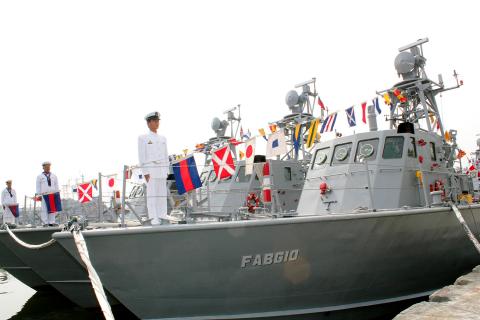
Photo: Military News Agency
The information could leave navy vessels exposed if it were to fall in enemy hands, reports said.
Naval Command said two control officers had received demerits over the affair and added that it had turned the case to a local military court for possible prosecution. It said it had also instructed all relevant units to tighten management of confidential information.
The navy decommissioned its last 20 Hai Ou missile boats during a ceremony at the Zuoying (左營) naval base in Greater Kaohsiung on July 1. The ships, whose design was inspired by Israel’s Dvora-class patrol boats, had been in service for about three decades. Each Hai Ou — a total of 50 were deployed — came equipped with locally produced Hsiung Feng I (HF-1) anti-ship missiles.
Amid modernization efforts, three squadrons of Kuang Hua VI (KH-6) radar-evading fast-attack missile boats have entered service since 2010. Each of the 31 KH-6s is armed with the more advanced HF-2 anti-ship missile.
The embarrassment over the disappearance of the classified chart comes after the Ministry of National Defense (MND) admitted last month that it had launched an investigation into the disappearance in May of a top-secret laptop used on a KH-6 vessel.
The computer, which belonged to the Chungshan Institute of Science and Technology’s (CSIST) — the nation’s top military research body — had been installed for a six-month period, during which the ship’s crew carried out tests of confidential communications equipment and procedures.
The Southern District Prosecutors’ Office is handling the investigation into the computer’s disappearance.
Additional reporting by CNA

FUKUOKA SITUATION: Japanese media reported that the pathogen is expected to be identified by the summer, while the CDC downplayed the idea that it was hMPV A “mysterious cold-like illness” reported in Japan’s Fukuoka Prefecture does not seem to be a new disease, but Japanese authorities have been asked about the situation, the Centers for Disease Control (CDC) said yesterday. The Fukuoka Prefectural Medical Association on Wednesday told a news conference that a “mystery cold” that has become a hot topic on social media is “highly likely to be caused by some kind of viral infection,” Japan’s KBC News reported. “Many people are experiencing symptoms starting with a sore throat, followed by a runny nose, phlegm and a severe cough,” KBC News reported, citing association officials. Health authorities are

Nvidia Corp CEO Jensen Huang (黃仁勳) arrived in Taiwan yesterday ahead of upcoming AI and technology events, saying he plans to meet with clients and Taiwan Semiconductor Manufacturing Co Chairman C.C. Wei (魏哲家) during his visit. After landing at Taipei Songshan Airport, Huang posed for photos with fans and handed out Yakult drinks to reporters and supporters waiting at the scene, saying he has “a lot to do” during the trip. Asked about reports that Nvidia’s planned headquarters site in Taipei’s Beitou Shilin Technology Park could break ground on May 27, Huang said that if the company holds an event, he would

The Ministry of Finance this afternoon announced the winning numbers for the March-April uniform invoice lottery. The winning number for the NT$10 million (US$318,060) special prize is 19531471, and the winning number for the NT$2 million grand prize is 85941329. Three numbers were drawn for the NT$200,000 first prize: 07225810, 20231230 and 83518781. Those with receipts matching the last seven digits of any of the first-prize numbers will win the NT$40,000 second prize, while those matching the last six digits will win the NT$10,000 third prize. Those whose receipts match the last five digits of the first-prize numbers can claim the NT$4,000 fourth prize,

SIX SUBSIDIES: The monthly allowance for older farmers is to increase to NT$10,000, and NT$5,000 is to be given to homemakers under the national pension system, Lai said The government is to implement major welfare policies for disadvantaged groups, including raising the monthly allowance for older farmers to NT$10,000 and providing homemakers with NT$5,000 per month, President William Lai (賴清德) said yesterday. Lai made the remarks during a visit to Wangling Temple in Chiayi County, saying that the planned increases were being introduced amid economic growth and an increase in tax revenue. Touting a policy, in which the government plans to provide a monthly allowance of NT$5,000 for every child under the age of 18 in a bid to address Taiwan’s low birthrate, Lai said that if received for the


 RSS
RSS