


Loosening currency exchange rate controls, reducing dependence on China and privatizing state companies were some of the items on former president Lee Teng-hui’s (李登輝) prescription list to help the nation’s ailing economy, which he discussed in recent interviews with the media.
In interviews with the Chinese-language Journalist and Wealth magazines, published on Wednesday and yesterday respectively, Lee shared his views on the political and economic situation in Taiwan as well as his observations on President Ma Ying-jeou’s (馬英九) administration.
The 89-year-old, an expert on agricultural economics, paid special attention to the economy and said Taiwan should keep the exchange rate of New Taiwan dollar against US dollar at about NT$33 or NT$34 to increase the competitiveness of Taiwan’s exports, rather than insisting on a rigid forex policy.
Social wealth is expected to increase after the stimulation of exports, he said, and the currency exchange rate could then return to current levels to stem inflation.
“The exchange rate, as well as policies, should be always flexible,” Lee said.
In general, Lee said he was gravely concerned with two elements of the economy — an overdependence on imported energy and the Chinese market.
On energy, Taiwan should be able to develop biomass energy by utilizing idle land and lands released by state-controlled Taiwan Sugar Corp to grow yam and sugar cane, which would also revive local agriculture, Lee said.
Taiwan should try to bring back its businesspeople in China since the second-largest economy in the world has been having troubles increasing its domestic consumption, but this could not be done without solving labor and wage issues, he said.
Turning to politics, Lee said that as a former president, he had been reluctant to criticize Ma, but Ma has not handled his policies on fuel and electricity price increases and the capital gains tax proposal well.
He ridiculed both Ma’s “one country, two areas (一國兩區)” proposal and the Democratic Progressive Party’s (DPP) rhetoric on Taiwan independence at the same time.
Ma’s proposal is basically a lie because it could not be implemented and his citing of the “two areas” design in the Act Governing Relations Between the People of the Taiwan Area and the Mainland Area (臺灣地區與大陸地區人民關係條例) as the basis for his argument was “a misinterpretation of the Constitution as well as a failure to distinguish the difference between the situation in the 1990s and today,” he said.
“Cross-strait relations have always been state-to-state relations: We are the Republic of China and they are the People’s Republic of China,” Lee said.
With the dynamics of global politics rapidly changing, the DPP’s call for Taiwanese independence is meaningless, he said, adding that the focus should be on the nation’s transformation from the past authoritarian regime into a full-fledged democracy.
Taiwanese can rest assured that the US would not abandon the nation, given that Taiwan’s strategic importance in geopolitics would only increase after US President Barack Obama’s foreign policy shift from the Middle East to the Asia-Pacific region, he said.
“And if you know that the Taiwan Relations Act is listed as a US domestic law, you would understand the delicacy of the US’ views on Taiwan,” he said.
Lee, the first directly elected president in the nation’s history, said he favored a parliamentary system and thought that there could still be a president who would be directly elected, but that person would only function as a titular head.
“The [parliamentary] system requires more debates and deliberation during the policy-formulation process, which would better represent the public’s voice,” he said.

NATIONAL SECURITY: Authorities are working to confirm the identities of the military personnel involved and investigating possible illegal conduct and regulatory violations Authorities are probing possible national security implications after Kinmen police and immigration officers on Sunday found a Chinese woman allegedly posing as a tourist while engaging in prostitution involving more than 10 military personnel. The woman, surnamed Chen (陳), has since been deported, authorities said, adding that investigators are still working to confirm the identities of those implicated, as the records only listed code names and aliases. The case stemmed from a report received by the Kinmen District Prosecutors’ Office on Friday last week from the Jinhu Precinct of the Kinmen County Police Bureau. On Sunday, police, along with the National Immigration

GLOBALGIVING: ‘ Caving to external pressure is not acceptable for an organization that has cultivated justice reform and human rights for 30 years,’ one NGO said A slew of non-government organizations (NGOs) have withdrawn from the GlobalGiving fundraising platform after it announced it would use “Chinese Taipei” instead of “Taiwan” from next month. The Taiwan Good Rice Association wrote on Facebook on Friday that it was informed on April 28 via a teleconference call of the change, which was made because the platform wanted to operate in China. Taiwan Good Rice is to terminate all cooperative relationships with GlobalGiving in response to the platform’s “unilateral and non-negotiable” decision to remove references to Taiwan, the NGO said. “Taiwan is in the official name of Taiwan Good Rice Association and the

HEAVY WEATHER: Typhoon Jangmi is due to crash straight into the Ryukyus as airlines look to shift flights to larger aircraft or cancel flights to Okinawa entirely Taiwan’s international air carriers announced flight adjustments over the weekend as Typhoon Jangmi is forecast to hit the Ryukyu Islands today and tomorrow. The Central Weather Administration (CWA) upgraded Jangmi from a tropical storm to a typhoon at 8am yesterday, with the eye located 580km south of Naha city. It was moving north at 19kph. Today, China Airlines’ CI-120, CI-121, CI-122 and CI-123 flights between Taoyuan and Naha, Okinawa, have been canceled as well as CI-132 and CI-133 between Kaohsiung and Naha. EVA Air’s BR-112, BR-113, BR-186 and BR-185 flights between Taoyuan and Naha are also canceled. Low-cost carrier Tigerair Taiwan canceled IT-230,
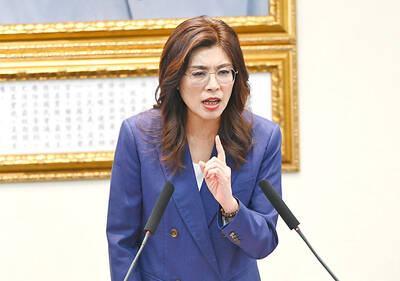
Chinese Nationalist Party (KMT) Chairwoman Cheng Li-wun (鄭麗文) yesterday briefed her party’s Central Standing Committee regarding her scheduled visit to the US between Monday next week and June 16, saying that her purpose would be to persuade the US that the Republic of China (ROC) Constitution was a “one China” constitution that would foster stable and peaceful cross-strait relations. The ROC Constitution is the most important defense for all Taiwanese citizens, as it upholds our democracy and has contributed to our robust economy, which aligns with international and US interests, she said. “We would not be troublemakers and drag the US under,”


 RSS
RSS