


A former senior official in US President Barack Obama’s administration yesterday downplayed arguments in favor of “abandoning Taipei” in Washington as he highlighted the importance of the US’ commitment to Taiwan’s security.
Taiwan’s security is important for multiple reasons, because “Taiwan should not be compelled to a status against the wishes of its people” and the use of force against Taiwan by China would have “profound negative impacts” in the region, Jeffrey Bader, former senior director for East Asian Affairs on the US National Security Council (NSC), said in a speech titled: “Obama’s Asia Policy” at an event held by the Taipei Forum Foundation in Taipei yesterday.
In response to a question from the audience for comment on “a school of thought” that suggested Washington should abandon Taipei in return for a better relationship with Beijing, Bader said he would call the idea of abandoning Taiwan like something from a “kids’ playground” rather than something learned at “school.”
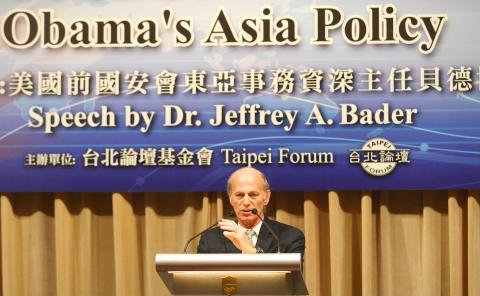
Photo: CNA
“There is a pretty strong consensus” in Washington “about the importance of Taiwan — democracy, stability and the peaceful resolution [of cross-strait differences],” said Bader, who added that his view significantly reflected those of his former colleges in the NSC and the US Department of State.
The question of abandoning Taiwan is “unthinkable,” he said.
Bader said Taiwan has demonstrated it is free and democratic.
“It would be completely contrary to US principles to accept the notion that free people be forced to accept a status that is not their choice,” he said.
It is embodied in US law and the US-China joint communiques that Washington help ensure a peaceful resolution of the Taiwan issue, Bader said.
“Peaceful resolution means no resolution can be imposed upon the people of Taiwan contrary to their wishes,” he said.
The arguments calling for the US to abandon Taiwan would also have profoundly negative impacts on the security of the region as it would “send a resounding signal” to Japan about the nature of China’s rise and about the balance of forces in the region, he said.
“We [the US] spent 67 years establishing our presence in the region with the goal of protecting stability, freedom and prosperity. You can’t simply remove a gigantic brick or cornerstone ... and expect security and stability will survive,” he said.
Bader said the notion of abandoning Taiwan was occasionally seen in newspaper articles “by people I have never heard of.”
“The nice thing in a free country is that anyone can say anything, and they usually do,” he said.
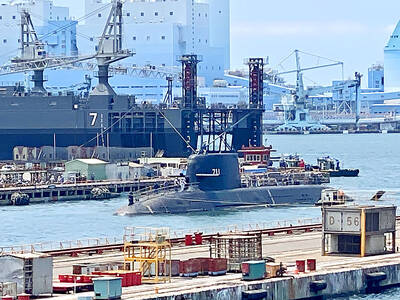
AGING: While Japan has 22 submarines, Taiwan only operates four, two of which were commissioned by the US in 1945 and 1946, and transferred to Taiwan in 1973 Taiwan would need at least 12 submarines to reach modern fleet capabilities, CSBC Corp, Taiwan chairman Chen Cheng-hung (陳政宏) said in an interview broadcast on Friday, citing a US assessment. CSBC is testing the nation’s first indigenous defense submarine, the Hai Kun (海鯤, Narwhal), which is scheduled to be delivered to the navy next month or in July. The Hai Kun has completed torpedo-firing tests and is scheduled to undergo overnight sea trials, Chen said on an SET TV military affairs program. Taiwan would require at least 12 submarines to establish a modern submarine force after assessing the nation’s operational environment and defense

A white king snake that frightened passengers and caused a stir on a Taipei MRT train on Friday evening has been claimed by its owner, who would be fined, Taipei Rapid Transit Corp (TRTC) said yesterday. A person on Threads posted that he thought he was lucky to find an empty row of seats on Friday after boarding a train on the Bannan (Blue) Line, only to spot a white snake with black stripes after sitting down. Startled, he jumped up, he wrote, describing the encounter as “terrifying.” “Taipei’s rat control plan: Release snakes on the metro,” one person wrote in reply, referring
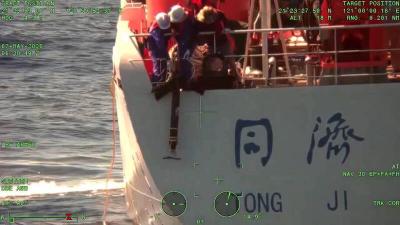
The coast guard today said that it had disrupted "illegal" operations by a Chinese research ship in waters close to the nation and driven it away, part of what Taipei sees a provocative pattern of China's stepped up maritime activities. The coast guard said that it on Thursday last week detected the Chinese ship Tongji (同濟號), which was commissioned only last year, 29 nautical miles (54km) southeast of the southern tip of Taiwan, although just outside restricted waters. The ship was observed lowering ropes into the water, suspected to be the deployment of scientific instruments for "illegal" survey operations, and the coast
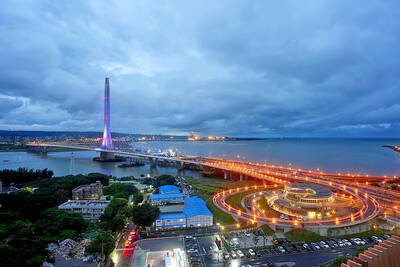
An inauguration ceremony was held yesterday for the Danjiang Bridge, the world’s longest single-mast asymmetric cable-stayed bridge, ahead of its official opening to traffic on Tuesday, marking a major milestone after nearly three decades of planning and construction. At the ceremony in New Taipei City attended by President William Lai (賴清德), Premier Cho Jung-tai (卓榮泰), Minister of Transportation and Communications Chen Shih-kai (陳世凱) and New Taipei City Mayor Hou Yu-ih (侯友宜), the bridge was hailed as both an engineering landmark and a long-awaited regional transport link connecting Tamsui (淡水) and Bali (八里)


 RSS
RSS