


A number of academics yesterday rebutted recent comments by former premier Hau Pei-tsun (郝柏村), who questioned the number of people killed in the 228 Incident in 1947 tragedy.
In a forum hosted by the Taiwan Association of University Professors, association president Chang Yen-hsien (張炎憲) said Hau’s suggestion that only about 500 people were killed was not based on historical facts.
The historian was referring to an op-ed piece published in the Chinese-language United Daily News on Tuesday in which Hau challenged the content of a history textbook which stated that more than 10,000 people were killed during the 228 Incident and said that in his view, about 500 people were killed during the crackdown.
The 228 Incident refers to the crackdown launched by the Chinese Nationalist Party (KMT) regime against civilian demonstrations in 1947, following an incident in Taipei on Feb. 27 of that year.
That tragic event also marked the beginning of the White Terror era that saw thousands of locals arrested, imprisoned and executed.
Although President Ma Ying-jeou (馬英九) said on Friday that “the focus is not on the number of the people that were killed ... The government mishandled the incident and of course it is responsible for the consequences,” Chang said that according to US cables leaked by WikiLeaks, Ma told US officials that he believed about 900 people were killed in the 228 Incident.
“Ma and his government only offer apologies once a year when it is time to hold the 228 Incident memorial ceremony, but his apologies are superficial,” Chang said.
Chen Yi-shen (陳儀深), an associate researcher at the Institute of Modern History at Academia Sinica, said the number of people who died during the 228 Incident could not be precisely calculated, but could be estimated on the basis of historical research. Most historical records showed more than 10,000 were killed in the massacre, with some academics claiming about 18,000 victims, Chen said.
“Hau thinks the 228 Incident is trivial and should not be -highlighted because he sees Taiwan as a part of China, and in Chinese modern history, a civil war or riot can easily claim the lives of 100,000 or 300,000 people, so [in comparison he views] the deaths of 10,000 victims as trivial,” Chang said.
“Denying the number who died comes from a fear to honestly examine history,” said Lee Hsiao-feng (李筱峰), a professor at the Graduate Institute of Taiwanese Culture at National Taipei University of Education.
Additional reporting by CNA

FUKUOKA SITUATION: Japanese media reported that the pathogen is expected to be identified by the summer, while the CDC downplayed the idea that it was hMPV A “mysterious cold-like illness” reported in Japan’s Fukuoka Prefecture does not seem to be a new disease, but Japanese authorities have been asked about the situation, the Centers for Disease Control (CDC) said yesterday. The Fukuoka Prefectural Medical Association on Wednesday told a news conference that a “mystery cold” that has become a hot topic on social media is “highly likely to be caused by some kind of viral infection,” Japan’s KBC News reported. “Many people are experiencing symptoms starting with a sore throat, followed by a runny nose, phlegm and a severe cough,” KBC News reported, citing association officials. Health authorities are

Nvidia Corp CEO Jensen Huang (黃仁勳) arrived in Taiwan yesterday ahead of upcoming AI and technology events, saying he plans to meet with clients and Taiwan Semiconductor Manufacturing Co Chairman C.C. Wei (魏哲家) during his visit. After landing at Taipei Songshan Airport, Huang posed for photos with fans and handed out Yakult drinks to reporters and supporters waiting at the scene, saying he has “a lot to do” during the trip. Asked about reports that Nvidia’s planned headquarters site in Taipei’s Beitou Shilin Technology Park could break ground on May 27, Huang said that if the company holds an event, he would

The Ministry of Finance this afternoon announced the winning numbers for the March-April uniform invoice lottery. The winning number for the NT$10 million (US$318,060) special prize is 19531471, and the winning number for the NT$2 million grand prize is 85941329. Three numbers were drawn for the NT$200,000 first prize: 07225810, 20231230 and 83518781. Those with receipts matching the last seven digits of any of the first-prize numbers will win the NT$40,000 second prize, while those matching the last six digits will win the NT$10,000 third prize. Those whose receipts match the last five digits of the first-prize numbers can claim the NT$4,000 fourth prize,
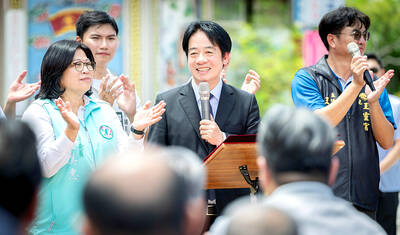
SIX SUBSIDIES: The monthly allowance for older farmers is to increase to NT$10,000, and NT$5,000 is to be given to homemakers under the national pension system, Lai said The government is to implement major welfare policies for disadvantaged groups, including raising the monthly allowance for older farmers to NT$10,000 and providing homemakers with NT$5,000 per month, President William Lai (賴清德) said yesterday. Lai made the remarks during a visit to Wangling Temple in Chiayi County, saying that the planned increases were being introduced amid economic growth and an increase in tax revenue. Touting a policy, in which the government plans to provide a monthly allowance of NT$5,000 for every child under the age of 18 in a bid to address Taiwan’s low birthrate, Lai said that if received for the


 RSS
RSS