


Texas Senator John Cornyn has opened direct negotiations with US Secretary of State Hillary Rodham Clinton over the release of a long-delayed report to the US Congress on the state of Taiwan’s air force.
The report is now 16 months overdue and Cornyn believes it would provide powerful evidence to support Taipei’s request to buy 66 F-16C/D aircraft.
While Clinton is not immediately involved with the Pentagon — where the report is being produced — she is one of the most influential figures within the administration of US President Barack Obama and wields enormous power.
She is talking with Cornyn on this issue — vital to Taiwan — because he is blocking a full US Senate vote on the nomination of William Burns, who is set to be the next deputy secretary of state and Clinton’s No. 2.
Cornyn, a senior Republican, is refusing to let the nomination go forward until the Obama administration approves the sale of the F-16s to Taiwan and releases the airpower report.
He reminded a Heritage Foundation conference on Wednesday that last year he introduced an amendment to the Defense Authorization Bill that required a Taiwan airpower report from the US Department of Defense 90 days after the bill became law, and now, 16 months later, the Department of Defense has still not produced the report.
“Of course, the report would state the capabilities of Taiwan’s air force as well as provide an analysis to the specific weapons systems that Taiwan needs in order to defend itself,” Cornyn said.
“Like I said, it’s 16 months overdue. I talked to Secretary Clinton yesterday because I had put a hold on a nominee, which is one of the rare points of leverage a senator has to try to get the attention of executive branch departments,” he said. “And she tells me that it’s now in the interagency review process and may take another three months or so before it’s completed.”
“We’re keeping the conversation going,” he said.
Clinton has enough clout within the administration to speed the report through the review process and get it released quickly.
Cornyn also reminded the audience of China experts that the White House had failed to accept Taiwan’s letter of request for the purchase of new F-16s.
“That’s not to say they have to actually sell them yet, but at least they should accept the letter of request,” Cornyn said.
He warned that the failure to produce the report — certain to show that Taiwan’s airforce is badly in need of a major boost — and the failure so far to sell the F-16s were both examples of how Beijing has in some ways “intimidated US defense policy and foreign policy because of concerns about irritating the Chinese.”
A source close to Cornyn told the Taipei Times the senator was prepared to keep the hold on Burns’ nomination for as long as it took to spur Clinton into action.
Not only is Cornyn a firm supporter of Taiwan, but if the -F-16C/D sale is approved, the contract will result in new jobs for his constituents in Texas.
Reports show the sale of the fighters and the release of the -report highlighting the growing military imbalance across the Taiwan Strait are being held up by Evan Medeiros, director for China, Taiwan and Mongolian Affairs at the National Security Council.
Medeiros is said to be the leading light among a group of presidential advisers who believe that an F-16 sale would badly impact US-China military exchanges.
He has argued in the past that the use of “rewards and sanctions” will lead China to “expand its commitments and comply with them.”
In this particular case, the logic appears to be that withholding the sale of advanced F-16s to Taiwan will be seen as a “reward” to Beijing and that China will respond by allowing US-China military exchanges to continue.
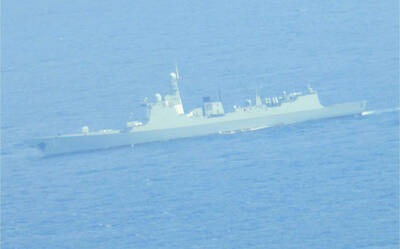
The military has spotted two Chinese warships operating in waters near Penghu County in the Taiwan Strait and sent its own naval and air forces to monitor the vessels, the Ministry of National Defense (MND) said. Beijing sends warships and warplanes into the waters and skies around Taiwan on an almost daily basis, drawing condemnation from Taipei. While the ministry offers daily updates on the locations of Chinese military aircraft, it only rarely gives details of where Chinese warships are operating, generally only when it detects aircraft carriers, as happened last week. A Chinese destroyer and a frigate entered waters to the southwest

The eastern extension of the Taipei MRT Red Line could begin operations as early as late June, the Taipei Department of Rapid Transit Systems said yesterday. Taipei Rapid Transit Corp said it is considering offering one month of free rides on the new section to mark its opening. Construction progress on the 1.4km extension, which is to run from the current terminal Xiangshan Station to a new eastern terminal, Guangci/Fengtian Temple Station, was 90.6 percent complete by the end of last month, the department said in a report to the Taipei City Council's Transportation Committee. While construction began in October 2016 with an
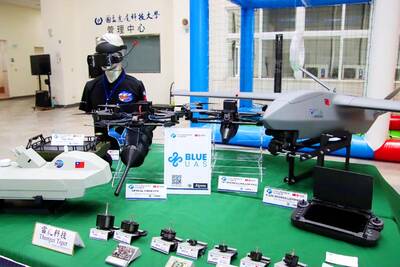
NON-RED SUPPLY: Boosting the nation’s drone industry is becoming increasingly urgent as China’s UAV dominance could become an issue in a crisis, an analyst said Taiwan’s drone exports to Europe grew 41.7-fold from 2024 to last year, with demand from Ukraine’s fight against Russian aggression the most likely driver of growth, a study showed. The Institute for Democracy, Society and Emerging Technology (DSET) in a statement on Wednesday said it found that many of Taiwan’s uncrewed aerial vehicle (UAV) sales were from Poland and the Czech Republic. These countries likely transferred the drones to Ukraine to aid it in its fight against the Russian invasion that started in 2022, it said. Despite the gains, Taiwan is not the dominant drone exporter to these markets, ranking second and fourth
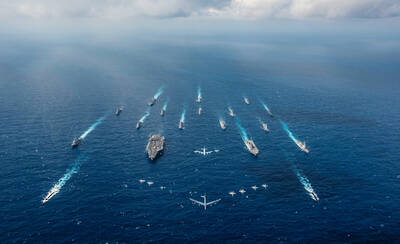
Japanese Prime Minister Sanae Takaichi’s comment last year on Tokyo’s potential reaction to a Taiwan-China conflict has forced Beijing to rewrite its invasion plans, a retired Japanese general said. Takaichi told the Diet on Nov. 7 last year that a Chinese naval blockade or military attack on Taiwan could constitute a “survival-threatening situation” for Japan, potentially allowing Tokyo to exercise its right to collective self-defense. Former Japan Ground Self-Defense Force general Kiyofumi Ogawa said in a recent speech that the remark has been interpreted as meaning Japan could intervene in the early stages of a Taiwan Strait conflict, undermining China’s previous assumptions


 RSS
RSS