


A Democratic Progressive Party (DPP) lawmaker said yesterday a new government food safety certification regime should be created to replace the two principal systems that failed to prevent the widespread use of potentially harmful chemicals in food products.
Amid a tainted food scandal that continues to dominate headlines, DPP Legislator Hsu Tain-tsair (許添財) said many customers had lost confidence in the state’s ability to eliminate the use of banned chemicals in everyday products, foods and beverages, undermining the image of Taiwanese goods at home and abroad.
A new government certification, created especially to address such “loopholes” in the inspection process and add to the existing checks from the Certified Agricultural Standards (CAS) and Good Manufacturing Practice (GMP) labels, would aim to allay such public concerns, Hsu said.
“Standing on the side of user-friendliness, the new certification would make the government hold responsibility for consumer safety. Not only would it aim to manage the source of the products, it would also monitor the entire [manufacturing] process,” he said.
The current certification regimes — the CAS and GMP labels — were created by the Ministry of Economic Affairs and the Council of Agriculture and are administered by industry groups.
Hsu said that direct public accountability, with government officials placed directly in charge of the new certification, was needed.
“If officials aren’t made responsible, then it means there is effectively no control,” Hsu said.
As it stands, when manufacturers don’t abide by health and safety practices, “they receive a fine, but there’s no real fear,” he said.
The proposed certification, which Hsu said he planned to introduce in the legislature, would serve as a form of safety guarantee, he said.
DPP lawmakers have already suggested they would back the proposal.
A statement given by the party yesterday said it would ask the government to consolidate the various food safety labels into a uniform platform “to better ensure public safety.”
A recent poll suggested almost seven in 10 members of the public said that they have lost confidence in the GMP label, citing the failure to discover the use of the chemical DEHP in clouding agents in sports drinks, juices, tea drinks, fruit syrup and tablets and powders.
DEHP, a category four substance, was also used to make flavorings and food coloring agents. Prolonged exposure has been linked to the stunted development of sex organs in males, hormone disruption and fertility problems.
The survey by the DPP showed that 67.9 percent of the public believed they or their families have at some point ingested goods containing the chemical.

UPGRADE: The Kang Ding-class frigate is replacing its Chaparall missiles with Tien Chien II and Hua Yang VLS, which would provide it with long-range, 360° air defense Taiwan plans to produce 1,200 to 1,376 Hai Chien II missiles (海劍二, Sea Sword II) — also known as TC-2N — to serve as the standard air defense system of the navy’s surface combatant fleet, a source said yesterday. Last week, the Hai Chien II, the naval version of the Tien Kung II missile (天劍二, Sky Sword II), completed a live-fire test in waters off the National Chungshan Institute of Science and Technology’s Jiupeng facility (九鵬) in Pingtung County’s Manjhou Township (滿州). The MIM72 Chaparral and other dated air defense missiles that currently arm Taiwanese ships have inadequate range to combat Chinese

REASONS FOR TRAVEL: An assistant professor said that proposed amendments to penalize drivers if they used drugs overseas would not deter people from traveling People who operate a motor vehicle under the influence of marijuana would have their driver’s license revoked, even if they used the substance while overseas, the Ministry of Transportation and Communications said yesterday, citing proposed amendments to the Road Traffic Management and Penalty Act (道路交通管理處罰條例). The amendments would also authorize the government to revoke the licenses of people determined to have used Category 1 or Category 2 narcotics, even if they were not operating a vehicle while under the influence of drugs, as well as ban them from taking the license test for three years, the ministry said. People aged 18 or

Shih Hsin University President Chen Ching-he (陳清河) yesterday issued a public apology for comments made in his commencement speech last week, stating that he has asked the school to suspend his duties and halt his wages for two months as a show of contrition. At the commencement ceremony on May 30, Chen said, “If you don’t manage your time well, or your own emotions, or your health, then I am telling every one of you — put a quick end to ‘you,’ because the world has no need for ‘you.’” The comments have sparked significant controversy online, and Chen through an open
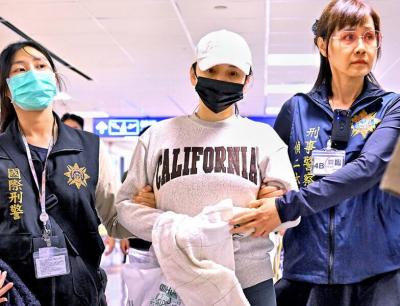
Johanne Liou (劉喬安), a Taiwanese woman who shot to unwanted fame during the Sunflower movement protests in 2014, returned to Taiwan last night after being deported from the US. She is to stand trial in Taiwan for charges involving embezzlement, fraud and drug crimes. The Criminal Investigation Bureau (CIB) said it took her into custody at Taiwan Taoyuan International Airport and would first question her before transferring her to the New Taipei District Prosecutors’ Office. She was arrested upon disembarking a flight from San Francisco that landed shortly before 7pm. Liou absconded to the US in 2019 after jumping bail


 RSS
RSS