


Clashes broke out between Tibet support groups and Grand Hotel staff in the lobby yesterday after the management canceled a room reservation made by the groups in preparation for the arrival of a delegation headed by Sichuan Province Governor Jiang Jufeng (蔣巨峰).
“We have signed a [room rental] contract with you and it was clearly written on the contract that the room would be used to hold a press conference. How can you cancel our reservation at the last minute? Is this how the Grand Hotel honors its business contracts?” Taiwan Friends of Tibet (TFOT) president Chow Mei-li (周美里) asked Grand Hotel manager Michael Chen (陳行中) after being informed of the cancelation.
TFOT’s press conference was to be held 30 minutes before the news conference by Jiang.
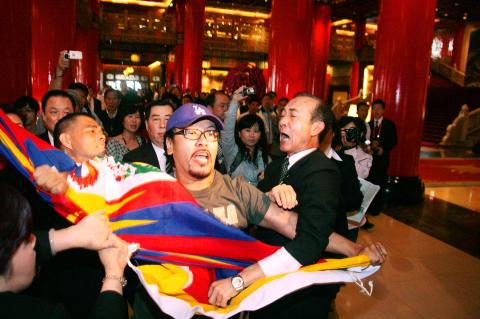
Photo: Loa Iok-sin, Taipei Times
PURPOSE
Chen said the reservation was canceled because the group rented the room “for certain purposes” that could “have an impact” on the hotel.
“Of course we came here for a purpose, who would reserve a hotel room without a purpose?” Chow said. “It’s written clearly on the contract that our purpose is to hold a press conference here.”
TFOT was to hold a press conference on the second floor of the hotel, as a symposium on business investment and tourism in Sichuan Province was to take place simultaneously on the 12th floor.
More serious verbal and physical conflict broke out when Tibetans accompanying Chow grew impatient and took out banners and Tibetan flags that were to be used to decorate the news conference venue. They shouted slogans calling on Jiang to release the more than 300 monks arrested from Kirti Monastery in the predominantly Tibetan area of Ngaba in Sichuan Province and to withdraw troops and police that had placed the monastery under siege.
The manager and other members of the hotel management tried to take the signs and banners from the Tibetans by force.
The two sides pushed and shoved, while hotel management and staffers chased Tibetans running around the lobby with Tibetan flags in hand.
Political commentator Paul Lin (林保華), head of the Taiwan Youth Anti-Communist Corps who had been invited to talk at the press conference, fainted after his blood pressure spiked.
POLICE INTERVENTION
The conflict ended when police arrived at the scene to break up the fight and helped negotiate terms for another room for TFOT and other supporting groups.
In the delayed news conference, Lin said that Jiang had served as Sichuan governor since 2007 and “should be held responsible for the arrests and bloody crackdowns of Tibetans in the province, as well as corruption and scandals related to the handling of donations” for the massive earthquake that devastated the province in May 2008.
Victims of Investment in China Association president William Kao (高為邦) warned entrepreneurs thinking of investing in Sichuan that it was not only one of the provinces in China with the worst human rights records, but also one with numerous cases of officials cheating Taiwanese investors.
CRACKDOWN
Toward the end of the conference, a video showing images of Tibetans who died during bloody crackdowns by Chinese security officials was shown.
In tears after watching the video, Chow urged the public to express their concern over human rights abuses in Sichuan in whichever way possible.
“You don’t have to be a Buddhist, a Tibetan, or Taiwanese,” Chow said. “You can be anyone, but as a person, you should give your full support to the Tibetans suffering there.”
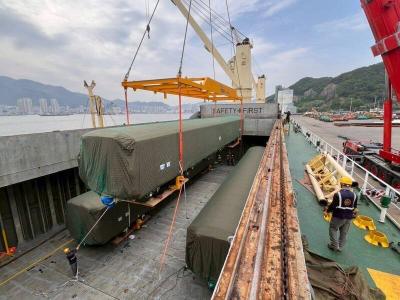
The first of 10 new high-capacity trains purchased from South Korea’s Hyundai Rotem arrived at the Port of Taipei yesterday to meet the demands of an expanding metro network, Taipei Rapid Transit Corp (TRTC) said yesterday. The train completed a three-day, 1,200km voyage from the Port of Masan in South Korea, the company said. Costing NT$590 million (US$18.79 million) each, the new six-carriage trains feature a redesigned interior based on "human-centric" transportation concepts, TRTC said. The design utilizes continuous longitudinal seating to widen the aisles and optimize passenger flow, while also upgrading passenger information displays and driving control systems for a more comfortable
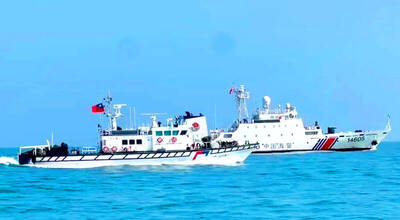
Instead of focusing solely on the threat of a full-scale military invasion, the US and its allies must prepare for a potential Chinese “quarantine” of Taiwan enforced through customs inspections, Stanford University Hoover fellow Eyck Freymann said in a Foreign Affairs article published on Wednesday. China could use various “gray zone” tactics in “reconfiguring the regional and ultimately the global economic order without a war,” said Freymann, who is also a nonresident research fellow at the US Naval War College. China might seize control of Taiwan’s links to the outside world by requiring all flights and ships entering or leaving Taiwan
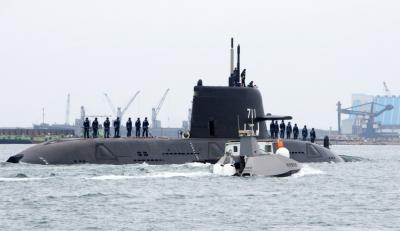
Taiwan's first indigenous defense submarine, the SS-711 Hai Kun (海鯤, or Narwhal), departed for its 13th sea trial at 7am today, marking its seventh submerged test, with delivery to the navy scheduled for July. The outing also marked its first sea deployment since President William Lai (賴清德) boarded the submarine for an inspection on March 19, drawing a crowd of military enthusiasts who gathered to show support. The submarine this morning departed port accompanied by CSBC Corp’s Endeavor Manta (奮進魔鬼魚號) uncrewed surface vessel and a navy M109 assault boat. Amid public interest in key milestones such as torpedo-launching operations and overnight submerged trials,
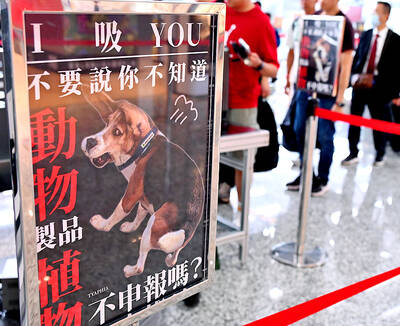
Quarantine awareness posters at Taiwan Taoyuan International Airport have gone viral for their use of wordplay. Issued by the airport branch of the Animal and Plant Health Inspection Agency, the posters feature sniffer dogs making a range of facial expressions, paired with advisory messages built around homophones. “We update the messages for holidays and campaign needs, periodically refreshing materials to attract people’s attention,” quarantine officials said. “The aim is to use the dogs’ appeal to draw focus to quarantine regulations.” A Japanese traveler visiting Taiwan has posted a photo on X of a poster showing a quarantine dog with a


 RSS
RSS