


Activists from both sides of the Taiwan Strait who advocate the defense of the disputed Diaoyutai islands (釣魚台) yesterday scaled down their plan to sail to the islets to claim sovereignty after seven people from Hong Kong and Macau backed off.
The seven dropped out after the National Immigration Agency told them joining the protest was inconsistent with the purpose for which their entry permits were issued and it would result in the revocation of their permits and a “denial of entry to Taiwan in future.”
Taipei County Councilor King Chieh-shou (金介壽), who together with the activists called on the governments on both sides of the strait to take a “stronger stance” against Japan on Saturday, also dropped out, citing difficulty renting boats because of government intervention.
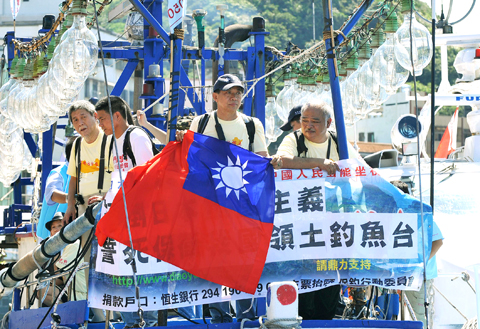
PHOTO: PATRICK LIN, AFP
“It was really difficult to rent a boat. Not only was it expensive — at a cost of NT$300,000 to NT$500,000 — the government also threatened the boat owners and said it would revoke their license if they rented us their boats,” King said.
Despite the withdrawals, two Taiwanese activists stuck with the plan and set sail yesterday.
Chung Hwa Baodiao Alliance executive director Huang Hsi-lin (黃錫麟) and alliance member Yin Pi-hsiung (殷必雄) set sail on a 10-tonne fishing boat with a captain and two crewmembers from Yeliou Harbor (野柳), Taipei County, at 3:55pm.
A Coast Guard Administration (CGA) patrol ship followed in their wake.
Coast Guard official Shih Yi-che (施義哲) said the patrol would escort the fishing boat throughout the trip to “ensure their safety.”
The Japan Interchange Foundation, Tokyo’s semiofficial mission in Taipei, lodged a protest with the Ministry of Forrign Affairs after the vessel was allowed to leave port, calling the move ‘’extremely regrettable,” adding that it could have an adverse effect on relations between Taiwan and Japan.
The fishing boat is expected to approach the Diaoyutais early this morning.
“We want to show our support for the [Chinese] mainland ship seized by Japan and to fight for the rights of Taiwanese fishermen in the area,” Huang said.
The Diaoyutais, which are surrounded by rich fishing grounds and potential natural gas deposits, are located 193km east of Taiwan. They are administered by Japan, but Taiwan and China also claim sovereignty over them.
Led by Chen Miau Tak (陳妙德), chairman of the Hong Kong Diaoyutai Islets Protection Task Force, the group of seven from Hong Kong and Macau arrived in Taiwan on Friday following the arrest of a captain of a Chinese fishing boat by the Japanese coast guard after a collision with a patrol boat in the disputed area.
The incident coincided with Japan’s seizure of two Taiwanese boats for allegedly fishing illegally in the disputed area. Both were later released after paying a fine.
Later yesterday, the Ministry of Foreign Affairs issued a press statement reaffirming the government’s position on the Diaoyutais, saying they are part of the country’s “inherent territory” and fall within its “sovereign jurisdiction.”
Saying the protest was “spontaneously initiated by civil associations,” the ministry said it had asked the Japanese government not to interfere with the trip and to keep everything in perspective to uphold the mutual interests and long-term friendship of the two countries.

NATIONAL SECURITY: Authorities are working to confirm the identities of the military personnel involved and investigating possible illegal conduct and regulatory violations Authorities are probing possible national security implications after Kinmen police and immigration officers on Sunday found a Chinese woman allegedly posing as a tourist while engaging in prostitution involving more than 10 military personnel. The woman, surnamed Chen (陳), has since been deported, authorities said, adding that investigators are still working to confirm the identities of those implicated, as the records only listed code names and aliases. The case stemmed from a report received by the Kinmen District Prosecutors’ Office on Friday last week from the Jinhu Precinct of the Kinmen County Police Bureau. On Sunday, police, along with the National Immigration

GLOBALGIVING: ‘ Caving to external pressure is not acceptable for an organization that has cultivated justice reform and human rights for 30 years,’ one NGO said A slew of non-government organizations (NGOs) have withdrawn from the GlobalGiving fundraising platform after it announced it would use “Chinese Taipei” instead of “Taiwan” from next month. The Taiwan Good Rice Association wrote on Facebook on Friday that it was informed on April 28 via a teleconference call of the change, which was made because the platform wanted to operate in China. Taiwan Good Rice is to terminate all cooperative relationships with GlobalGiving in response to the platform’s “unilateral and non-negotiable” decision to remove references to Taiwan, the NGO said. “Taiwan is in the official name of Taiwan Good Rice Association and the

HEAVY WEATHER: Typhoon Jangmi is due to crash straight into the Ryukyus as airlines look to shift flights to larger aircraft or cancel flights to Okinawa entirely Taiwan’s international air carriers announced flight adjustments over the weekend as Typhoon Jangmi is forecast to hit the Ryukyu Islands today and tomorrow. The Central Weather Administration (CWA) upgraded Jangmi from a tropical storm to a typhoon at 8am yesterday, with the eye located 580km south of Naha city. It was moving north at 19kph. Today, China Airlines’ CI-120, CI-121, CI-122 and CI-123 flights between Taoyuan and Naha, Okinawa, have been canceled as well as CI-132 and CI-133 between Kaohsiung and Naha. EVA Air’s BR-112, BR-113, BR-186 and BR-185 flights between Taoyuan and Naha are also canceled. Low-cost carrier Tigerair Taiwan canceled IT-230,

Chinese Nationalist Party (KMT) Chairwoman Cheng Li-wun (鄭麗文) yesterday briefed her party’s Central Standing Committee regarding her scheduled visit to the US between Monday next week and June 16, saying that her purpose would be to persuade the US that the Republic of China (ROC) Constitution was a “one China” constitution that would foster stable and peaceful cross-strait relations. The ROC Constitution is the most important defense for all Taiwanese citizens, as it upholds our democracy and has contributed to our robust economy, which aligns with international and US interests, she said. “We would not be troublemakers and drag the US under,”


 RSS
RSS