


Democratic Progressive Party (DPP) legislators yesterday strongly denied allegations by former National Security Council (NSC) secretary-general Su Chi (蘇起) that former president Chen Shui-bian (陳水扁) had formed a secret committee to explore the feasibility of developing nuclear weapons after a new book by a US go-between brought the nuclear controversy back into the spotlight.
DPP Legislator Kuan Bi-ling (管碧玲) accused Su at a press conference of lying and the party has demanded an investigation into the matter.
“This is a joke,” Kuan said, calling the allegations another lie by Su, who in 2006 admitted that he had created the co-called “1992 consensus” between Taiwan and China.
Kuan called on President Ma Ying-jeou’s (馬英九) administration to launch a special committee to investigate the nuclear allegations and the “1992 consensus.”
The Chinese-language United Daily News yesterday quoted Su as confirming the content of a book authored by US academic on cross-strait affairs Jeremy Stone.
In the second half of his memoir Catalytic Diplomacy: Russia, China, North Korea and Iran, Stone writes that he was first alarmed by an Aug. 13, 2004, editorial in the Taipei Times that speculated on the need for Taiwan to acquire or develop nuclear weapons as a deterrent against Chinese aggression.
Stone said he learned from a source that the DPP administration had set up a committee under then-NSC secretary-general Chiou I-jen (邱義仁) to explore the feasibility of a nuclear weapons program.
Stone said the source told him the move was intended as a bargaining chip and a “greater security guarantee” from Beijing and Washington.
The diplomat said he launched an investigation into the matter and informed the US of the potential dangers involved with Taipei’s alleged move.
One of Stone’s sources, which he characterized as having “impeccable standing,” told Stone that he had been told by a former senior Taiwanese military official that Taiwan “still has a military project going on in the nuclear area.”
“The speculation is probably true,” United Daily News quoted Su as saying, adding that he had received similar information from a DPP friend in 2007, when he was a legislator.
Su said an important DPP official who is still active in the political scene in southern Taiwan had discussed the matter with his source after being apprised by Chen in person of the nuclear plan.
Su asked then-premier Chang Chun-hsiung (張俊雄) and then-minister of national defense Lee Tien-yu (李天羽) about the allegations in the legislature on Oct. 19, 2007, but the pair dismissed the information, while the former president refuted the accusation the next day, saying the DPP administration would never develop nuclear weapons.
Asked for comment yesterday, KMT Legislator Lin Yu-fang (林郁方), a four-term legislator on the Foreign and National Defense Committee, dismissed the possibility of Taiwan ever developing nuclear weapons.
“I’ve never heard of it,” Lin said, adding that even if the DPP administration had explored that possibility, “they might have awakened from the dream really soon and realized that they could not see things through.”
“It would be impossible to develop nuclear weapons behind Washington’s back,” Lin said.

Taiwan has received more than US$70 million in royalties as of the end of last year from developing the F-16V jet as countries worldwide purchase or upgrade to this popular model, government and military officials said on Saturday. Taiwan funded the development of the F-16V jet and ended up the sole investor as other countries withdrew from the program. Now the F-16V is increasingly popular and countries must pay Taiwan a percentage in royalties when they purchase new F-16V aircraft or upgrade older F-16 models. The next five years are expected to be the peak for these royalties, with Taiwan potentially earning
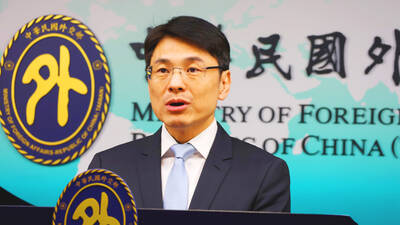
STAY IN YOUR LANE: As the US and Israel attack Iran, the ministry has warned China not to overstep by including Taiwanese citizens in its evacuation orders The Ministry of Foreign Affairs (MOFA) yesterday rebuked a statement by China’s embassy in Israel that it would evacuate Taiwanese holders of Chinese travel documents from Israel amid the latter’s escalating conflict with Iran. Tensions have risen across the Middle East in the wake of US and Israeli airstrikes on Iran beginning Saturday. China subsequently issued an evacuation notice for its citizens. In a news release, the Chinese embassy in Israel said holders of “Taiwan compatriot permits (台胞證)” issued to Taiwanese nationals by Chinese authorities for travel to China — could register for evacuation to Egypt. In Taipei, the ministry yesterday said Taiwan
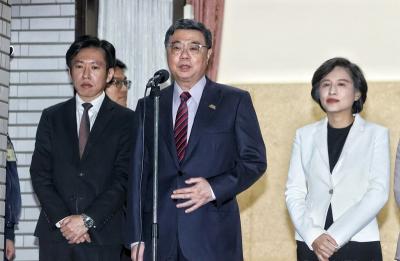
Taiwan is awaiting official notification from the US regarding the status of the Agreement on Reciprocal Trade (ART) after the US Supreme Court ruled US President Donald Trump's global tariffs unconstitutional. Speaking to reporters before a legislative hearing today, Premier Cho Jung-tai (卓榮泰) said that Taiwan's negotiation team remains focused on ensuring that the bilateral trade deal remains intact despite the legal challenge to Trump's tariff policy. "The US has pledged to notify its trade partners once the subsequent administrative and legal processes are finalized, and that certainly includes Taiwan," Cho said when asked about opposition parties’ doubts that the ART was
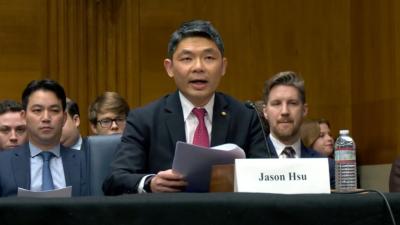
If China chose to invade Taiwan tomorrow, it would only have to sever three undersea fiber-optic cable clusters to cause a data blackout, Jason Hsu (許毓仁), a senior fellow at the Hudson Institute and former Chinese Nationalist Party (KMT) legislator, told a US security panel yesterday. In a Taiwan contingency, cable disruption would be one of the earliest preinvasion actions and the signal that escalation had begun, he said, adding that Taiwan’s current cable repair capabilities are insufficient. The US-China Economic and Security Review Commission (USCC) yesterday held a hearing on US-China Competition Under the Sea, with Hsu speaking on


 RSS
RSS