


After 50,000 people signed up to purchase 200 hectares of coastal wetlands in Changhua County in an attempt to block the construction of a petrochemical plant in the area, environmentalists yesterday announced the beginning of the second phase of the project — to purchase another 800 hectares.
The group also urged the government not to scupper the campaign through administrative measures.
“More than 50,000 people — from across the country, including the offshore islands — have agreed to purchase a total of 200 hectares of wetlands along the Changhua coast. Now it’s time for us to start the second phase of the project,” Taiwan Environmental Protection Union Changhua Division chairman Tsai Chia-yang (蔡嘉陽) said. “This time, we will look to purchase another 800 hectares of wetlands in the area.”
Tsai said that the original 200 hectares are in a coastal strip along which the critically endangered pink dolphin lives. The 800 hectares to be purchased in the second phase of the campaign are an essential habitat for some bird species, he said.
Although coastal wetlands in Changhua County’s Dacheng Township (大城), to the north of the mouth of Jhuoshuei River (濁水溪), are an important habitat for many endangered fish and bird species, Kuokuang Petrochemical Technology Co plans to build oil refineries in the area.
Worried about the ecological damage and pollution that such a plan would bring, environmentalists and locals have launched the ambitious project to raise money for an environmental trust fund to purchase the land that Kuokuang wants to use to build refineries.
Each share — 1m² of land — will cost only NT$119.
Though more than 50,000 people have expressed interest, the Ministry of the Interior has yet to approve the application for the creation of the environmental trust fund.
Deputy Minister of the Interior Lin Tsyr-ling (林慈玲) said environmental groups had not yet registered to enable themselves to create a trust fund and that the groups had not received consent from the National Property Administration to buy the land.
Tsai said the groups were still in the process of registering to create a trust fund, but added that he did not agree that the consent of the National Property Administration is needed before the ministry could review their case.
“The ministry says it’s the agency in charge of approving trust funds, but then it says it won’t do anything with our application before receiving consent from the National Property Administration. That’s giving the power to decide to the National Property Administration,” Tsai said.
“If the government thinks 50,000 people is not enough, we will go for 500,000 in the second phase to see if they would dare try to scupper the plan through administrative measures,” he said.
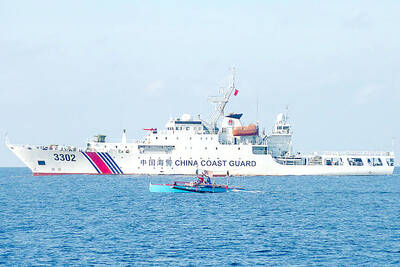
EXPANSIONIST: China deploys an average of 40 to 50 warships and coast guard vessels daily in the South China Sea, despite pledges not to militarize the region, an official said China is attempting to expand its influence across the First Island Chain and increase pressure on Japan by sending coast guard vessels into waters off of Taiwan under the pretext of maritime negotiations with Japan and the Philippines, a national security official said yesterday. China’s recent actions in the waters east of Taiwan and Japan and the Philippines’ exclusive economic zones (EEZ) are attempts to establish dominance in First Island Chain waters, said the official who declined to be named, adding that this is “expansion disguised as law enforcement.” Framing China’s actions solely as a cross-strait issue is a serious misjudgment that
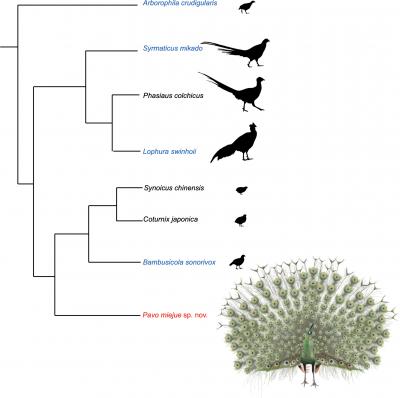
Through analyzing fossil evidence, a research team at National Taiwan University (NTU) discovered the largest endemic bird to have lived in Taiwan, naming it Pavo miejue, or extinct peafowl (滅絕孔雀). The Mikado pheasant, which is printed on the back of the NT$1,000 bank note, was previously believed to be the biggest endemic bird to Taiwan. The research team’s findings suggest that Pavo miejue lived during the Pleistocene epoch tens of thousands of years ago. It is the first endemic extinct bird species discovered and formally named in Taiwan. The study was coauthored by NTU Institute of Ecology and Evolutionary Biology professor Tsai Cheng-hsiu (蔡政修),
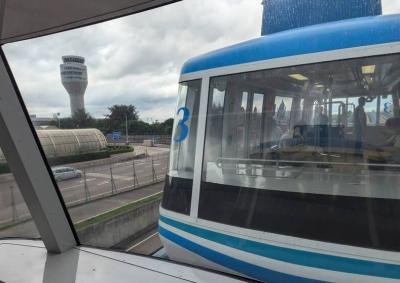
Taiwan Taoyuan International Airport is to suspend its automated Skytrain service connecting Terminal 1 and Terminal 2 starting on July 1 to facilitate connection works for the upcoming Terminal 3, the airport operator said today. Passengers and staff who need to travel between the two terminals after the suspension can instead use the Taoyuan MRT or the airport's 24-hour shuttle bus service, Taoyuan International Airport Corp said. The Taoyuan MRT Airport Line directly links the two terminals, while the shuttle buses are to operate around the clock, the company added. The Skytrain provides free transportation between the airport’s two terminals for travelers and
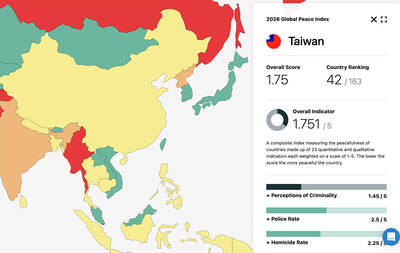
Taiwan ranked 42nd in terms of peacefulness among 163 countries, down five places from last year, according to this year’s Global Peace Index. With an overall score of 1.751, Taiwan dropped from 37th last year, the report published by the global Institute for Economics and Peace showed. The overall score measures a country’s level of peacefulness using 23 quantitative and qualitative indicators across three domains — ongoing domestic and international conflict, societal safety and security, and militarization. While Taiwan ranked 42nd worldwide, it was listed in ninth place among the 19 Asian-Pacific countries in the report, after New Zealand, Singapore, Japan, Malaysia,


 RSS
RSS