


The Legislative Yuan yesterday decided not to review a bill on the introduction of a second-generation National Health Insurance (NHI) program until next week.
Chinese Nationalist Party (KMT) Legislator Lin Yi-shih (林益世), who is also director-general of the party’s Policy Committee, said the legislature took a break yesterday because it had been busy for the previous four days.
The Legislative Yuan is currently holding a two-week provisional session, which began on Tuesday and runs until Aug. 30, to deal with a number of priority bills. Items that cleared the legislative floor earlier in the week include the cross-strait Economic Cooperation Framework Agreement (ECFA) and several bills regarding the admission of Chinese students to Taiwan’s universities and colleges.
The proposed amendment to the National Health Insurance Act (全民健康保險法) is the only item on Thursday’s agenda not to have been reviewed.
The bill mainly involves a new scheme for calculating premiums based on total household income, rather than the existing system, which considers an individual’s salary and wage. The change is considered essential to saving the cash-strapped program.
However, lawmakers were not optimistic about the bill’s passage during the special session because of the many controversies involved.
Democratic Progressive Party (DPP) Legislator Huang Sue-ying (黃淑英) said the legislature should not hurry the bill through given that there are 26 clauses in the bill that are highly disputable.
KMT Legislator Yang Li-huan (楊麗環) said resolving the NHI system’s structural problems is more important than changing the premium calculation method.
One urgent issue is how to curb excessive medical procedures, which generate lucrative profits for medical institutions and lead to expanding NHI expenditure, Yang said.
She also urged the Department of Health to calculate the cost of keeping the insurance system operating.
KMT caucus whip Lin Hung-chih (林鴻池) said that if the bill fails to clear the legislature in the provisional session, he hopes it can be listed as a priority item for the next regular legislative session due to begin next month.

The military has spotted two Chinese warships operating in waters near Penghu County in the Taiwan Strait and sent its own naval and air forces to monitor the vessels, the Ministry of National Defense (MND) said. Beijing sends warships and warplanes into the waters and skies around Taiwan on an almost daily basis, drawing condemnation from Taipei. While the ministry offers daily updates on the locations of Chinese military aircraft, it only rarely gives details of where Chinese warships are operating, generally only when it detects aircraft carriers, as happened last week. A Chinese destroyer and a frigate entered waters to the southwest
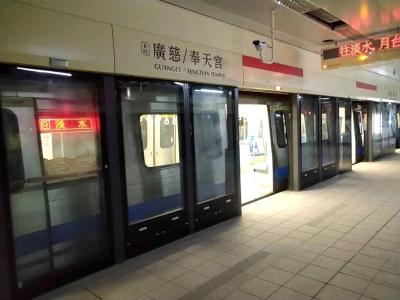
The eastern extension of the Taipei MRT Red Line could begin operations as early as late June, the Taipei Department of Rapid Transit Systems said yesterday. Taipei Rapid Transit Corp said it is considering offering one month of free rides on the new section to mark its opening. Construction progress on the 1.4km extension, which is to run from the current terminal Xiangshan Station to a new eastern terminal, Guangci/Fengtian Temple Station, was 90.6 percent complete by the end of last month, the department said in a report to the Taipei City Council's Transportation Committee. While construction began in October 2016 with an
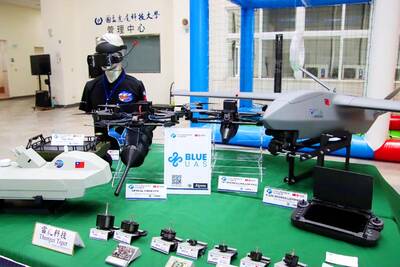
NON-RED SUPPLY: Boosting the nation’s drone industry is becoming increasingly urgent as China’s UAV dominance could become an issue in a crisis, an analyst said Taiwan’s drone exports to Europe grew 41.7-fold from 2024 to last year, with demand from Ukraine’s fight against Russian aggression the most likely driver of growth, a study showed. The Institute for Democracy, Society and Emerging Technology (DSET) in a statement on Wednesday said it found that many of Taiwan’s uncrewed aerial vehicle (UAV) sales were from Poland and the Czech Republic. These countries likely transferred the drones to Ukraine to aid it in its fight against the Russian invasion that started in 2022, it said. Despite the gains, Taiwan is not the dominant drone exporter to these markets, ranking second and fourth

Japanese Prime Minister Sanae Takaichi’s comment last year on Tokyo’s potential reaction to a Taiwan-China conflict has forced Beijing to rewrite its invasion plans, a retired Japanese general said. Takaichi told the Diet on Nov. 7 last year that a Chinese naval blockade or military attack on Taiwan could constitute a “survival-threatening situation” for Japan, potentially allowing Tokyo to exercise its right to collective self-defense. Former Japan Ground Self-Defense Force general Kiyofumi Ogawa said in a recent speech that the remark has been interpreted as meaning Japan could intervene in the early stages of a Taiwan Strait conflict, undermining China’s previous assumptions


 RSS
RSS