


The last time Su Chien-yi’s (蘇建益) pregnant wife saw her newlywed husband was on the morning of Aug. 9 last year. Despite a typhoon warning, heavy rains and washed out roads, he had been called in to the office for overtime work.
He never made it home. Su was one of 10 victims on Shuangyuan Bridge (雙園大橋) when it collapsed into the Gaoping River (高屏溪) that afternoon after raging waters washed away its support columns.
There was no warning about the bridge’s imminent collapse, nor was any attempt made to seal off the bridge that connected Kaohsiung and Pingtung counties, despite the record rainfall upstream brought by Typhoon Morakot.
One year later, Su Lee Yu-mei (蘇李玉美) is demanding answers from the government on whether her son’s family is entitled to national compensation. Despite months of consultations, the government has yet to make a decision.
Under the State Compensation Act (國家賠償法), the government is liable for any damage caused by a defect in public facilities, including roads and bridges, or public officials’ negligence.
Chou Chun-mi (周春米), a lawyer representing the victims’ families, said both these factors were evident when the 2.9km bridge collapsed.
“It’s a fact that the bridge washed away and because the victims were found to have died as a result, the government should be liable for compensation,” she said.
However, the Ministry of Transportation and Communications (MOTC) has given conflicting signals on the issue over the past six months. First, it rejected the claim in February, saying the act did not apply in the case of a natural disaster. In May, it asked the families to reopen the case.
A senior Directorate-General of Highways official said there was a policy change after the government decided to compensate the families of four people killed when a landslide buried a section of National Freeway No. 3 in Taipei County in April.
“What we realized was that the motorists are innocent when incidents like this occur,” said Mile Chen (陳茂南), chief secretary at the directorate. “We decided to take another look at their claims as a result.”
Nevertheless, claimants like Su Lee say they are getting tired of waiting while the government decides what should have been apparent from the start: That people drowned because the government was unprepared.
“If President Ma Ying-jeou (馬英九) or Minister of Transportation and Communications Mao Chi-kuo’s (毛治國) children had died that day, would the government still be adopting this attitude?” she asked at a press conference held by Democratic Progressive Party Legislator Pan Men-an (潘孟安) yesterday.
Pan said it was incomprehensible that it took the ministry less than a month to decide to compensate the landslide victims’ families, but the Shuangyuan families have been waiting for almost a year.
Representatives of the 22 other people who lost family members in the incident said they were angry with the lack of communication on the progress of the case since May.
“Don’t they feel disgraced or ashamed that we have to hold two press conferences [to ask for information]?” said Lin Liang-lin (林良璘), who lost his brother. “It’s been three months [without] a word.”
The directorate promised to give a decision by Aug. 20, but in the meantime, it said it would hold talks with Chou.
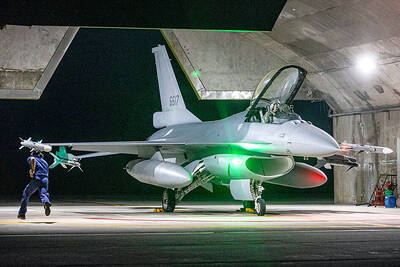
Taiwan has received more than US$70 million in royalties as of the end of last year from developing the F-16V jet as countries worldwide purchase or upgrade to this popular model, government and military officials said on Saturday. Taiwan funded the development of the F-16V jet and ended up the sole investor as other countries withdrew from the program. Now the F-16V is increasingly popular and countries must pay Taiwan a percentage in royalties when they purchase new F-16V aircraft or upgrade older F-16 models. The next five years are expected to be the peak for these royalties, with Taiwan potentially earning
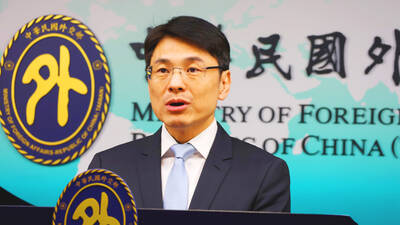
STAY IN YOUR LANE: As the US and Israel attack Iran, the ministry has warned China not to overstep by including Taiwanese citizens in its evacuation orders The Ministry of Foreign Affairs (MOFA) yesterday rebuked a statement by China’s embassy in Israel that it would evacuate Taiwanese holders of Chinese travel documents from Israel amid the latter’s escalating conflict with Iran. Tensions have risen across the Middle East in the wake of US and Israeli airstrikes on Iran beginning Saturday. China subsequently issued an evacuation notice for its citizens. In a news release, the Chinese embassy in Israel said holders of “Taiwan compatriot permits (台胞證)” issued to Taiwanese nationals by Chinese authorities for travel to China — could register for evacuation to Egypt. In Taipei, the ministry yesterday said Taiwan
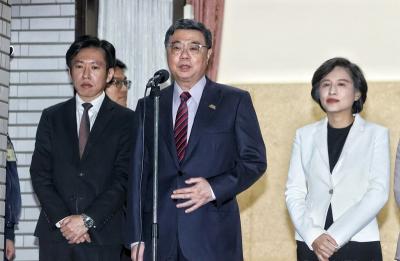
Taiwan is awaiting official notification from the US regarding the status of the Agreement on Reciprocal Trade (ART) after the US Supreme Court ruled US President Donald Trump's global tariffs unconstitutional. Speaking to reporters before a legislative hearing today, Premier Cho Jung-tai (卓榮泰) said that Taiwan's negotiation team remains focused on ensuring that the bilateral trade deal remains intact despite the legal challenge to Trump's tariff policy. "The US has pledged to notify its trade partners once the subsequent administrative and legal processes are finalized, and that certainly includes Taiwan," Cho said when asked about opposition parties’ doubts that the ART was
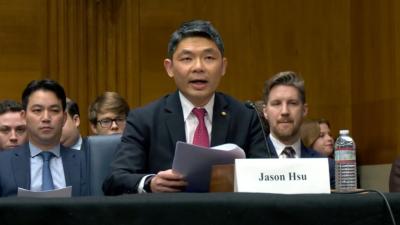
If China chose to invade Taiwan tomorrow, it would only have to sever three undersea fiber-optic cable clusters to cause a data blackout, Jason Hsu (許毓仁), a senior fellow at the Hudson Institute and former Chinese Nationalist Party (KMT) legislator, told a US security panel yesterday. In a Taiwan contingency, cable disruption would be one of the earliest preinvasion actions and the signal that escalation had begun, he said, adding that Taiwan’s current cable repair capabilities are insufficient. The US-China Economic and Security Review Commission (USCC) yesterday held a hearing on US-China Competition Under the Sea, with Hsu speaking on


 RSS
RSS