


China Airlines (CAL), the nation’s largest air carrier, denied a news report yesterday that one of its former captains, who has since left the company, once flew a Boeing 737-800 back to Taiwan from Bali, Indonesia, in late 2008 with the aircraft leaking oil.
CAL spokesman Hamilton Liu (劉國芊) said the Boeing 737-800 cargo/passenger plane, flight number B-18609, was in good condition when it was flown from Taiwan to Bali in November 2008, as the aircraft had just had a maintenance check a few days earlier.
After the captain re-started the plane in Bali and was getting ready for the return flight, he found that a fuel tank in the right wing was experiencing slight seepage. He then asked for repairs by a CAL mechanical service team posted in Bali, Liu said.
It was midnight by the time the seepage was fixed and flight safety papers were signed by both the service team and the captain, allowing the plane to depart Bali, he said.
The spokesman made the remarks in response to a front-page report in the Chinese-language Apple Daily, which said CAL instructed the captain to fly the aircraft back to Taiwan the same day despite the oil leak after learning that the required spare parts were unavailable in Bali.
Fourteen passengers aboard the return flight were also told to study the emergency exit and to take part in an exercise during the flight, which the daily said “scared them to death.”
The Civil Aeronautics Administration (CAA), which oversees CAL operations, said yesterday that the CAL captain was not technically wrong to fly the plane back to Taiwan the same day after the seepage problem was fixed.
However, the CAA Flight Standards Division said the captain and crew were found to have violated flight safety standards by restarting the plane after repairs without obtaining written permission from the head office.
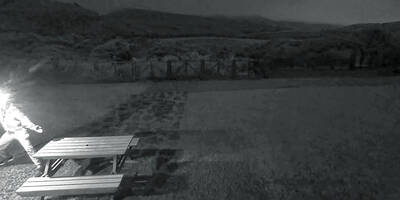
Yangmingshan National Park authorities yesterday urged visitors to respect public spaces and obey the law after a couple was caught on a camera livestream having sex at the park’s Qingtiangang (擎天崗) earlier in the day. The Shilin Police Precinct in Taipei said it has identified a suspect and his vehicle registration number, and would summon him for questioning. The case would be handled in accordance with public indecency charges, it added. The couple entered the park at about 11pm on Thursday and began fooling around by 1am yesterday, the police said, adding that the two were unaware of the park’s all-day live
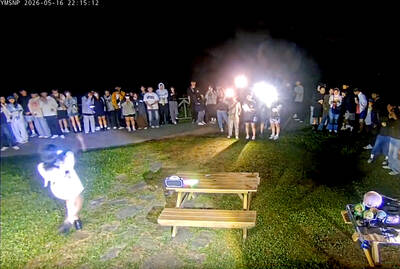
Yangmingshan National Park’s Qingtiangang (擎天崗) nature area has gone viral after a park livestream camera observed a couple in the throes of intimate congress, which was broadcast live on YouTube, drawing large late-night crowds and sparking a backlash over noise, bright lights and disruption to wildlife habitat. The area’s livestream footage appeared to show a couple engaging in sexual activity on a picnic table in the park on Friday last week, with the uncensored footage streamed publicly online. The footage quickly spread across social media, prompting a tide of visitors to travel to the site to “check in” and recreate the

A former soldier and an active-duty army officer were yesterday indicted for allegedly selling classified military training materials to a Chinese intelligence operative for a total of NT$79,440. The Taipei District Prosecutors’ Office indicted Chen Tai-yin (陳泰尹) and Lee Chun-ta (李俊達) for contravening the National Security Act (國家安全法) and the Anti-Corruption Act (貪污治罪條例). Chen left the military in September 2013 after serving alongside then-staff sergeant Lee, now an army lieutenant, at the 21st Artillery Command of the army’s Sixth Corps from 2011 to 2013, according to the indictment. Chen met a Chinese intelligence operative identified as “Wang” (王) through a friend in November

Minister of Digital Affairs Lin Yi-ching (林宜敬) yesterday cited regulatory issues and national security concerns as an expert said that Taiwan is among the few Asian regions without Starlink. Lin made the remarks on Facebook after funP Innovation Group chief executive officer Nathan Chiu (邱繼弘) on Friday said Taiwan and four other countries in Asia — China, North Korea, Afghanistan and Syria — have no access to Starlink. Starlink has become available in 166 countries worldwide, including Ukraine, Malaysia, the Philippines and Vietnam, in the six years since it became commercial, he said. While China and North Korea block Starlink, Syria is not


 RSS
RSS