


Seeking re-election in the year-end vote, Taipei Mayor Hau Lung-bin (郝龍斌) opened a campaign office yesterday with “Taipei, fly high” as his campaign slogan.
Hau said that when he first ran for Taipei mayor four years ago, he proposed to improve transportation in the nation’s capital and connect it with the world, including China. The launch of direct flights between Taipei Songshan Airport and Shanghai Hongqiao Airport last week was the realization of his campaign promise, he said.
“Taipei City is like a little bird getting out of the cage and flying high into the sky,” he said.
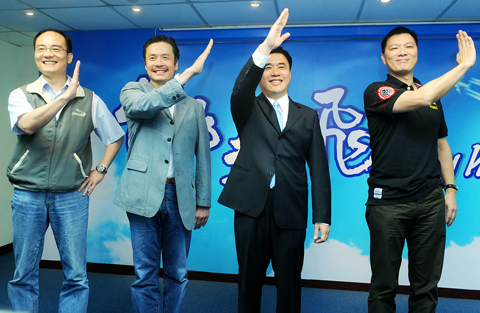
PHOTO: WANG MIN-WEI, TAIPEI TIMES
Hau then criticized the campaign slogan of Democratic Progressive Party (DPP) opponent Su Tseng-chang (蘇貞昌) —“Taipei will surpass Taipei” — saying this was not a vision, but a “natural fact.”
Hau, of the Chinese Nationalist Party (KMT), said that when the DPP was in power, it adopted a “locked-up country” policy with regard to Beijing, neglecting Taiwan’s long-term development.
“The result is we lost our capital and manpower, our economy backtracked and our national competitiveness dropped off,” he said. “Look at Hong Kong, Singapore, Seoul and Shanghai. Which is not welcoming with open arms people from other countries to come and visit, do business and study?”
Opening up was not a slogan, Hau said, and internationalization was not an article posted on somebody’s blog. It required action, he said. Citing the city’s participation in the Shanghai World Expo, Hau said Taipei took advantage of the opportunity to raise its international profile and it was the materialization of his campaign slogan.
Hau said as the KMT government is set to sign an economic cooperation framework agreement (ECFA) with Beijing, opposing the trade pact would only “plunge the capital city further into the center of Taiwan’s political storm and push it out of the heart of Asia.”
“The November election is the choice between opening up a city or closing it up, between empty talk or concrete action, between pursuing a personal political agenda or making the city a better place,” he said.
Noting that Su has said he would participate in a march organized by the DPP on Saturday appealing for a referendum on an ECFA, Hau yesterday urged Su to propose an alternative plan if he was against the trade pact.
KMT Secretary-General King Pu-tsung (金溥聰), who also attended the event, said Su’s campaign slogan was too conservative and constrained, emphasizing that Taipei needed someone like Hau, who he described as “ambitious, energetic, active, courageous” and an “adventurist.”
“When you [Su] say you want to surpass yourself, it sounds to me like a 50-year-old man trying to cheer himself up when he is exercising,” he said.
Despite the criticism he lodged against his opponent, Hau failed to present new proposals on how to run the city.
When asked by the Taipei Times about when he planned to release his manifesto, Hau looked confused and said: “I thought I already did that,” referring to the policy proposals he made four years ago when he was campaigning for Taipei mayor.
He then turned to his deputy office manager, Chuang Wen-ssu (莊文思), for confirmation. Chuang said the office would either unveil the manifesto in September after launching its campaign headquarters, or when Hau officially registers as a candidate.
Chuang said the manifesto would include the mid and long-term plans that Hau had already made public. They would also add Hau’s “campaign promises,” he said.
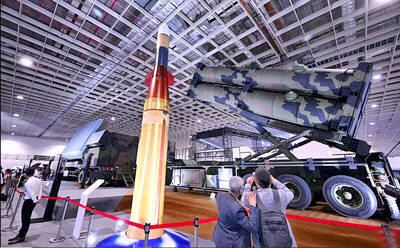
Taiwan is to commence mass production of the Tien Kung (天弓, “Sky Bow”) III, IV and V missiles by the second quarter of this year if the legislature approves the government’s NT$1.25 trillion (US$39.78 billion) special defense budget, an official said yesterday. Commenting on condition of anonymity, a defense official with knowledge of the matter said that the advanced systems are expected to provide crucial capabilities against ballistic and cruise missiles for the proposed “T-Dome,” an advanced, multi-layered air defense network. The Tien Kung III is an air defense missile with a maximum interception altitude of 35km. The Tien Kung IV and V
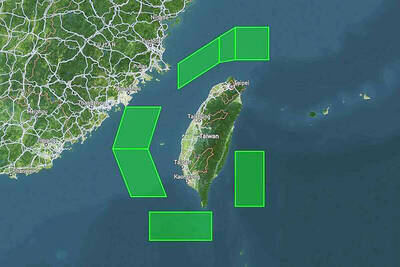
The disruption of 941 flights in and out of Taiwan due to China’s large-scale military exercises was no accident, but rather the result of a “quasi-blockade” used to simulate creating the air and sea routes needed for an amphibious landing, a military expert said. The disruptions occurred on Tuesday and lasted about 10 hours as China conducted live-fire drills in the Taiwan Strait. The Civil Aviation Administration (CAA) said the exercises affected 857 international flights and 84 domestic flights, affecting more than 100,000 travelers. Su Tzu-yun (蘇紫雲), a research fellow at the government-sponsored Institute for National Defense and Security Research, said the air
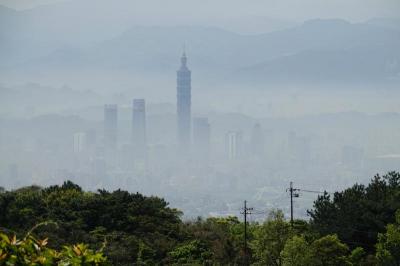
A strong continental cold air mass is to bring pollutants to Taiwan from tomorrow, the Ministry of Environment said today, as it issued an “orange” air quality alert for most of the country. All of Taiwan except for Hualien and Taitung counties is to be under an “orange” air quality alert tomorrow, indicating air quality that is unhealthy for sensitive groups. In China, areas from Shandong to Shanghai have been enveloped in haze since Saturday, the ministry said in a news release. Yesterday, hourly concentrations of PM2.5 in these areas ranged from 65 to 160 micrograms per cubic meter (mg/m³), and pollutants were
Taiwan’s armed forces have established response protocols for a wide range of sudden contingencies, including the “Wan Chun Plan” to protect the head of state, the Ministry of Defense (MND) said today. After US President Donald Trump on Saturday launched a series of airstrikes in Venezuela and kidnapped Venezuelan President Nicolas Maduro, concerns have been raised as to whether China would launch a similar “decapitation strike” on Taiwan. The armed forces regularly coordinate with relevant agencies and practice drills to ensure preparedness for a wide range of scenarios, Vice Minister of National Defense Hsu Szu-chien (徐斯儉) told reporters before a


 RSS
RSS