


Kaohsiung Mayor Chen Chu (陳菊) said yesterday that the city's Education Bureau and schools had overlooked the importance of resolving the problem of bullying on campus.
Chen said city government agencies should acknowledge the issue and study how to ensure campus security.
“I will put Deputy Mayor Lee [Yung-te (李永得)] in charge. I want to see updated reports and statistics every six months,” she said.
Chen was responding to concerns raised on the council floor by Chinese Nationalist Party (KMT) City Councilor Lin Kuo-cheng (林國正) about campus security.
Lin accused the city government of failing to take campus security seriously.
Lin cited the latest statistics from the National Police Agency (NPA) showing that the city's crime rate had reached 6.28 criminals per 100,000 people, while Taipei City only had a crime rate of 3.53 offenders per 100,000 people.
NPA data also showed that the number of teenagers on drugs in Kaohsiung was about 1.78 times that in Taipei City, Lin said.
Chen said many school bullies or teenage drug addicts in the city were from economically disadvantaged families or were dropouts, but the city government would never give up on them.
“The issue of campus security is a matter of conscience,” Chen said, adding that the city government would never evade the issue.
In other news, the city's Economic Development Bureau urged residents of Dapingding (大坪頂) to learn to live in harmony with the Caprimulgus affinis after residents complained about the noise made by the birds.
Bureau director-general Liu Hsin-cheng (劉馨正) said an increasing number of the rare birds, commonly known as the Savanna Nightjar, had migrated to urban areas in recent years.
Many Siaogang District (小港) residents had complained about having difficulty sleeping because of the constant chirping made by the birds during the mating season, Liu said.
Saying that the mating season would last through August, Liu urged residents to strike a balance between their lives and protection of the birds.

Taiwan has received more than US$70 million in royalties as of the end of last year from developing the F-16V jet as countries worldwide purchase or upgrade to this popular model, government and military officials said on Saturday. Taiwan funded the development of the F-16V jet and ended up the sole investor as other countries withdrew from the program. Now the F-16V is increasingly popular and countries must pay Taiwan a percentage in royalties when they purchase new F-16V aircraft or upgrade older F-16 models. The next five years are expected to be the peak for these royalties, with Taiwan potentially earning
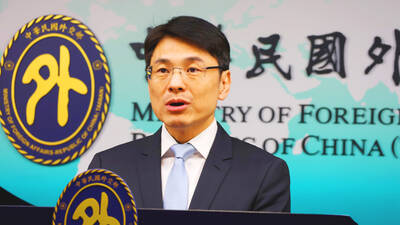
STAY IN YOUR LANE: As the US and Israel attack Iran, the ministry has warned China not to overstep by including Taiwanese citizens in its evacuation orders The Ministry of Foreign Affairs (MOFA) yesterday rebuked a statement by China’s embassy in Israel that it would evacuate Taiwanese holders of Chinese travel documents from Israel amid the latter’s escalating conflict with Iran. Tensions have risen across the Middle East in the wake of US and Israeli airstrikes on Iran beginning Saturday. China subsequently issued an evacuation notice for its citizens. In a news release, the Chinese embassy in Israel said holders of “Taiwan compatriot permits (台胞證)” issued to Taiwanese nationals by Chinese authorities for travel to China — could register for evacuation to Egypt. In Taipei, the ministry yesterday said Taiwan
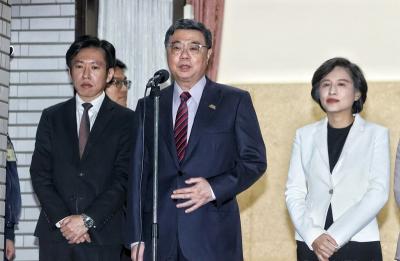
Taiwan is awaiting official notification from the US regarding the status of the Agreement on Reciprocal Trade (ART) after the US Supreme Court ruled US President Donald Trump's global tariffs unconstitutional. Speaking to reporters before a legislative hearing today, Premier Cho Jung-tai (卓榮泰) said that Taiwan's negotiation team remains focused on ensuring that the bilateral trade deal remains intact despite the legal challenge to Trump's tariff policy. "The US has pledged to notify its trade partners once the subsequent administrative and legal processes are finalized, and that certainly includes Taiwan," Cho said when asked about opposition parties’ doubts that the ART was
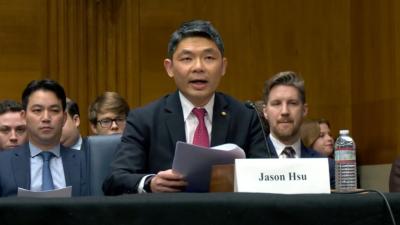
If China chose to invade Taiwan tomorrow, it would only have to sever three undersea fiber-optic cable clusters to cause a data blackout, Jason Hsu (許毓仁), a senior fellow at the Hudson Institute and former Chinese Nationalist Party (KMT) legislator, told a US security panel yesterday. In a Taiwan contingency, cable disruption would be one of the earliest preinvasion actions and the signal that escalation had begun, he said, adding that Taiwan’s current cable repair capabilities are insufficient. The US-China Economic and Security Review Commission (USCC) yesterday held a hearing on US-China Competition Under the Sea, with Hsu speaking on


 RSS
RSS