


Shanghai Mayor Han Zheng's (韓正) tour of Taipei yesterday took him to the MRT and local attractions to experience local culture, but it attracted complaints from some residents over tight security for Han and the Chinese delegation.
Accompanied by Taipei Mayor Hau Lung-bin (郝龍斌) and top-level city officials, Han and the Shanghai delegation toured the National Palace Museum and visited the Beitou Incinerator to gain a deeper understanding of Taipei's efforts in garbage recycling.
The two mayors later took the MRT from Beitou Station to Jiantan Station to experience what Han called “mass culture” in Taipei, causing some chaos as officials, reporters and passengers crowded the stations and the trains.
Hau and the Taipei City Police Department had insisted there would be no extra police force or traffic controls arranged for Han and the delegation. However, a group of security guards followed Han all day yesterday, and traffic lights were timed along the way to clear the traffic for the two mayors' motorcades.
An MRT passenger surnamed Chiang (江) complained about being pushed by the crowd at Beitou Station, urging the city officials and Chinese delegation not to disturb residents with their visiting schedule.
“I am on my way to school, and it's really annoying that I have to wait and let those government officials get in the trains first,” she said.
Unbothered by the complaints, Han used the MRT EasyCard to enter and leave the stations, and lauded Taipei’s MRT system for its great management.
“I am impressed by the management of the Taipei MRT system, and Shanghai should learn from Taipei's experience,” he said.
Hau welcomed Han to visit Taipei again soon to experience more local culture, and formally invited him to attend the Taipei International Flora Expo in November.
Han accepted the invitation, but declined to confirm whether or not he will attend the event.
Han attended a luncheon hosted by Straits Exchange Foundation Chairman Chiang Pin-kun (江丙坤) earlier yesterday, and met with former Chinese Nationalist Party (KMT) chairman Wu Poh-hsiung (吳伯雄) for dinner.
Han will visit Taichung and Taoyuan today and leave tomorrow.
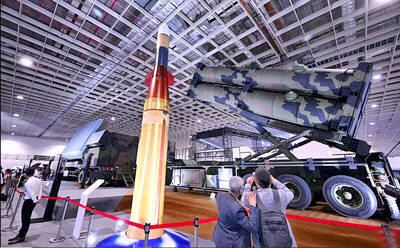
Taiwan is to commence mass production of the Tien Kung (天弓, “Sky Bow”) III, IV and V missiles by the second quarter of this year if the legislature approves the government’s NT$1.25 trillion (US$39.78 billion) special defense budget, an official said yesterday. Commenting on condition of anonymity, a defense official with knowledge of the matter said that the advanced systems are expected to provide crucial capabilities against ballistic and cruise missiles for the proposed “T-Dome,” an advanced, multi-layered air defense network. The Tien Kung III is an air defense missile with a maximum interception altitude of 35km. The Tien Kung IV and V
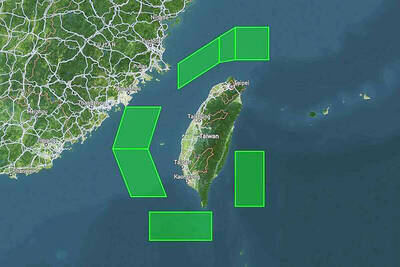
The disruption of 941 flights in and out of Taiwan due to China’s large-scale military exercises was no accident, but rather the result of a “quasi-blockade” used to simulate creating the air and sea routes needed for an amphibious landing, a military expert said. The disruptions occurred on Tuesday and lasted about 10 hours as China conducted live-fire drills in the Taiwan Strait. The Civil Aviation Administration (CAA) said the exercises affected 857 international flights and 84 domestic flights, affecting more than 100,000 travelers. Su Tzu-yun (蘇紫雲), a research fellow at the government-sponsored Institute for National Defense and Security Research, said the air
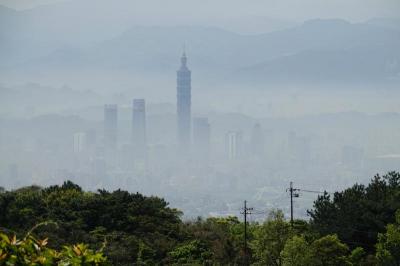
A strong continental cold air mass is to bring pollutants to Taiwan from tomorrow, the Ministry of Environment said today, as it issued an “orange” air quality alert for most of the country. All of Taiwan except for Hualien and Taitung counties is to be under an “orange” air quality alert tomorrow, indicating air quality that is unhealthy for sensitive groups. In China, areas from Shandong to Shanghai have been enveloped in haze since Saturday, the ministry said in a news release. Yesterday, hourly concentrations of PM2.5 in these areas ranged from 65 to 160 micrograms per cubic meter (mg/m³), and pollutants were
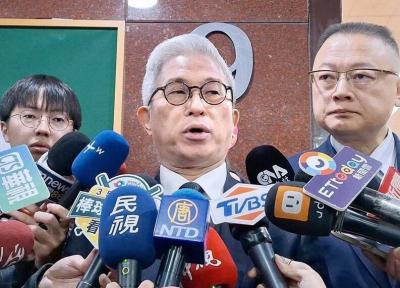
Taiwan’s armed forces have established response protocols for a wide range of sudden contingencies, including the “Wan Chun Plan” to protect the head of state, the Ministry of Defense (MND) said today. After US President Donald Trump on Saturday launched a series of airstrikes in Venezuela and kidnapped Venezuelan President Nicolas Maduro, concerns have been raised as to whether China would launch a similar “decapitation strike” on Taiwan. The armed forces regularly coordinate with relevant agencies and practice drills to ensure preparedness for a wide range of scenarios, Vice Minister of National Defense Hsu Szu-chien (徐斯儉) told reporters before a


 RSS
RSS