


The National Communications Commission is scheduled to submit two proposals to the Cabinet by April to help facilitate the switch from analog to digital for terrestrial TV services.
The government hopes to phase out analog signals by 2012.
One of the proposals will suggest that the government subsidize all viewing households in buying set-top boxes, while the other would propose that the government subsidize low-income families only.
Should the Cabinet opt for the first proposal, each household would receive a subsidy to buy one set-top box. If it chooses the second option, the government will subsidize the purchase, including the set-top boxes, cables and antennas.
The first proposal is estimated to cost the nation about NT$10.5 billion (US$300 million), while the second is expected to cost NT$200 million.
Before formulating the proposals, the commission has reviewed developments in Japan, South Korea, the US, the UK and Germany.
Japan and South Korea only subsidized low-income families. The US, on the other hand, provided each viewing household a US$40 coupon to purchase a set-top box. It withdrew analog services last June. The UK and Germany did not provide any subsidy.
Taiwan has about 7 million households with TV, including about 100,000 that are considered low-income households.
Only five TV networks offer digital broadcasting: Taiwan Television, China Television, Chinese Television Service, Formosa Television and the Public Television Service.
The commission also hoped that the government would consider providing high-definition TV services if it chooses the first proposal. The massive demand for set-top boxes will help lower the costs of the set-top boxes and make them more affordable.
It could also serve as an opportunity to develop the digital content industry, with Taiwan currently trailing behind South Korea.

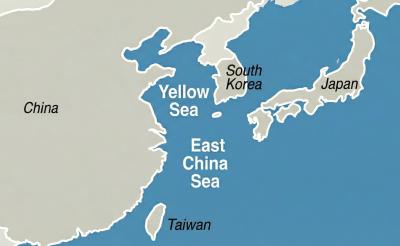
China has reserved offshore airspace in the Yellow Sea and East China Sea from March 27 to May 6, issuing alerts usually used to warn of military exercises, although no such exercises have been announced, the Wall Street Journal (WSJ) reported yesterday. Reserving such a large area for 40 days without explanation is an “unusual step,” as military exercises normally only last a few days, the paper said. These alerts, known as Notice to Air Missions (Notams), “are intended to inform pilots and aviation authorities of temporary airspace hazards or restrictions,” the article said. The airspace reserved in the alert is

NAMING SPAT: The foreign ministry called on Denmark to propose an acceptable solution to the erroneous nationality used for Taiwanese on residence permits Taiwan has revoked some privileges for Danish diplomatic staff over a Danish permit that lists “Taiwan” as “China,” Eric Huang (黃鈞耀), head of the Ministry of Foreign Affairs’ Department of European Affairs, told a news conference in Taipei yesterday. Reporters asked Huang whether the Danish government had responded to the ministry’s request that it correct the nationality on Danish residence permits of Taiwanese, which has been listed as “China” since 2024. Taiwan’s representative office in Denmark continues to communicate with the Danish government, and the ministry has revoked some privileges previously granted to Danish representatives in Taiwan and would continue to review

More than 6,000 Taiwanese students have participated in exchange programs in China over the past two years, despite the Mainland Affairs Council’s (MAC) “orange light” travel advisory, government records showed. The MAC’s publicly available registry showed that Taiwanese college and university students who went on exchange programs across the Strait numbered 3,592 and 2,966 people respectively. The National Immigration Agency data revealed that 2,296 and 2,551 Chinese students visited Taiwan for study in the same two years. A review of the Web sites of publicly-run universities and colleges showed that Taiwanese higher education institutions continued to recruit students for Chinese educational programs without

China has reserved offshore airspace over the Yellow Sea and East China Sea from March 27 to May 6, issuing alerts that are usually used to warn of military exercises, although no such exercises have been announced, the Wall Street Journal (WSJ) reported on Sunday. Reserving such a large area for 40 days without explanation is an “unusual step,” as military exercises normally only last a few days, the paper said. The alerts, known as notice to air missions (NOTAMs), “are intended to inform pilots and aviation authorities of temporary airspace hazards or restrictions,” the article said. The airspace reserved in the alert


 RSS
RSS