


Although 97 percent of college students know photocopying textbooks is illegal, 52 percent of them still copied books cover to cover, a survey showed yesterday.
The poll showed that 24.3 percent of respondents had made cover-to-cover copies of Mandarin textbooks, 9 percent had done so with foreign-language textbooks, while 18.5 percent of the students said they had copied both.
Almost 63 percent of students who had previously made copies of textbooks from cover to cover repeated the practice during this semester, the survey said.
The poll was commissioned by the Taiwan Book Publishers Association and conducted by National Chengchi University’s Public Opinion and Market Poll Center on 1,000 randomly selected college students between Sept. 26 and Oct. 15.
In Taiwan, it is common for college students to copy part or every chapter of a textbook assigned by their teachers.
Students have defended themselves by complaining about the price of textbooks, particularly foreign-language books.
Under the Copyright Act (著作權法), teachers and students can copy part of a book to use as teaching material, but they are banned from copying it from cover to cover.
Government agencies have made inspection trips to photocopying stores near universities to clamp down on illegal photocopying of textbooks over the past few years.
As many as 57.2 percent of students at public universities said they had made copies of textbooks, while 50.4 percent of their counterparts at private universities said they had done so, the poll showed.
The survey found that students majoring in languages and literature tended to commit the offense more often than students majoring in social sciences, medicine or engineering.
The survey also showed that students with higher monthly allowances were more likely to copy an entire textbook instead of buying it.
A total of 43.2 percent of those polled said they copied textbooks because they were too expensive, while 52.3 percent said they wanted to save money even though they could afford the books.
Nearly 20 percent of the students said they had copied the books because “everyone else was doing it.”

The military has spotted two Chinese warships operating in waters near Penghu County in the Taiwan Strait and sent its own naval and air forces to monitor the vessels, the Ministry of National Defense (MND) said. Beijing sends warships and warplanes into the waters and skies around Taiwan on an almost daily basis, drawing condemnation from Taipei. While the ministry offers daily updates on the locations of Chinese military aircraft, it only rarely gives details of where Chinese warships are operating, generally only when it detects aircraft carriers, as happened last week. A Chinese destroyer and a frigate entered waters to the southwest
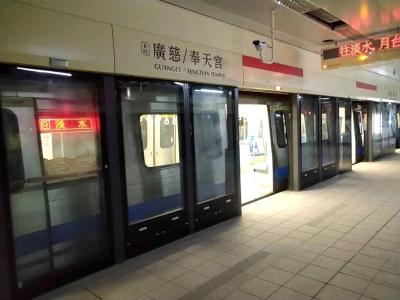
The eastern extension of the Taipei MRT Red Line could begin operations as early as late June, the Taipei Department of Rapid Transit Systems said yesterday. Taipei Rapid Transit Corp said it is considering offering one month of free rides on the new section to mark its opening. Construction progress on the 1.4km extension, which is to run from the current terminal Xiangshan Station to a new eastern terminal, Guangci/Fengtian Temple Station, was 90.6 percent complete by the end of last month, the department said in a report to the Taipei City Council's Transportation Committee. While construction began in October 2016 with an
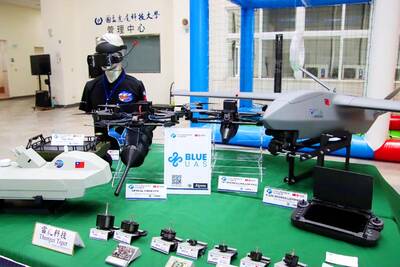
NON-RED SUPPLY: Boosting the nation’s drone industry is becoming increasingly urgent as China’s UAV dominance could become an issue in a crisis, an analyst said Taiwan’s drone exports to Europe grew 41.7-fold from 2024 to last year, with demand from Ukraine’s fight against Russian aggression the most likely driver of growth, a study showed. The Institute for Democracy, Society and Emerging Technology (DSET) in a statement on Wednesday said it found that many of Taiwan’s uncrewed aerial vehicle (UAV) sales were from Poland and the Czech Republic. These countries likely transferred the drones to Ukraine to aid it in its fight against the Russian invasion that started in 2022, it said. Despite the gains, Taiwan is not the dominant drone exporter to these markets, ranking second and fourth

Japanese Prime Minister Sanae Takaichi’s comment last year on Tokyo’s potential reaction to a Taiwan-China conflict has forced Beijing to rewrite its invasion plans, a retired Japanese general said. Takaichi told the Diet on Nov. 7 last year that a Chinese naval blockade or military attack on Taiwan could constitute a “survival-threatening situation” for Japan, potentially allowing Tokyo to exercise its right to collective self-defense. Former Japan Ground Self-Defense Force general Kiyofumi Ogawa said in a recent speech that the remark has been interpreted as meaning Japan could intervene in the early stages of a Taiwan Strait conflict, undermining China’s previous assumptions


 RSS
RSS