


A National Taiwan University (NTU) doctoral student who protested the government’s relaxation of US bone-in beef import regulations by eating a cow dung hamburger yesterday continued his campaign in front of the legislature after police had forcibly removed him and a coffin on Sunday night.
Chu Cheng-chi (朱政騏), a graduate student at NTU’s Graduate Institute of Sociology, lay down outside the legislature’s front gate and covered himself with a straw mat — a gesture Chu said symbolized how the poor cover the body of a deceased person.
He said he would continue his hunger strike to protest a proposal by the Chinese Nationalist Party (KMT) caucus to amend the Act Governing Food Sanitation (食品衛生管理法).
Chu was referring to a proposal the KMT put forward last Tuesday to authorize the government to “draw up measures to inspect beef products from areas where the risk of mad cow disease has been under control,” instead of two other prosoals for a ban on “risky” beef products from the US.
Chu began a “lie in” protest in a coffin in front of the legislature on Saturday and vowed to stage a hunger strike until today, but police fined him and forcibly removed the coffin on Sunday night, saying Chu had violated the Road Traffic Management and Punishment Act (道路交通管理處罰條例).
Huang Tai-shan (黃泰山), a doctoral student from National Tsing Hua University, who also covered himself with a grass mat next to Chu, said five more doctoral students would join the protest should police forcibly remove Chu and Huang.
Chu began his anti-US beef campaign on Oct. 29 after the government announced its plan to allow imports of US bone-in beef, as well as offal and ground beef from cattle younger than 30 months.
Chu posted a video clip on Youtube in which he ate a cow dung hamburger on Ketagalan Boulevard in front of the Presidential Office.
Meanwhile, KMT caucus whip Lin Yi-shih (林益世) continued to criticize the Democratic Progressive Party (DPP) caucus for threatening to paralyze today’s plenary session over the wording of a number of proposed amendments to the Act Governing Food Sanitation.
Lin said the KMT’s proposal would guarantee public health as well as protect Taiwan-US relations.
He accused the DPP of being too “emotional.”
“Does the DPP have its own political interests or the public’s interests in mind?” Lin said.
The legislature is scheduled to debate the proposal today.
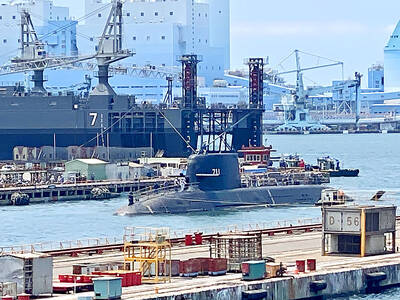
AGING: While Japan has 22 submarines, Taiwan only operates four, two of which were commissioned by the US in 1945 and 1946, and transferred to Taiwan in 1973 Taiwan would need at least 12 submarines to reach modern fleet capabilities, CSBC Corp, Taiwan chairman Chen Cheng-hung (陳政宏) said in an interview broadcast on Friday, citing a US assessment. CSBC is testing the nation’s first indigenous defense submarine, the Hai Kun (海鯤, Narwhal), which is scheduled to be delivered to the navy next month or in July. The Hai Kun has completed torpedo-firing tests and is scheduled to undergo overnight sea trials, Chen said on an SET TV military affairs program. Taiwan would require at least 12 submarines to establish a modern submarine force after assessing the nation’s operational environment and defense

Yangmingshan National Park authorities yesterday urged visitors to respect public spaces and obey the law after a couple was caught on a camera livestream having sex at the park’s Qingtiangang (擎天崗) earlier in the day. The Shilin Police Precinct in Taipei said it has identified a suspect and his vehicle registration number, and would summon him for questioning. The case would be handled in accordance with public indecency charges, it added. The couple entered the park at about 11pm on Thursday and began fooling around by 1am yesterday, the police said, adding that the two were unaware of the park’s all-day live
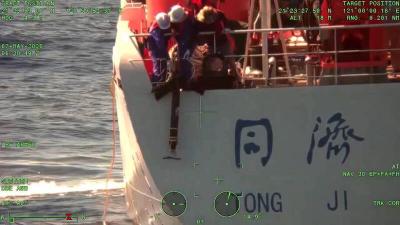
The coast guard today said that it had disrupted "illegal" operations by a Chinese research ship in waters close to the nation and driven it away, part of what Taipei sees a provocative pattern of China's stepped up maritime activities. The coast guard said that it on Thursday last week detected the Chinese ship Tongji (同濟號), which was commissioned only last year, 29 nautical miles (54km) southeast of the southern tip of Taiwan, although just outside restricted waters. The ship was observed lowering ropes into the water, suspected to be the deployment of scientific instruments for "illegal" survey operations, and the coast

A former soldier and an active-duty army officer were yesterday indicted for allegedly selling classified military training materials to a Chinese intelligence operative for a total of NT$79,440. The Taipei District Prosecutors’ Office indicted Chen Tai-yin (陳泰尹) and Lee Chun-ta (李俊達) for contravening the National Security Act (國家安全法) and the Anti-Corruption Act (貪污治罪條例). Chen left the military in September 2013 after serving alongside then-staff sergeant Lee, now an army lieutenant, at the 21st Artillery Command of the army’s Sixth Corps from 2011 to 2013, according to the indictment. Chen met a Chinese intelligence operative identified as “Wang” (王) through a friend in November


 RSS
RSS