


As post-Morakot relief, rescue and clean-up efforts moved into their 12th day yesterday, retrieval of body parts, the distribution of cash aid and provisions to take care of the mental health of the victims, as well as rescue work, topped of the list.
Clad in biochemical protective suits and masks, yesterday morning two dozen soldiers from Army Troop 542 traversed the rapid Nantzuhsien River (楠梓仙溪) to the site of Jiaxian Township’s (甲仙) Xiaolin Village (小林), Kaohsiung County, to retrieve three bodies that were discovered on Tuesday.
Recovery of the victims was difficult because the dead were buried under between 3m and 10m of mud and rocks from the mudslides caused by Typhoon Morakot on Aug. 8.
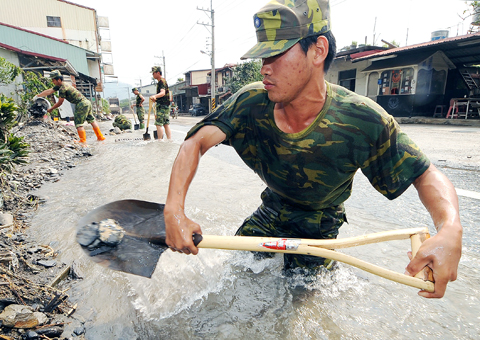
PHOTO: LIAO CHEN-HUEI, TAIPEI TIMES
Because of poor weather conditions, the bodies, as well as some 30 others that had been sighted on Tuesday, could not be retrieved and carried across the river until yesterday.
In response to criticism that some soldiers had been ordered to search for bodies by kneeling on the ground and sniffing for rotting flesh, the Army’s Eighth Troop Director of Political Warfare Hu Jui-chou (胡瑞舟) told a press conference that three search and rescue dogs, five sets of flammable gas detectors, three ground-penetrating radars and three methane detectors, provided by other government agencies, would be employed in future retrieval work.
Local media reported that some soldiers had developed psychological problems after sniffing for the dead. One female solder was quoted by local media as saying that since she did not know what a corpse smelled like, another soldier had taken her to a corpse that had been dug up so that she could identify the “death smell.”
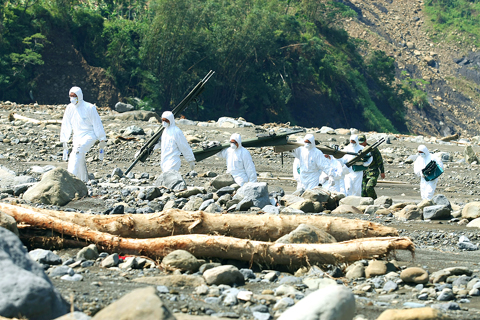
PHOTO: CNA
“The soldiers who performed rescue work by sniffing for bodies will be given physical and mental health checks soon,” Hu said.
The Ministry of Education said that it had summoned 190 certified mental health therapists to come to the aid of the thousands of school children traumatized by the storm.
“A number of children are already showing signs of acute stress disorder or post-traumatic stress disorder,” said Wu Song-lin (吳松林), director of the Student Counseling Center at National Kaohsiung Normal University, who doubles as the head of the education ministry’s Southern Taiwan Counseling Center.

Play therapy, music therapy, or role playing would be employed to help the children, Wu said, adding: “We will first arrange for group counseling sessions for all affected teachers and students, and then provide further assistance to students who show signs of mental health problems.”
Meanwhile, the Ministry of Justice’s Institute of Forensic Medicine and Investigation Bureau said its forensics experts had so far tested 21 DNA samples taken from bodies and identified five bodies of victims of the typhoon.
Local prosecutors’ offices are urging those who have missing family members to have their DNA samples taken in order to aid them in identifying those who died in the disaster.
Meanwhile, Pingtung County Government yesterday began distributing cash relief to victims in community centers and shelters around Linbian Township (林邊) and Jiadong Township (佳冬), one of the worst affected regions.
The aid, which includes a NT$10,000 consolation fund and a NT$20,000 flood subsidy for every household, would be given to a total of 8,306 families, the government said, adding that those without identification documents could still receive money if a township, village or borough government employee could identify the person.
ADDITIONAL REPORTING BY SHELLEY HUANG AND AGENCIES
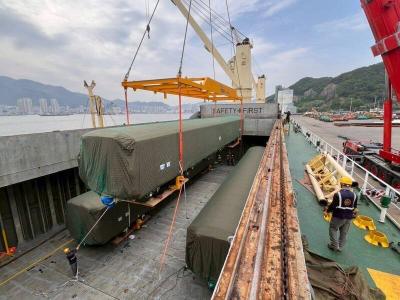
The first of 10 new high-capacity trains purchased from South Korea’s Hyundai Rotem arrived at the Port of Taipei yesterday to meet the demands of an expanding metro network, Taipei Rapid Transit Corp (TRTC) said yesterday. The train completed a three-day, 1,200km voyage from the Port of Masan in South Korea, the company said. Costing NT$590 million (US$18.79 million) each, the new six-carriage trains feature a redesigned interior based on "human-centric" transportation concepts, TRTC said. The design utilizes continuous longitudinal seating to widen the aisles and optimize passenger flow, while also upgrading passenger information displays and driving control systems for a more comfortable
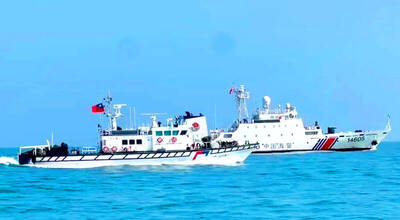
Instead of focusing solely on the threat of a full-scale military invasion, the US and its allies must prepare for a potential Chinese “quarantine” of Taiwan enforced through customs inspections, Stanford University Hoover fellow Eyck Freymann said in a Foreign Affairs article published on Wednesday. China could use various “gray zone” tactics in “reconfiguring the regional and ultimately the global economic order without a war,” said Freymann, who is also a nonresident research fellow at the US Naval War College. China might seize control of Taiwan’s links to the outside world by requiring all flights and ships entering or leaving Taiwan
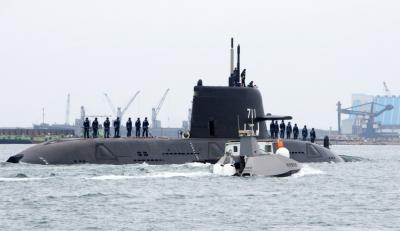
Taiwan's first indigenous defense submarine, the SS-711 Hai Kun (海鯤, or Narwhal), departed for its 13th sea trial at 7am today, marking its seventh submerged test, with delivery to the navy scheduled for July. The outing also marked its first sea deployment since President William Lai (賴清德) boarded the submarine for an inspection on March 19, drawing a crowd of military enthusiasts who gathered to show support. The submarine this morning departed port accompanied by CSBC Corp’s Endeavor Manta (奮進魔鬼魚號) uncrewed surface vessel and a navy M109 assault boat. Amid public interest in key milestones such as torpedo-launching operations and overnight submerged trials,
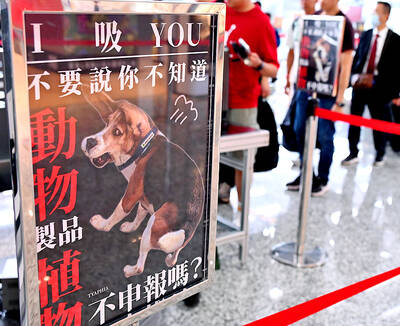
Quarantine awareness posters at Taiwan Taoyuan International Airport have gone viral for their use of wordplay. Issued by the airport branch of the Animal and Plant Health Inspection Agency, the posters feature sniffer dogs making a range of facial expressions, paired with advisory messages built around homophones. “We update the messages for holidays and campaign needs, periodically refreshing materials to attract people’s attention,” quarantine officials said. “The aim is to use the dogs’ appeal to draw focus to quarantine regulations.” A Japanese traveler visiting Taiwan has posted a photo on X of a poster showing a quarantine dog with a


 RSS
RSS