


A Hakka Journalism Award recipient yesterday accused the Council for Hakka Affairs (CHA) of restricting his freedom of speech after it refused to show a recorded message about his nomination at the award ceremony.
Yeh Jih-chia (葉日嘉), a freelancer, received this year’s Hakka Journalism Award for his report on the Miaoli County Government’s demolition of historic kilns in Houlong Township (後龍), which was published in Hakka Magazine earlier this year.
The three kilns, torn down in January to make way for a development project, were the last kilns built during the Japanese colonial period to manufacture bricks and pottery, when Miaoli was the country’s pottery production center.
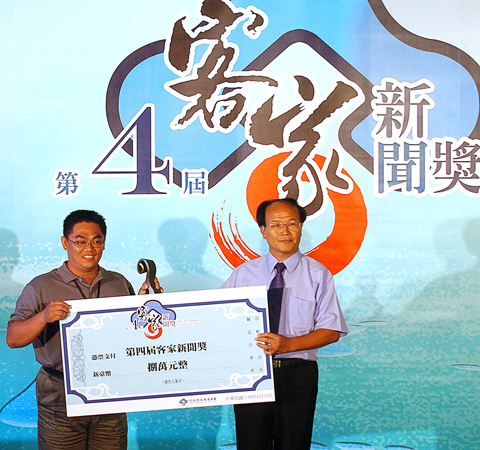
PHOTO: WANG MIN-WEI, TAIPEI TIMES
After submitting his work and receiving a nomination for the award, Yeh was asked by the council to introduce his own work and share his thoughts in a video clip.
The council has been showing video recordings by award nominees at its award ceremony since the award was first held three years ago.
As Yeh is also a member of the campaign to save the kilns, in the video clip he held up signs asking Miaoli County Commissioner Liu Cheng-hung (劉政鴻) to apologize and Miaoli International Culture and Tourism Bureau director Lin Chen-feng (林振豐) to step down.
“I sent my video on Tuesday [last week] and received a telephone call from an official asking if I could change the content because they considered it inappropriate,” Yeh said after receiving the award yesterday.
“The official said they were afraid showing the video could create conflict between the council and the Miaoli County Government,” he said.
“I said I wouldn’t change it and it was up to them whether to show it or not,” he said.
Although an independent panel of judges decided to give the award to Yeh, the council decided not to show his video, making Yeh one of only two nominees without a video presentation.
The other, Chung Chao-wen (鍾肇文), passed away before he could make a video.
“I think that the council is too conservative. It’s my right to say what I want to say in my video,” Yeh said. “If there are any consequences, I will take responsibility for what I say.”
The council’s Public Media Center deputy director, Andrew Yu (游進忠), said it was his decision to block Yeh’s video.
“If we showed the video at an award ceremony organized by the council, it would be like a government organization attacking the head of another government organization — that’s something we simply cannot do, otherwise we would upset people,” Yu said. “There’s no freedom of speech at a government agency.”
Minister of the Council for Hakka Affairs Huang Yu-chen (黃玉振), who said he was unaware of the decision until told by reporters, supported Yu’s decision.
Chiang Min-hsiu (江明修), dean of National Central University’s College of Hakka Studies and head of the panel of judges for the award, however, disagreed.
“Whatever Yeh has to say represents only himself, not any other organization, and should be respected,” Chiang said. “Especially because what he feels about the entire issue was what motivated him to write the story that won the award.”
“I think the council overreacted,” he said.
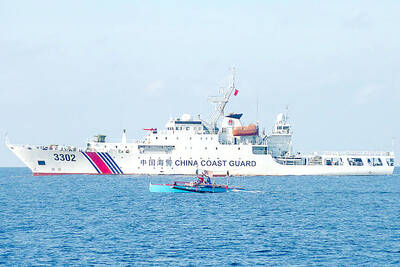
EXPANSIONIST: China deploys an average of 40 to 50 warships and coast guard vessels daily in the South China Sea, despite pledges not to militarize the region, an official said China is attempting to expand its influence across the First Island Chain and increase pressure on Japan by sending coast guard vessels into waters off of Taiwan under the pretext of maritime negotiations with Japan and the Philippines, a national security official said yesterday. China’s recent actions in the waters east of Taiwan and Japan and the Philippines’ exclusive economic zones (EEZ) are attempts to establish dominance in First Island Chain waters, said the official who declined to be named, adding that this is “expansion disguised as law enforcement.” Framing China’s actions solely as a cross-strait issue is a serious misjudgment that
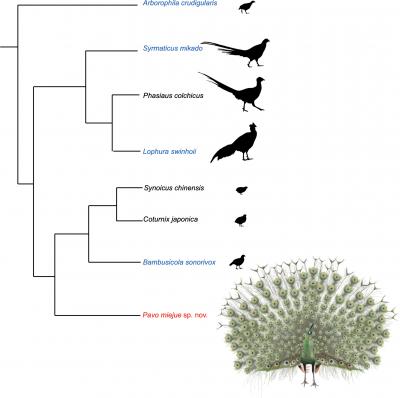
Through analyzing fossil evidence, a research team at National Taiwan University (NTU) discovered the largest endemic bird to have lived in Taiwan, naming it Pavo miejue, or extinct peafowl (滅絕孔雀). The Mikado pheasant, which is printed on the back of the NT$1,000 bank note, was previously believed to be the biggest endemic bird to Taiwan. The research team’s findings suggest that Pavo miejue lived during the Pleistocene epoch tens of thousands of years ago. It is the first endemic extinct bird species discovered and formally named in Taiwan. The study was coauthored by NTU Institute of Ecology and Evolutionary Biology professor Tsai Cheng-hsiu (蔡政修),
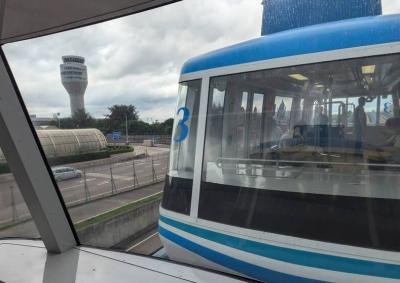
Taiwan Taoyuan International Airport is to suspend its automated Skytrain service connecting Terminal 1 and Terminal 2 starting on July 1 to facilitate connection works for the upcoming Terminal 3, the airport operator said today. Passengers and staff who need to travel between the two terminals after the suspension can instead use the Taoyuan MRT or the airport's 24-hour shuttle bus service, Taoyuan International Airport Corp said. The Taoyuan MRT Airport Line directly links the two terminals, while the shuttle buses are to operate around the clock, the company added. The Skytrain provides free transportation between the airport’s two terminals for travelers and
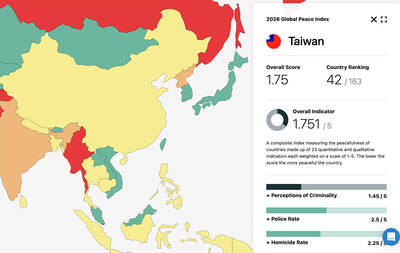
Taiwan ranked 42nd in terms of peacefulness among 163 countries, down five places from last year, according to this year’s Global Peace Index. With an overall score of 1.751, Taiwan dropped from 37th last year, the report published by the global Institute for Economics and Peace showed. The overall score measures a country’s level of peacefulness using 23 quantitative and qualitative indicators across three domains — ongoing domestic and international conflict, societal safety and security, and militarization. While Taiwan ranked 42nd worldwide, it was listed in ninth place among the 19 Asian-Pacific countries in the report, after New Zealand, Singapore, Japan, Malaysia,


 RSS
RSS