


The pan-blue-dominated legislature yesterday passed the central government’s special budget request to boost investment in public construction projects for this fiscal year.
The budget passed after the legislature cut 11 proposals put forward by the Democratic Progressive Party (DPP).
The legislature approved NT$149.1 billion (US$4.4 billion) after cutting the government’s request of NT$150.6 billion by NT$1.5 billion.
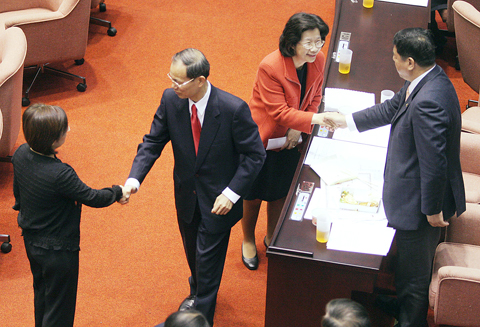
PHOTO: CNA
The government is allowed to take out loans to cover the expenditure.
The request was part of the central government’s special budget request of NT$500 billion to invest in public projects over the next four years as a measure to revive the economy and lower unemployment.
Legislative Speaker Wang Jin-pyng (王金平) told reporters that the government should do its best to achieve its goal by raising this year’s GDP by 0.68 percentage points.
During the review, lawmakers voted down 11 proposals by the DPP, including one that would require that Premier Liu Chao-shiuan (劉兆玄) step down if the government fails to execute a minimum of 80 percent of the works as listed in the request.
The Legislative Yuan instead passed a Chinese Nationalist Party (KMT) motion that stated the government’s audit branches should subject heads of government agencies responsible for executing details of the budget request to Control Yuan investigation and discipline if the government fails to complete at least 80 percent of the construction projects as a result of public officials’ neglect of their duties.
Lawmakers also rejected a DPP proposal that would slash the NT$312 million earmarked for new project offices under different government branches.
But legislators resolved to bar the government from hiring foreign laborers for the construction projects. They also agreed that the government should give priority to Aboriginal laborers for projects in Aboriginal communities.
After passage of the special budget request, DPP legislators held up banners and signs on the legislative floor that accused the KMT government of exploiting the budget request to garner support for the KMT ahead of the year-end elections.
DPP caucus secretary-general Gao Jyh-peng (高志鵬) lashed out at the KMT, saying that the party asked to put the budget request to a vote despite the fact that the legislature had not thoroughly reviewed the details of the bill.
KMT caucus secretary-general Yang Chiung-ying (楊瓊瓔) rebutted DPP criticism at a press conference.
“What politicians have in mind is to build a better nation for our next generation,” she said, urging the DPP to cooperate with the KMT in reviving the nation’s economy.
At a separate setting later yesterday, President Ma Ying-jeou (馬英九) lauded the legislature’s budget approval for an expanded public works program, saying it would revitalize the economy, and added that the budget would create more job opportunities and contribute 0.28 percentage points to GDP.
Ma made the remarks at an unscheduled press conference held at KMT headquarters shortly after the legislature approved the budget plan.
Ma led Liu, Wang and KMT Chairman Wu Poh-hsiung (吳伯雄) to thank the legislature for approving the budget.
“We expect the budget to create 190,000 to 220,000 jobs this year and contribute 0.28 percent points to GDP,” Ma said. “I thank the Legislative Yuan and the Cabinet for their cooperative efforts in helping the government implement many policies.”
Ma lauded the government’s achievements in reviving the economy, fighting corruption, improving people’s lives, reorganizing local governments and defending human rights since he took office.
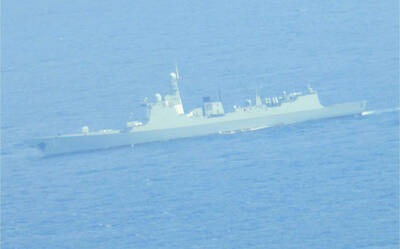
The military has spotted two Chinese warships operating in waters near Penghu County in the Taiwan Strait and sent its own naval and air forces to monitor the vessels, the Ministry of National Defense (MND) said. Beijing sends warships and warplanes into the waters and skies around Taiwan on an almost daily basis, drawing condemnation from Taipei. While the ministry offers daily updates on the locations of Chinese military aircraft, it only rarely gives details of where Chinese warships are operating, generally only when it detects aircraft carriers, as happened last week. A Chinese destroyer and a frigate entered waters to the southwest
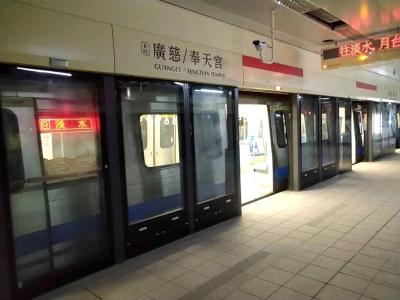
The eastern extension of the Taipei MRT Red Line could begin operations as early as late June, the Taipei Department of Rapid Transit Systems said yesterday. Taipei Rapid Transit Corp said it is considering offering one month of free rides on the new section to mark its opening. Construction progress on the 1.4km extension, which is to run from the current terminal Xiangshan Station to a new eastern terminal, Guangci/Fengtian Temple Station, was 90.6 percent complete by the end of last month, the department said in a report to the Taipei City Council's Transportation Committee. While construction began in October 2016 with an
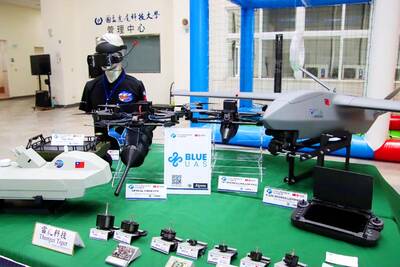
NON-RED SUPPLY: Boosting the nation’s drone industry is becoming increasingly urgent as China’s UAV dominance could become an issue in a crisis, an analyst said Taiwan’s drone exports to Europe grew 41.7-fold from 2024 to last year, with demand from Ukraine’s fight against Russian aggression the most likely driver of growth, a study showed. The Institute for Democracy, Society and Emerging Technology (DSET) in a statement on Wednesday said it found that many of Taiwan’s uncrewed aerial vehicle (UAV) sales were from Poland and the Czech Republic. These countries likely transferred the drones to Ukraine to aid it in its fight against the Russian invasion that started in 2022, it said. Despite the gains, Taiwan is not the dominant drone exporter to these markets, ranking second and fourth

Japanese Prime Minister Sanae Takaichi’s comment last year on Tokyo’s potential reaction to a Taiwan-China conflict has forced Beijing to rewrite its invasion plans, a retired Japanese general said. Takaichi told the Diet on Nov. 7 last year that a Chinese naval blockade or military attack on Taiwan could constitute a “survival-threatening situation” for Japan, potentially allowing Tokyo to exercise its right to collective self-defense. Former Japan Ground Self-Defense Force general Kiyofumi Ogawa said in a recent speech that the remark has been interpreted as meaning Japan could intervene in the early stages of a Taiwan Strait conflict, undermining China’s previous assumptions


 RSS
RSS