


Accompanied by legislators across party lines, women’s groups yesterday slammed the military for lacking education in discipline, ethics and legal training after a scandal last month in which more than 20 officers were involved in hiring underage prostitutes.
Last month, a Navy lieutenant surnamed Wang (王) was caught in Kaohsiung hiring a prostitute under 18 years old, nicknamed Hsiao Chen (小真). The military launched a probe into the case and found that 23 soldiers and officers had all been in touch with Chen and two other underage prostitutes because of Wang’s recommendation.
While prostitution is banned in the Criminal Code (刑法), hiring an underage prostitute also violates the Act against Sexual Transaction for Children and Teenagers (兒童及青少年性交易防治法).
“It is unthinkable that our military officer, who is supposed to protect our security and social stability, not only hired underage prostitutes, but also acted as the go-between for more transactions,” Women’s Rescue Foundation executive director Cynthia Kao (高小晴) told a news conference at the Legislative Yuan yesterday.
Kao then cited two other cases last year in which two officers were accused of raping civilian women, and questioned: “I wonder what happened to the education and training on discipline and gender equality in our military?”
Lee Li-fen (李麗芬), secretary of the International Campaign to End Child Prostitution in Asian Tourism — Taiwan, agreed with Kao’s view and said she suspected that sex education provided by the Ministry of National Defense (MND) may be superficial.
“We know that the ministry tells soldiers about sex, but with the outbreak of so many sexual crimes in the military, I wonder if the MND includes professionals in the education, and talks to soldiers about sex and human rights in depth and with sufficient time,” Lee said.
Both Kao and Lee demanded extra punishment for military personnel committing sexual offenses.
Chang Shan-ton (張善東), director of the Military Discipline and Ethics Division, apologized on behalf of the MND for the scandal and said that there may not be sufficient education in the military on the subject, but said that well-planned sex education would soon be in place.
“By June, 80 percent of soldiers and officers will have attended the new courses,” Chang said at the press conference.
As for punishment, Chang said he could not interfere in the judicial process, but added: “We’ve given the severest administrative penalty possible to the 11 officers on whom we’ve completed our own investigation.”
Chang said that the 11 officers were given major demerits that would prevent them from further promotion in the military. They will automatically be removed from the military if they are later found guilty by the judiciary.
Democratic Progressive Party Legislator Huang Sue-ying (黃淑英) and Chinese Nationalist Party (KMT) Legislator Cheng Li-wun (鄭麗文), who both attended the press conference, promised they would work for amendments to give extra penalties to military personnel committing sexual offenses.

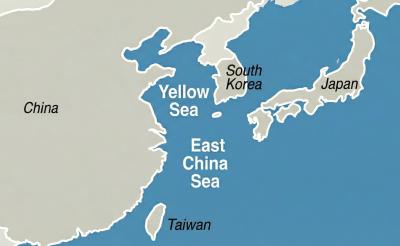
China has reserved offshore airspace in the Yellow Sea and East China Sea from March 27 to May 6, issuing alerts usually used to warn of military exercises, although no such exercises have been announced, the Wall Street Journal (WSJ) reported yesterday. Reserving such a large area for 40 days without explanation is an “unusual step,” as military exercises normally only last a few days, the paper said. These alerts, known as Notice to Air Missions (Notams), “are intended to inform pilots and aviation authorities of temporary airspace hazards or restrictions,” the article said. The airspace reserved in the alert is

South Korea is planning to revise its controversial electronic arrival card, a step Taiwanese officials said prompted them to hold off on planned retaliatory measures, a South Korean media report said yesterday. A Yonhap News Agency report said that the South Korean Ministry of Foreign Affairs is planning to remove the “previous departure place” and “next destination” fields from its e-arrival card system. The plan, reached after interagency consultations, is under review and aims to simplify entry procedures and align the electronic form with the paper version, a South Korean ministry official said. The fields — which appeared only on the electronic form

A bipartisan group of US senators has introduced a bill to enhance cooperation with Taiwan on drone development and to reduce reliance on supply chains linked to China. The proposed Blue Skies for Taiwan Act of 2026 was introduced by Republican US senators Ted Cruz and John Curtis, and Democratic US senators Jeff Merkley and Andy Kim. The legislation seeks to ease constraints on Taiwan-US cooperation in uncrewed aerial systems (UAS), including dependence on China-sourced components, limited access to capital and regulatory barriers under US export controls, a news release issued by Cruz on Wednesday said. The bill would establish a "Blue UAS
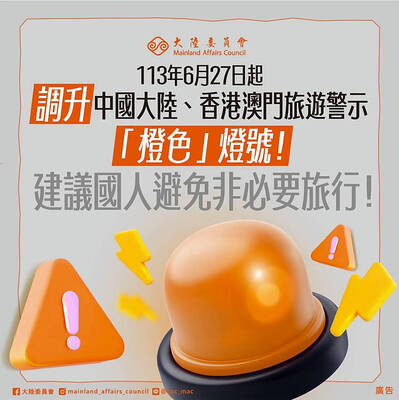
More than 6,000 Taiwanese students have participated in exchange programs in China over the past two years, despite the Mainland Affairs Council’s (MAC) “orange light” travel advisory, government records showed. The MAC’s publicly available registry showed that Taiwanese college and university students who went on exchange programs across the Strait numbered 3,592 and 2,966 people respectively. The National Immigration Agency data revealed that 2,296 and 2,551 Chinese students visited Taiwan for study in the same two years. A review of the Web sites of publicly-run universities and colleges showed that Taiwanese higher education institutions continued to recruit students for Chinese educational programs without


 RSS
RSS