


After the Miaoli County Government razed three kilns that served as the last witness to the county’s once-prosperous pottery industry, preservationists set up a commemorative Web site and pledged to take action against county government officials who backed down from an agreement with the Council for Cultural Affairs (CCA) to postpone the demolition.
“This is not the time for us to mourn: We must keep fighting,” Yang Chang-chen (楊長鎮), a Miaoli native and long-time activist for local culture preservation, wrote in a message posted on the site.
Yang said he would write a petition to the Control Yuan, requesting a probe into Miaoli County Commissioner Liu Cheng-hung (劉政鴻) and potential impeachment.
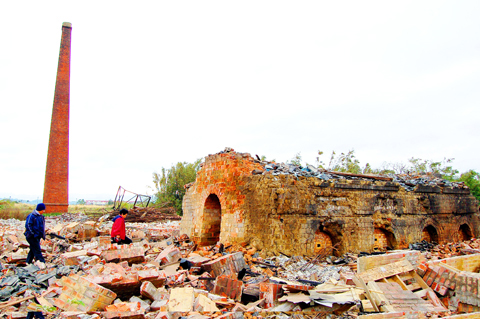
PHOTO: PENG CHIEN-LI, TAIPEI TIMES
The three kilns were located in Miaoli’s Houlong Township (後龍) and were surrounded by rice fields and farms.
The area had a flourishing industry producing pottery, china, tiles and bricks during the Japanese colonial period.
As the nation’s economy developed, the old-fashioned labor-intensive kilns that once dotted the area became outdated. Eventually they were either closed, demolished or turned into factories that produce pottery with modern technology and equipment.
In 2003, however, the county government said it would build a station for the high-speed rail nearby and drew up an urban development project to turn the surrounding area into a transportation hub and high-tech industrial zone.
After the plans were drawn up, a county cultural heritage assessment commission said the three remaining old-style kilns were not of “enough historic value for preservation” and could be torn down.
Local historians and activists were upset by the decision and formed the Alliance to Rescue the Historic Kilns of Miaoli.
More than 50 civic groups across the country and nearly 600 individuals signed a petition asking the authorities to preserve the kilns.
“Miaoli can only become an attractive place for visitors if we preserve all these places with history and memory,” Den Shui-hui (鄧淑慧), founder of the alliance and owner of a traditional snake-shaped kiln in nearby Jhunan Township (竹南) told the Taipei Times via telephone.
“These kilns were hand-built and each of the bricks used was hand-made,” Den said.
“Many of the bricks actually bear some kind of mark on them and each mark has a story behind it,” Den said.
Den is also a researcher who has authored eight books on kilns in Miaoli.
The activists took their case to the CCA.
Last Tuesday, the council said it would ask the Miaoli County Government to halt the demolition and wait for the results of further negotiations with the activists.
Despite all the efforts, two of the three kilns were torn down on Thursday.
On the same day, the council released a statement expressing regret over the demolition and said it had reached an agreement with the county government to “postpone demolition until after a negotiation meeting on Jan. 14 to spare the remaining bun-shaped kiln.”
The last kiln, however, was torn down on Friday.
“We demand apologies from the CCA and County Commissioner Liu and we demand that the head of the county’s International Culture and Tourism Bureau, Lin Chen-feng [林振豐], step down. We’ll also sue him,” Den said.

The Ministry of Finance this afternoon announced the winning numbers for the March-April uniform invoice lottery. The winning number for the NT$10 million (US$318,060) special prize is 19531471, and the winning number for the NT$2 million grand prize is 85941329. Three numbers were drawn for the NT$200,000 first prize: 07225810, 20231230 and 83518781. Those with receipts matching the last seven digits of any of the first-prize numbers will win the NT$40,000 second prize, while those matching the last six digits will win the NT$10,000 third prize. Those whose receipts match the last five digits of the first-prize numbers can claim the NT$4,000 fourth prize,

SIX SUBSIDIES: The monthly allowance for older farmers is to increase to NT$10,000, and NT$5,000 is to be given to homemakers under the national pension system, Lai said The government is to implement major welfare policies for disadvantaged groups, including raising the monthly allowance for older farmers to NT$10,000 and providing homemakers with NT$5,000 per month, President William Lai (賴清德) said yesterday. Lai made the remarks during a visit to Wangling Temple in Chiayi County, saying that the planned increases were being introduced amid economic growth and an increase in tax revenue. Touting a policy, in which the government plans to provide a monthly allowance of NT$5,000 for every child under the age of 18 in a bid to address Taiwan’s low birthrate, Lai said that if received for the
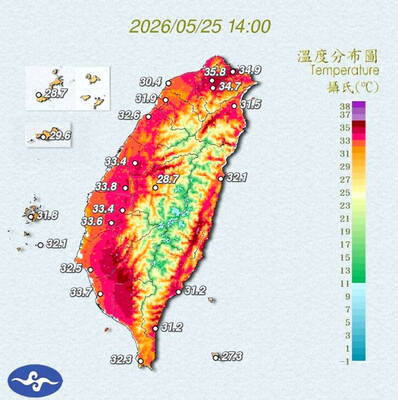
STAY COOL: The HPA recommended that people stay hydrated, use air-conditioning or fans while indoors, wear loose-fitting clothes and walk in the shade while outdoors Employers must implement measures such as installing cooling equipment, and providing drinking water and rest breaks for outdoor workers starting from Monday next week, the Taipei Department of Labor said on Sunday. Employers who fail to comply could face fines of NT$30,000 to NT$300,000 under the Occupational Safety and Health Act (職業安全衛生法), the department said. Businesses in Taipei employing fewer than 100 workers, as well as registered self-employed workers with labor insurance coverage, could receive on-site assessments and guidance from occupational safety consultants to help them apply for central government subsidies to implement or improve heat-protection measures, it said. Under the Ministry of

ISOLATION: The outposts would serve as support and backup bases, forcing US forces to either face China head-on or reroute, increasing travel time and operational costs China’s outposts in the South China Sea could be used to delay and constrain foreign forces during a conflict in the Taiwan Strait, giving Beijing a critical window to carry out amphibious landing and blockade operations, a report said. The Chinese Communist Party’s (CCP) forward operating bases on islands and reclaimed features in the South China Sea could delay foreign forces long enough for the Chinese People’s Liberation Army (PLA) to secure a key 48-to-72-hour window in the Taiwan Strait, a report commissioned by the Mainland Affairs Council found. The report, conducted by the Institute for National Defense and Security Research, examined


 RSS
RSS