


Amid heated debate and verbal disputes, the four agreements signed by Straits Exchange Foundation (SEF) Chairman Chiang Pin-kung (江丙坤) and Association for Relations Across the Taiwan Strait Chairman Chen Yunlin (陳雲林) last month passed the Legislative Yuan’s joint committee review yesterday.
During the meeting, Democratic Progressive Party (DPP) lawmakers questioned the legality of some of the clauses contained in the four agreements, which deal with direct cargo links, direct daily passenger transport links, direct mail delivery services and a joint food safety monitoring mechanism.
One of the disputes was over the issue of exemptions from income and business taxes for marine transport companies on revenues from cross-strait cargo services.
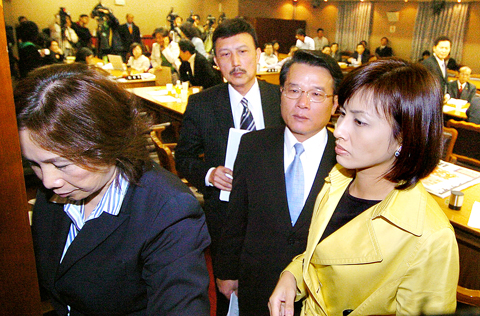
PHOTO: LIAO CHEN-HUEI, TAIPEI TIMES
Mainland Affairs Council (MAC) Chairwoman Lai Hsin-yuan (賴幸媛) and Vice Chairman Fu Don-cheng (傅棟成) insisted that the exemptions were legal, but DPP lawmakers challenged that view.
“Any tax breaks — including those for the automobile industry recently proposed by the government — require a revision of the tax laws,” DPP Legislator Tien Chiu-chin (田秋堇) said during a question-and-answer session of a joint meeting of the Internal Administration Committee and the Transportation, Health, Environment and Labor Committee.
“Since when did the SEF become the supreme government agency that can invalidate laws just by signing agreements?” she said.
Fu argued that the Statute Governing the Relations between the People of the Taiwan Area and the Mainland Area (兩岸人民關係條例) states that special treatment may be applied to “taxations, such as tariffs.”
DPP Legislator Chiu Yi-ying (邱議瑩) disagreed.
“This is not how you should interpret the statute,” Chiu said, with other DPP legislators agreeing.
Chinese Nationalist Party (KMT) Legislator Wu Yu-sheng (吳育昇) then accused the DPP of technically attempting to block the agreements.
The situation worsened when KMT legislators Yang Li-huan (楊麗環) and Huang Chao-shun (黃昭順) also expressed opposition to the business tax exemption.
The committee ended up passing the direct cross-strait marine transport agreement conditionally, after promising to launch a further law revision process.
Despite questions raised by the DPP about some of the clauses in the four agreements, the agreements were all eventually passed at the meeting where the KMT held a majority.
The agreements will be sent to the legislature’s General Assembly for approval today.
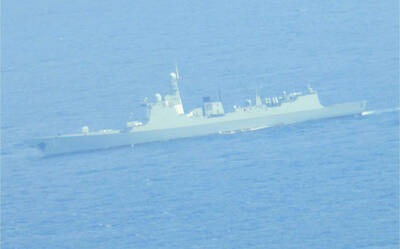
The military has spotted two Chinese warships operating in waters near Penghu County in the Taiwan Strait and sent its own naval and air forces to monitor the vessels, the Ministry of National Defense (MND) said. Beijing sends warships and warplanes into the waters and skies around Taiwan on an almost daily basis, drawing condemnation from Taipei. While the ministry offers daily updates on the locations of Chinese military aircraft, it only rarely gives details of where Chinese warships are operating, generally only when it detects aircraft carriers, as happened last week. A Chinese destroyer and a frigate entered waters to the southwest
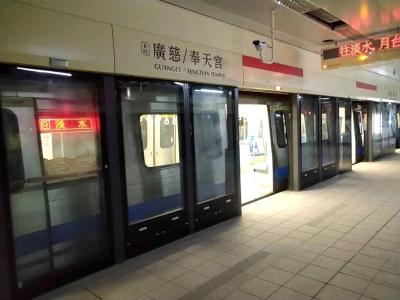
The eastern extension of the Taipei MRT Red Line could begin operations as early as late June, the Taipei Department of Rapid Transit Systems said yesterday. Taipei Rapid Transit Corp said it is considering offering one month of free rides on the new section to mark its opening. Construction progress on the 1.4km extension, which is to run from the current terminal Xiangshan Station to a new eastern terminal, Guangci/Fengtian Temple Station, was 90.6 percent complete by the end of last month, the department said in a report to the Taipei City Council's Transportation Committee. While construction began in October 2016 with an
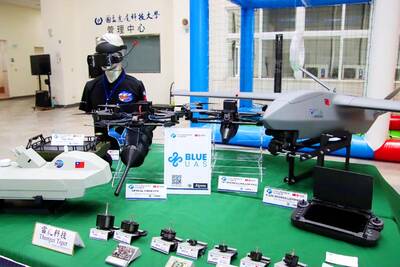
NON-RED SUPPLY: Boosting the nation’s drone industry is becoming increasingly urgent as China’s UAV dominance could become an issue in a crisis, an analyst said Taiwan’s drone exports to Europe grew 41.7-fold from 2024 to last year, with demand from Ukraine’s fight against Russian aggression the most likely driver of growth, a study showed. The Institute for Democracy, Society and Emerging Technology (DSET) in a statement on Wednesday said it found that many of Taiwan’s uncrewed aerial vehicle (UAV) sales were from Poland and the Czech Republic. These countries likely transferred the drones to Ukraine to aid it in its fight against the Russian invasion that started in 2022, it said. Despite the gains, Taiwan is not the dominant drone exporter to these markets, ranking second and fourth

Japanese Prime Minister Sanae Takaichi’s comment last year on Tokyo’s potential reaction to a Taiwan-China conflict has forced Beijing to rewrite its invasion plans, a retired Japanese general said. Takaichi told the Diet on Nov. 7 last year that a Chinese naval blockade or military attack on Taiwan could constitute a “survival-threatening situation” for Japan, potentially allowing Tokyo to exercise its right to collective self-defense. Former Japan Ground Self-Defense Force general Kiyofumi Ogawa said in a recent speech that the remark has been interpreted as meaning Japan could intervene in the early stages of a Taiwan Strait conflict, undermining China’s previous assumptions


 RSS
RSS