


The Presidential Office yesterday downplayed the removal of President Ma Ying-jeou’s (馬英九) photograph and information from the APEC Web site, saying they were happy about the “breakthrough” the country made this year.
Presidential Office Spokesman Wang Yu-chi (王郁琦) called the “breakthrough” the “biggest” since APEC was established 17 years ago.
“It serves the interests of Taiwan if we continue to make progress,” he said.
Ma on Tuesday acknowledged the organizer of this year’s APEC summit for using his photograph and referring to him as “president” on the Web site and official documents, saying it indicated his more conciliatory cross-strait policies were working.
It marked the first time that the country’s president was introduced in an APEC document and the first time since Taiwan became an APEC member economy in 1991 that a host country published a picture of a Taiwanese president on the Web site.
Ma’s photograph and other information, however, were later removed from the Web site. Critics suspected China of interfering in the matter.
Since Taiwan and China joined APEC in 1991, Beijing has blocked Taipei’s presidents and foreign ministers from attending the group’s forums, citing a memorandum of understanding signed with China and Hong Kong before Taipei joined the group under the name “Chinese Taipei.” Under this memorandum, the three economies entered the organization as a single economic entity.
Beijing’s backroom bullying over Taiwan’s participation at APEC reached a climax in 2001, when the meeting was held in Shanghai, and Beijing blocked Taiwan from attending the leaders meeting.
The Ministry of Foreign Affairs (MOFA) said yesterday that Taiwan’s standing in APEC remained solid, adding that Taiwan was not the only country whose profile was erased from the APEC Web site.
“According to our understanding,” said Director-General of the Department of International Organizations Paul Chang (章文樑), “the entire section that introduces all the heads of member economies was completely taken down.”
He added that Taiwan was not singled out and the public should not read too much into the situation.
Chang insisted that the deletion was not specifically aimed at Taiwan and if APEC organizers made any gestures to demean Taiwan, “we will lodge a protest at an appropriate time.”
MOFA is still investigating why the section was taken down, he added.
MOFA said that Lima commissioned its national news agency, Andina, to handle all media-related affairs and to post APEC-related information on the Web site.
The APEC summit, also known as the informal economic leaders’ meeting, will be held in Lima from tomorrow through Sunday this year.
The reception is scheduled for tomorrow and business networking, tours and golf are planned for Sunday.
Leaders scheduled to speak at the summit include Australian Prime Minister Kevin Rudd, Canadian Prime Minister Stephen Harper, Chilean President Michelle Bachelet, South Korean President Lee Myung-bak, US President George W. Bush and Chinese President Hu Jintao (胡錦濤).
Former vice president and honorary Chinese Nationalist Party (KMT) Chairman Lien Chan (連戰) is standing in for Ma in Lima this year. Lien is the highest-ranking Taiwanese official to attend the event.
Former president Chen Shui-bian (陳水扁) proposed that former vice president Li Yuan-zu (李元簇) be the APEC representative, but the proposal was voted down by Beijing.
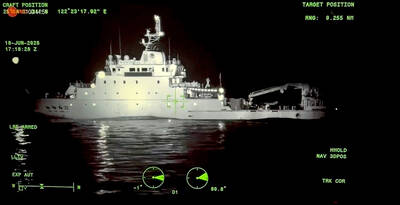
EXCUSES: Beijing is using government and research vessels as a pretext to harass the nation and enter its EEZ, and engage in ‘hegemonic expansion,’ the coast guard said The Coast Guard Administration yesterday said it drove away Chinese oceanographic research vessel Xiang Yang Hong 22 (向陽紅33) from restricted waters after warning it that it was in Taiwan’s exclusive economic zone (EEZ). The Chinese vessel entered restricted waters off the coast of Yilan County’s Suao (蘇澳) at 11:35pm on Thursday, the coast guard said, adding that it dispatched the Lanyu patrol vessel and the boat PP-10077 to shadow the Chinese ship and issue radio warnings ordering it to leave. China has no sovereignty over waters off Taiwan’s east coast, Lanyu’s crew told Xiang Yang Hong 22 over the radio, and demanded
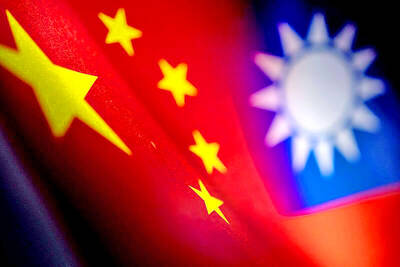
BAIT AND SWITCH: Allowing KMT-run counties to sell to China while the threat of abrupt cancelations hangs overhead is another form of coercion, officials said Beijing is using agricultural purchase offers announced during the Straits Forum to deepen Taiwan’s dependence on the Chinese market, a Taiwanese official said yesterday as they criticized the Taitung County commissioner’s participation in the initiative. During the Straits Forum held in Xiamen on Saturday, Chinese officials announced a sales and purchase agreement for agricultural products from some counties led by the Chinese Nationalist Party (KMT). Taitung County Commissioner Yao Ching-ling (饒慶鈴), who was barred from attending the event in person by the Mainland Affairs Council, participated via video. Under the agreement, China would purchase atemoyas, pomeloes, tea and grouper harvested in Taitung,
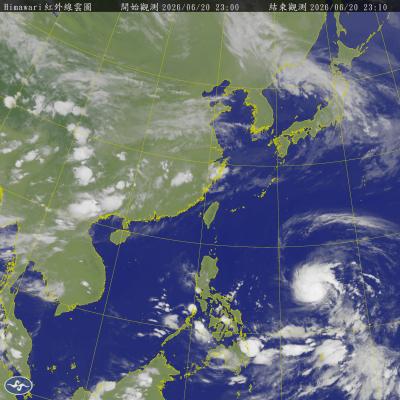
Tropical Storm Mekkhala is forecast to strengthen into a typhoon tomorrow and could come close enough to Taiwan later in the week to prompt a sea warning, the Central Weather Administration (CWA) said yesterday. As of 2 pm, the storm was located 1,870 kilometers southeast of Taiwan's southern tip and moving west- northwest at 23 km per hour. CWA forecaster Cheng Chieh-jen (鄭傑仁) said Mekkhala is expected to continue moving west-northwest through Tuesday under the influence of the Pacific high- pressure system before gradually turning north toward waters east of Taiwan or south of the Ryukyu Islands. The timing and angle of the
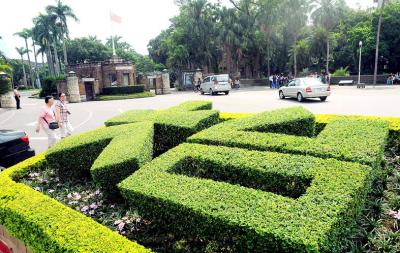
Four Taiwanese universities have been ranked among the world's top 200 institutions in the Quacquarelli Symonds (QS) World University Rankings for next year, the highest Taiwan has ever placed in the category, with National Taiwan University (NTU) achieving its best performance at 54th globally and 17th in Asia. The four Taiwanese institutions in the global top 200 are NTU (54th), National Tsing Hua University (142nd), National Yang Ming Chiao Tung University (177th) and National Cheng Kung University (191st), the rankings showed. All four universities achieved their highest-ever global rankings this year, QS data showed. National Cheng Kung University entered the top 200 for


 RSS
RSS