


The Association of Taiwan Journalists (ATJ) yesterday condemned violent acts — by both demonstrators and the police — that harmed reporters at various protest scenes on Thursday night.
“We fully support freedom of expression, but strongly condemn any form of violence,” ATJ secretary-general Liu Chia-yun (劉嘉韻) said. “Freedom of the press, as well as journalists’ right to work safely should be respected by both demonstrators and the police.”
Clashes erupted between demonstrators and the police during a rally organized by the Democratic Progressive Party near the Presidential Office on Thursday.
The crowd threw rocks, plastic bottles, dirt, firecrackers, eggs and ink among other things at the police while also engaging in physical clashes with the police.
Some of the objects ended up wounding reporters.
“The crowd threw anything they could find. I was hit on the head and feet by a big flower pot,” Tracy Hwang (黃安晴), a reporter with CTI-TV said. “When I was hit, I dropped my walkie-talkie, and they just picked it up and threw it at the police. My cameraman was hit on the head with a brick, and he was bleeding all over.”
According to information released by the ATJ yesterday, a total of eight TV reporters were wounded and sent to the emergency room during the day, while several other reporters from the print media suffered minor injuries after being hit by flying water bottles.
Clashes also took place in the early hours of yesterday morning after protesters marched toward the Grand Hotel, where China’s Association for Relations Across the Taiwan Strait chairman Chen Yunlin (陳雲林) was staying. They were stopped by police on the road leading to Zhongshan Bridge.
A video clip broadcast by Formosa TV (FTV) showed that when the riot police advanced to push protesters back, an officer hit FTV reporter Tsai Meng-yu (蔡孟育) twice on the face with a pole.
“As soon as he [the police officer] ran out, he started beating just anybody he ran into,” Tsai said. “I tried to run away when the police started their advance, but as I turned around, I felt two hits right away — one on my nose, and one on my [right] eye. I felt dizzy and started bleeding.”
Tsai said that he was considering filing a lawsuit against the officer.
“This is horrible police brutality. Tsai was holding a microphone with an FTV logo on it, so it’s quite obvious that he is a reporter,” said ATJ chairman Leon Chuang (莊豐嘉). “Even if Tsai weren’t a reporter, I doubt it’s really necessary to beat a civilian like that.”

LOUD AND PROUD Taiwan might have taken a drubbing against Australia and Japan, but you might not know it from the enthusiasm and numbers of the fans Taiwan might not be expected to win the World Baseball Classic (WBC) but their fans are making their presence felt in Tokyo, with tens of thousands decked out in the team’s blue, blowing horns and singing songs. Taiwanese fans have packed out the Tokyo Dome for all three of their games so far and even threatened to drown out home team supporters when their team played Japan on Friday. They blew trumpets, chanted for their favorite players and had their own cheerleading squad who dance on a stage during the game. The team struggled to match that exuberance on the field, with
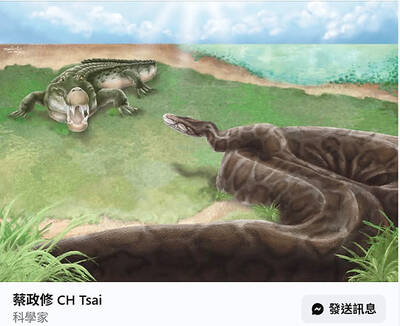
Taiwanese paleontologists have discovered fossil evidence that pythons up to 4m long inhabited Taiwan during the Pleistocene epoch, reporting their findings in the international scientific journal Historical Biology. National Taiwan University (NTU) Institute of Ecology and Evolutionary Biology associate professor Tsai Cheng-hsiu (蔡政修) led the team that discovered the largest snake fossil ever found in Taiwan. The single trunk vertebra was discovered in Tainan at the Chiting Formation, dated to between 400,000 and 800,000 years ago in the Middle Pleistocene, the paper said. The area also produced Taiwan’s first avian fossil, as well as crocodile, mammoth, saber-toothed cat and rhinoceros fossils, it said. Discoveries

Taiwanese paleontologists have discovered fossil evidence that pythons up to 4m long inhabited Taiwan during the Pleistocene epoch, reporting their findings in the international scientific journal Historical Biology. National Taiwan University (NTU) Institute of Ecology and Evolutionary Biology associate professor Tsai Cheng-hsiu (蔡政修) led the team that discovered the largest snake fossil ever found in Taiwan. A single trunk vertebra was discovered in Tainan at the Chiting Formation, dated to between 800,000 to 400,000 years ago in the Middle Pleistocene, the paper said. The area also produced Taiwan’s first avian fossil, as well as crocodile, mammoth, sabre-toothed cat and rhinoceros fossils, it said. Discoveries

Whether Japan would help defend Taiwan in case of a cross-strait conflict would depend on the US and the extent to which Japan would be allowed to act under the US-Japan Security Treaty, former Japanese minister of defense Satoshi Morimoto said. As China has not given up on the idea of invading Taiwan by force, to what extent Japan could support US military action would hinge on Washington’s intention and its negotiation with Tokyo, Morimoto said in an interview with the Liberty Times (sister paper of the Taipei Times) yesterday. There has to be sufficient mutual recognition of how Japan could provide


 RSS
RSS