


Some 500 college students staged a sit-in yesterday in front of the Executive Yuan over the police response to protests against Association for Relations Across the Taiwan Strait (ARATS) Chairman Chen Yunlin’s (陳雲林) visit.
“The protest will continue through the night, into tomorrow and [through] tomorrow ... until our three appeals are accepted,” said Lee Ming-tsung (李明璁), the group’s spokesman and an associate professor of sociology at National Taiwan University.
The group demanded in a written petition that President Ma Ying-jeou (馬英九) and Premier Liu Chao-shiuan (劉兆玄) apologize for the use of excessive force by police, that National Police Agency (NPA) Director-General Wang Cho-chiun (王卓鈞) and National Security Bureau Director Tsai Chao-ming (蔡朝明) step down and that the government scrap the Assembly and Parade Law (集會遊行法).
Chang Tieh-chih (張鐵志), a doctoral student at the department of political science at Columbia University, called on Liu to talk to the students, who were blocked by dozens of police at the front gate of the Executive Yuan.
Liu convened a regular weekly Cabinet meeting yesterday morning, with many high-level officials in attendance, but no one emerged to talk to the students.
The protest was organized via an online drive appealing to students at various universities. The group wore black T-shirts to symbolize their anger.
“When I saw on TV that protesters were being treated violently by the police, I felt really confused. How can the police be violent toward people who haven’t even broken the law and are just carrying the national flag?” said Chang Yi-shih (張逸詩), a student at National Taipei University.
More than 1,000 people, many of whom were professors and students, had signed the three petitions and the group was still collecting signatures, Lee said.
“Do we really have to reduce the standard of democracy and freedom in Taiwan to the low level of authoritarian China for the sake of enhancing cross-strait economic ties?” Lee asked.
“It’s not about the police’s use of excessive force or about their party affiliation. It’s about the government exerting its power in a violent way to repress civil society,” Lee said.

FUKUOKA SITUATION: Japanese media reported that the pathogen is expected to be identified by the summer, while the CDC downplayed the idea that it was hMPV A “mysterious cold-like illness” reported in Japan’s Fukuoka Prefecture does not seem to be a new disease, but Japanese authorities have been asked about the situation, the Centers for Disease Control (CDC) said yesterday. The Fukuoka Prefectural Medical Association on Wednesday told a news conference that a “mystery cold” that has become a hot topic on social media is “highly likely to be caused by some kind of viral infection,” Japan’s KBC News reported. “Many people are experiencing symptoms starting with a sore throat, followed by a runny nose, phlegm and a severe cough,” KBC News reported, citing association officials. Health authorities are

Nvidia Corp CEO Jensen Huang (黃仁勳) arrived in Taiwan yesterday ahead of upcoming AI and technology events, saying he plans to meet with clients and Taiwan Semiconductor Manufacturing Co Chairman C.C. Wei (魏哲家) during his visit. After landing at Taipei Songshan Airport, Huang posed for photos with fans and handed out Yakult drinks to reporters and supporters waiting at the scene, saying he has “a lot to do” during the trip. Asked about reports that Nvidia’s planned headquarters site in Taipei’s Beitou Shilin Technology Park could break ground on May 27, Huang said that if the company holds an event, he would

The Ministry of Finance this afternoon announced the winning numbers for the March-April uniform invoice lottery. The winning number for the NT$10 million (US$318,060) special prize is 19531471, and the winning number for the NT$2 million grand prize is 85941329. Three numbers were drawn for the NT$200,000 first prize: 07225810, 20231230 and 83518781. Those with receipts matching the last seven digits of any of the first-prize numbers will win the NT$40,000 second prize, while those matching the last six digits will win the NT$10,000 third prize. Those whose receipts match the last five digits of the first-prize numbers can claim the NT$4,000 fourth prize,
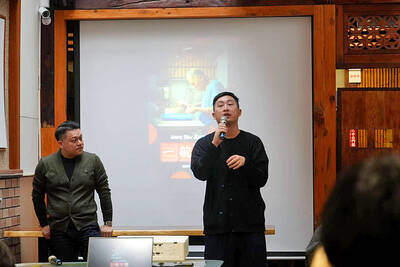
Taiwan Travelogue (臺灣漫遊錄), which earlier this week became the first Taiwanese novel to win the International Booker Prize, is to be adapted into a television series through a Taiwan-Japan coproduction, producer Chang Chen-yu (張辰漁) said yesterday. Chang, a producer at World Softest Production Film Co, wrote on Facebook that the company had been searching for projects with international appeal that retain a strong Taiwanese identity after colleagues and Japanese partners strongly recommended the novel. After reading the book, Chang said he immediately decided to pursue the screen rights. “A great story has the power to transcend time and borders, and connect countless people,”


 RSS
RSS