


Four Democratic Progressive Party (DPP) legislators yesterday recommended a “dream team” made up of six senior party members to run in next year’s mayoral elections, as part of a strategy to boost party morale.
Not everyone, however, agreed that the team would be the answer.
DPP legislators Chai Trong-rong (蔡同榮), Wang Sing-nan (王幸男), Kuo Wen-cheng (郭玟成) and Su Cheng-ching (蘇震清) said they would nominate former president Chen Shui-bian (陳水扁) to run for Tainan County commissioner, former vice president Annette Lu (呂秀蓮) as Taoyuan County commissioner and four former premiers — Su Tseng-chang (蘇貞昌), Frank Hsieh (謝長廷), Yu Shyi-kun and Chang Chun-hsiung (張俊雄) — to head Taipei County, Kaohsiung County, Ilan County and Chiayi City respectively.
The four lawmakers said they would propose the nomination at the DPP National Convention on Sunday.
Describing the six former officials as the DPP’s “dream team,” Wang said that if Chen were deemed unsuitable to take part in the election because of his status as former president, former Presidential Office secretary-general Mark Chen (陳唐山) could run in his stead.
DPP Chairwoman Tsai Ing-wen (蔡英文) should also run for Taipei mayor, Wang said.
Asked if the six had agreed to the nominations, Kuo said they would have little choice if their nominations won majority support on Sunday.
Other DPP lawmakers, however, were not as enthusiastic.
DPP Legislator Lee Chun-yi (李俊毅) said he was optimistic about the nominations, but added that other senior DPP members, such as former justice minister Chen Ding-nan (陳定南), had been defeated in county elections when they tried to re-enter local politics after leaving the central government.
DPP Legislator Kao Jyh-peng (高志鵬) said that although the return of various senior party members to the political scene could raise the party’s fighting spirit, the public might interpret it as the party suffering from a lack of qualified individuals.
DPP convener Ker Chien-ming (柯建銘) said Chen Shui-bian was least likely to make a return to politics given his current circumstances.
DPP Legislator Kuan Bi-ling (管碧玲), meanwhile, urged her colleagues to hold off discussing candidates as the party had yet to pass regulations governing the draft system.
In a statement issued later yesterday, Chen Shui-bian thanked Huang and others but declined their invitation, saying that the DPP had to seriously consider a “second generational shift” if it wanted to stand a chance in the presidential election in 2012.
“If you love me, please don’t set me up,” he said in a statement issued by his office.
He attributed the DPP victory in the 2000 election and the KMT triumph in this year’s presidential poll to generational shifts.
“It is too early to tell what will happen in 2012,” he said. “But shouldn’t we give the young and new as well as women a chance?”
He urged the “big four” — Lu, Su, Yu and Hsieh — to “step aside and refrain from blocking the road” and asked them to “give the younger generation a chance.”
Chen Shui-bian called on party members to support the party and Tsai. He also urged them to win back public support by promoting party unity, ideals and values.
Emphasizing that President Ma Ying-jeou (馬英九) is the country’s head of state, Chen Shui-bian said he did have something to say about the Ma administration but he did not want the public to think that there were two presidents so he would rather keep quiet.
ADDITIONAL REPORTING BY KO SHU-LING
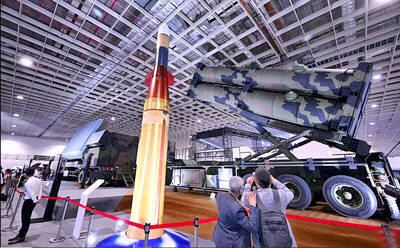
Taiwan is to commence mass production of the Tien Kung (天弓, “Sky Bow”) III, IV and V missiles by the second quarter of this year if the legislature approves the government’s NT$1.25 trillion (US$39.78 billion) special defense budget, an official said yesterday. Commenting on condition of anonymity, a defense official with knowledge of the matter said that the advanced systems are expected to provide crucial capabilities against ballistic and cruise missiles for the proposed “T-Dome,” an advanced, multi-layered air defense network. The Tien Kung III is an air defense missile with a maximum interception altitude of 35km. The Tien Kung IV and V
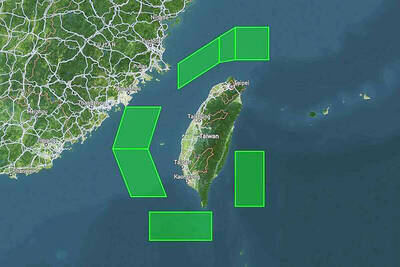
The disruption of 941 flights in and out of Taiwan due to China’s large-scale military exercises was no accident, but rather the result of a “quasi-blockade” used to simulate creating the air and sea routes needed for an amphibious landing, a military expert said. The disruptions occurred on Tuesday and lasted about 10 hours as China conducted live-fire drills in the Taiwan Strait. The Civil Aviation Administration (CAA) said the exercises affected 857 international flights and 84 domestic flights, affecting more than 100,000 travelers. Su Tzu-yun (蘇紫雲), a research fellow at the government-sponsored Institute for National Defense and Security Research, said the air
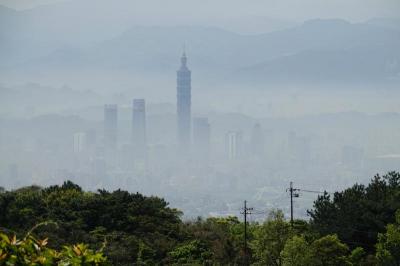
A strong continental cold air mass is to bring pollutants to Taiwan from tomorrow, the Ministry of Environment said today, as it issued an “orange” air quality alert for most of the country. All of Taiwan except for Hualien and Taitung counties is to be under an “orange” air quality alert tomorrow, indicating air quality that is unhealthy for sensitive groups. In China, areas from Shandong to Shanghai have been enveloped in haze since Saturday, the ministry said in a news release. Yesterday, hourly concentrations of PM2.5 in these areas ranged from 65 to 160 micrograms per cubic meter (mg/m³), and pollutants were
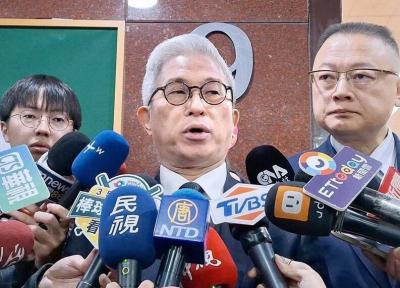
Taiwan’s armed forces have established response protocols for a wide range of sudden contingencies, including the “Wan Chun Plan” to protect the head of state, the Ministry of Defense (MND) said today. After US President Donald Trump on Saturday launched a series of airstrikes in Venezuela and kidnapped Venezuelan President Nicolas Maduro, concerns have been raised as to whether China would launch a similar “decapitation strike” on Taiwan. The armed forces regularly coordinate with relevant agencies and practice drills to ensure preparedness for a wide range of scenarios, Vice Minister of National Defense Hsu Szu-chien (徐斯儉) told reporters before a


 RSS
RSS