


Mainland Affairs Council Chairwoman Lai Shin-yuan (賴幸媛) yesterday hailed the conclusion of cross-strait talks on Friday as a new page in Taipei and Beijing relations when greeting the returning delegation headed by Straits Exchange Foundation (SEF) Chairman Chiang Pin-kung (江丙坤) at Taiwan Taoyuan International Airport.<>
“Chiang met the public’s expectations and successfully accomplished his tasks, opening a new page in positive cross-strait exchanges,” Lai said.
During Chiang’s four-day visit to China, he signed accords with his Chinese counterpart Chen Yunlin (陳雲林), chairman of China’s Association for Relations Across the Taiwan Strait (ARATS), to launch weekend cross-strait flights and allow more Chinese tourists to visit Taiwan.
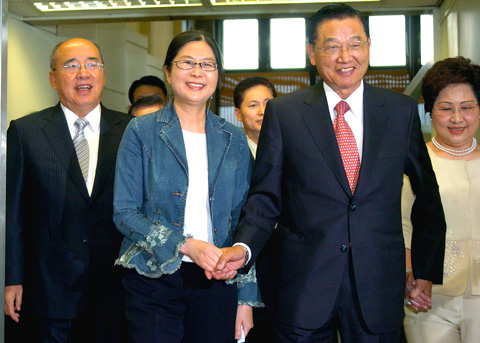
PHOTO: CHU PEI-HSIUNG, TAIPEI TIMES
Chiang yesterday said he did not reach a consensus with Chen on setting up branch offices of their respective organizations in Taipei and in Beijing, as had been reported in the local media.
“Chen suggested setting up a semi-official travel agency in Taipei to help streamline the process of obtaining visas to China. I replied that I would take his suggestion back to Taipei. That’s all I said,” Chiang said.
Later yesterday, President Ma Ying-jeou (馬英九) received Chiang at the Presidential Office. Ma urged Chiang to organize a new round of cross-strait negotiations to reach a deal on the new cross-strait flight routes.
Taipei and Beijing agreed that weekend charter flights must fly through Hong Kong airspace instead of taking a direct route across the strait, but during the talks, Chiang suggested allowing the charter flights to fly a “direct route.”
Chiang’s move sparked controversy as to whether he was authorized to make the proposal as the Ministry of National Defense had expressed its opposition for national security reasons.
Ma yesterday said he backed the “direct flight” proposal.
“The shorter the flying time [between Taiwan and China], the more everyone will benefit,” Ma said.
“Direct flight, new flight routes, cargo charter flights and weekday passenger charter flights should all be put on the table as soon as possible,” he said.
Both sides of the Taiwan Strait agreed to establish “institutionalized” communication channels following the Chiang-Chen talks, Ma said.
“Different issues can be talked about by different groups at the same time and the talks can take place in Taiwan and in China simultaneously,” Ma said. “That way, it would be faster. There are a thousand of things that remain to be done. My worry is that progress will fall behind the public’s expectations.”

FUKUOKA SITUATION: Japanese media reported that the pathogen is expected to be identified by the summer, while the CDC downplayed the idea that it was hMPV A “mysterious cold-like illness” reported in Japan’s Fukuoka Prefecture does not seem to be a new disease, but Japanese authorities have been asked about the situation, the Centers for Disease Control (CDC) said yesterday. The Fukuoka Prefectural Medical Association on Wednesday told a news conference that a “mystery cold” that has become a hot topic on social media is “highly likely to be caused by some kind of viral infection,” Japan’s KBC News reported. “Many people are experiencing symptoms starting with a sore throat, followed by a runny nose, phlegm and a severe cough,” KBC News reported, citing association officials. Health authorities are

Nvidia Corp CEO Jensen Huang (黃仁勳) arrived in Taiwan yesterday ahead of upcoming AI and technology events, saying he plans to meet with clients and Taiwan Semiconductor Manufacturing Co Chairman C.C. Wei (魏哲家) during his visit. After landing at Taipei Songshan Airport, Huang posed for photos with fans and handed out Yakult drinks to reporters and supporters waiting at the scene, saying he has “a lot to do” during the trip. Asked about reports that Nvidia’s planned headquarters site in Taipei’s Beitou Shilin Technology Park could break ground on May 27, Huang said that if the company holds an event, he would

The Ministry of Finance this afternoon announced the winning numbers for the March-April uniform invoice lottery. The winning number for the NT$10 million (US$318,060) special prize is 19531471, and the winning number for the NT$2 million grand prize is 85941329. Three numbers were drawn for the NT$200,000 first prize: 07225810, 20231230 and 83518781. Those with receipts matching the last seven digits of any of the first-prize numbers will win the NT$40,000 second prize, while those matching the last six digits will win the NT$10,000 third prize. Those whose receipts match the last five digits of the first-prize numbers can claim the NT$4,000 fourth prize,
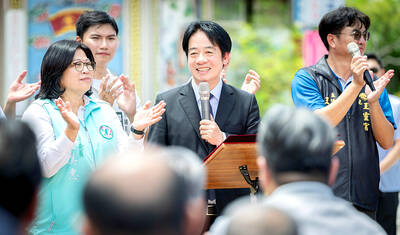
SIX SUBSIDIES: The monthly allowance for older farmers is to increase to NT$10,000, and NT$5,000 is to be given to homemakers under the national pension system, Lai said The government is to implement major welfare policies for disadvantaged groups, including raising the monthly allowance for older farmers to NT$10,000 and providing homemakers with NT$5,000 per month, President William Lai (賴清德) said yesterday. Lai made the remarks during a visit to Wangling Temple in Chiayi County, saying that the planned increases were being introduced amid economic growth and an increase in tax revenue. Touting a policy, in which the government plans to provide a monthly allowance of NT$5,000 for every child under the age of 18 in a bid to address Taiwan’s low birthrate, Lai said that if received for the


 RSS
RSS