


The Ministry of Transportation and Communications (MOTC) is planning to allow taxi drivers who are over 65 years old to continue working, providing they pass an official health examination.
Currently, taxi drivers must retire when they reach 65. The new policy will enable them to drive until they turn 68.
Those who are 60 years old and above are obligated to have health examinations once every year. Those who are under 60 must have a health examination once every three years.
Jack Hsu (�?h), director general of the MOTC’s Department of Railways and Highways, said yesterday that the ministry is in the process of completing all legal procedures, and the new policy is scheduled to be executed next month.
Approximately 10,000 taxi drivers may be able to hit the road again once the policy takes effect.
The ministry has also required the drivers to indicate problems staying awake during the daytime in a self-evaluated form.
Drivers who indicate one of these problems are required to undergo a formal evaluation in the hospital.
Drivers who have a body mass index exceeding 30 will not be allowed to drive. Also, drivers cannot have any lung problems or infectious diseases.
The ministry also said yesterday that it will start giving out subsidies for gas to city bus and freeway bus operators as well as taxi drivers next week.
The measure will continue from now until the end of this year.
The announcement came a week after the Executive Yuan decided to raise the retail gas price.
Specifically, the ministry will subsidize the city and freeway bus operators to the tune of NT$7.4 per liter of gas.
For taxis that have raised their rates since May last year, each will get a subsidy of NT$3.9 per liter.
Those that have not raised the rate, however, will each get a subsidy of NT$5.9 per liter. Drivers are required to have gas cards issued by CPC, Taiwan (台灣中油), and accounts in which money has to be added every month.
Taxi drivers will then receive either a NT$4 or a NT$6 rebate for each liter purchased. The subsidy is capped at 450 liters per month.
In addition to the monthly subsidy, taxi drivers will also get subsidies for gas used between May 28 and May 31.
In total, drivers in the former category will each receive NT$1,981 this month, whereas those in the latter category will each receive NT$2,881.
CPC, Taiwan will start taking applications for drivers who haven’t owned gas cards on Monday.
All card owners could start receiving the subsidies next Thursday.
Hsu emphasized that the ministry will reduce the subsidy if the retail gas price drops, but it will not raise the subsidy beyond the stated amount even if the retail price continues to rise over the next six months.
Meanwhile, the ministry is considering requiring taxis to pick up passengers at designated taxi stops instead of at the roadside. The planned move however has so far met with criticism from taxi drivers.

FUKUOKA SITUATION: Japanese media reported that the pathogen is expected to be identified by the summer, while the CDC downplayed the idea that it was hMPV A “mysterious cold-like illness” reported in Japan’s Fukuoka Prefecture does not seem to be a new disease, but Japanese authorities have been asked about the situation, the Centers for Disease Control (CDC) said yesterday. The Fukuoka Prefectural Medical Association on Wednesday told a news conference that a “mystery cold” that has become a hot topic on social media is “highly likely to be caused by some kind of viral infection,” Japan’s KBC News reported. “Many people are experiencing symptoms starting with a sore throat, followed by a runny nose, phlegm and a severe cough,” KBC News reported, citing association officials. Health authorities are

Nvidia Corp CEO Jensen Huang (黃仁勳) arrived in Taiwan yesterday ahead of upcoming AI and technology events, saying he plans to meet with clients and Taiwan Semiconductor Manufacturing Co Chairman C.C. Wei (魏哲家) during his visit. After landing at Taipei Songshan Airport, Huang posed for photos with fans and handed out Yakult drinks to reporters and supporters waiting at the scene, saying he has “a lot to do” during the trip. Asked about reports that Nvidia’s planned headquarters site in Taipei’s Beitou Shilin Technology Park could break ground on May 27, Huang said that if the company holds an event, he would

The Ministry of Finance this afternoon announced the winning numbers for the March-April uniform invoice lottery. The winning number for the NT$10 million (US$318,060) special prize is 19531471, and the winning number for the NT$2 million grand prize is 85941329. Three numbers were drawn for the NT$200,000 first prize: 07225810, 20231230 and 83518781. Those with receipts matching the last seven digits of any of the first-prize numbers will win the NT$40,000 second prize, while those matching the last six digits will win the NT$10,000 third prize. Those whose receipts match the last five digits of the first-prize numbers can claim the NT$4,000 fourth prize,
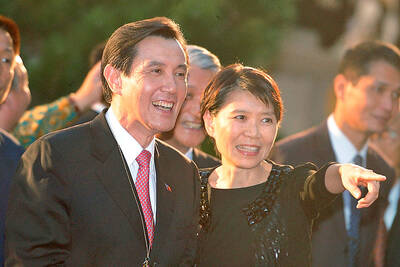
Former president Ma Ying-jeou (馬英九) yesterday expressed “shock and regret” over a statement issued by his wife without his consent, and rejected her assertion that his eldest sister, Ma Yi-nan (馬以南), would manage his medical care or act as his spokesperson amid an ongoing embezzlement probe into his foundation. Ma Ying-jeou in a statement said he was shocked by a statement by his wife, Chou Mei-ching (周美青), regarding his affairs. Ma Yi-nan “must not” be in charge of his healthcare and other personal affairs, nor can she be allowed to represent the Ma family, the former president said. He said he was also


 RSS
RSS