


Merchants conspiring to pass oilfish for the more expensive cod may soon be unable to do so, as a Barcode of Life Databank (BOLD) capable of identifying fish samples within days is under way and would be completed as early as next year, the Council of Agriculture (COA) said yesterday.
The COA-funded BOLD project is part of the Consortium for the Barcode of Life (CBOL), an international collaboration project devoted to identifying global biological species using DNA barcodes, said project leader and research fellow at the Academia Sinica’s research center for biodiversity, Shao Kwang-tsao (邵廣昭).
“DNA barcoding is a taxonomic technique that uses short but species-specific DNA sequences in the genome for species identification,” Shao said.
The most common section of DNA used is cytochrome c oxidase subunit 1 (CO1), a gene in the mitochondria, because CO1 variation is very small within species but disparate in different species, he said.
Once a species’ CO1 sequence is filed into BOLD, the speedy and economical DNA barcode can analyze fish samples within 3 days for less than NT$1,000.
“For example, when a cargo of fish comes into the country via seaports, we can identify what type of fish they are even with their heads and tails cut off so that consumers can be sure of the type of fish they are purchasing,” he said.
Seaport patrols can similarly use the technique to prevent illegal fish smuggling, he said.
Among the 300-some fish commonly consumed by Taiwanese, 200 fish types have already been successfully identified, Shao said, adding that the databank would be completed by next year.
Though the project was commissioned by the COA, commercial fish identification was merely a “side benefit” of the BOLD project, center research assistant Chen Hsuan-wen (陳宣汶) said.
“Including fish species, CBOL has so far documented 38,762 species globally with 392,594 records in the bank,” he said. “Biodiversity is an invaluable resource we have. For people to know ways to conserve the ecosystem, we must first know what is out there.”
BOLD is a collaboration of international scholars to build a complete global biodiversity databank, aimed at fostering in people a better understanding and appreciation for the vastness of the variety of life on the planet, he said.
For example, he said, the databank can be useful when assessing the biodiversity impact and feasibility of development of a certain area.
“The current environmental impact assessment (EIA) process allows limited time for EIA committees to obtain information on the biodiversity of proposed construction sites,” he said. “If, say, a comprehensive BOLD system was in place, the Suhua Freeway EIA committee would be able to quickly understand the endemic ecosystem, from microorganisms to higher level animals, and make a better informed decision based on the information.”
BOLD further provides continuity in biodiversity taxonomy research, Chen said.
“Many species may not be observed easily, so to pass down valuable information effectively, a globally understandable identification system would be very important, and DNA barcodes fit the bill,” he said.
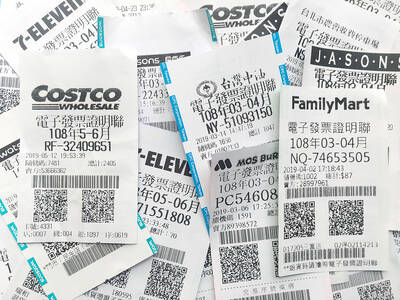
A NT$39 receipt for two bottles of tea at a FamilyMart was among the NT$10 million (US $312,969) special prize winners in the January-February uniform invoice lottery. FamilyMart said that two NT$10 million-winning receipts were issued at its stores, as well as two NT$2 million grand prizes and three NT$200,000 first prizes. The two NT$10 million receipts were issued at stores in Pingtung County and Yilan County’s Dongshan Township (冬山). One winner spent just NT$39 on two bottles of tea, while another spent NT$80 on water, tea and coffee, the company said. Meanwhile, 7-Eleven reported three NT$10 million winners — in New Taipei

Considering that most countries issue more than five denominations of banknotes, the central bank has decided to redesign all five denominations, the bank said as it prepares for the first major overhaul of the banknotes in more than 24 years. Central bank Governor Yang Chin-lung (楊金龍) is expected to report to the Legislative Yuan today on the bank’s operations and the redesign’s progress. The bank in a report sent to the legislature ahead of today’s meeting said it had commissioned a survey on the public’s preferences. Survey results showed that NT$100 and NT$1,000 banknotes are the most commonly used, while NT$200 and NT$2,000

ANNUAL EVENT: Two massive Pokemon balloons are to be set up in Daan Park, with an event zone operating from 10am to 6pm This year’s Taipei Floral Picnic is to be held at Daan Park today and tomorrow, featuring an exclusive Pokemon Go event, a themed food market, a coffee rave picnic area and stage performances, the Taipei Department of Information and Tourism said yesterday. Two massive Pokemon balloons are to be set up in the park as attractions, with an exclusive event zone operating from 10am to 6pm, it said. Participants who complete designated tasks on-site would have a chance to receive limited-edition souvenirs, it added. People could also try the newly launched game Pokemon Pokopia in the trial area, the department said. Three PokeStops are

The Centers for Disease Control (CDC) yesterday reported the first case of a new COVID-19 subvariant — BA.3.2 — in a 10-year-old Singaporean girl who had a fever upon arrival in Taiwan and tested positive for the disease. The girl left Taiwan on March 20 and the case did not have a direct impact on the local community, it said. The WHO added the BA.3.2 strain to its list of Variants Under Monitoring in December last year, but this was the first imported case of the COVID-19 variant in Taiwan, CDC Deputy Director-General Lin Ming-cheng (林明誠) said. The girl arrived in Taiwan on


 RSS
RSS