


Environmental protection is without borders, and nations around the world are collaborating in air quality monitoring efforts to monitor pollutant density in the air, as well as to formulate possible ways to combat health and environmental hazards the pollutants are causing, the Environmental Protection Administration (EPA) said yesterday.
Because of air currents that travel around the globe, airborne waste from industrial operations and biomass incineration in China and Southeast Asian countries are causing increasing degrees of air contamination around the world, EPA Minister Winston Dang (陳重信) said.
Such wastes have caused the world to suffer from more frequent and severe acid rain, sandstorms, as well as denser concentrations of heavy metal particles, Dang said.
“In the past two years we have observed that every time a front comes from China, the mercury level in Taiwan’s air increased drastically,” Dang said. “From 1950 to 2000, China suffered from one sandstorm per year. However, in 2002, 10 sandstorms were recorded, while in 2006, 17 sandstorms occurred.”
With this in mind, the administration two years ago built the Lulin (鹿林) Atmospheric Background Station near Yushan (玉山), Taiwan’s highest mountain, to detect the air composition makeup of air transported from faraway places.
The station was built at 2,862m above sea level for several reasons, Dang said.
“Heavy metals, such as mercury, do not travel to such altitudes if they are from local sources — the particles we get in samples here would be those that travel around the Earth on air currents,” he said.
In addition, because polluting behavior can mostly be ruled out in the population-scarce mountain area, the samples obtained from the station can additionally provide “baseline” information for air quality in the rest of the nation, he said.
Mercury, an element that exists naturally in the environment, is mostly released into the air through human activities such as mining or burning coal, Dang said.
“When converted in the environment by microorganisms into the more toxic methylmercury, mercury’s most common organic form, the element attacks the central nervous system in humans and bioaccumulates in the aquatic food chain,” he said.
Fifty to 60 percent of the mercury in Taiwan’s air comes from industrial areas in China, Dang said, adding Japan and the US similarly suffer from China’s pollution.
“While we can refuse to eat contaminated fish, we cannot stop breathing — the situation is very serious and action should be taken to combat this problem,” he said.
Since 2006, the administration had joined the US’ National Oceanic and Atmospheric Administration in a global network project to monitor the planet’s air quality, Dang said.
One of the advantages of working with other countries is that the best equipment and personnel can be employed, Dang said.
“The equipment the station utilizes, a Depolarization Lidar System, which measures the vertical distribution of aerosol particles smaller than the size of bacteria by laser detection, is currently one of the most advanced pieces of equipment in the world,” he said.
The network has discovered that pollutants would first go from China to Taiwan, then, through Okinawa and Hawaii, eventually arriving in California, he said.
The information is both alarming and useful, Dang said.
“We know that environmental protection knows no national borders,” he said.
“In view of heavy pollution in developing countries, international strategies for cleaner industrial development and public health protection should be urgently formulated,” he said.
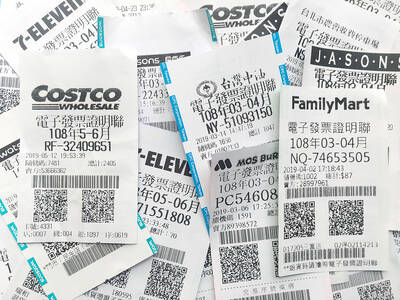
A NT$39 receipt for two bottles of tea at a FamilyMart was among the NT$10 million (US $312,969) special prize winners in the January-February uniform invoice lottery. FamilyMart said that two NT$10 million-winning receipts were issued at its stores, as well as two NT$2 million grand prizes and three NT$200,000 first prizes. The two NT$10 million receipts were issued at stores in Pingtung County and Yilan County’s Dongshan Township (冬山). One winner spent just NT$39 on two bottles of tea, while another spent NT$80 on water, tea and coffee, the company said. Meanwhile, 7-Eleven reported three NT$10 million winners — in New Taipei

Considering that most countries issue more than five denominations of banknotes, the central bank has decided to redesign all five denominations, the bank said as it prepares for the first major overhaul of the banknotes in more than 24 years. Central bank Governor Yang Chin-lung (楊金龍) is expected to report to the Legislative Yuan today on the bank’s operations and the redesign’s progress. The bank in a report sent to the legislature ahead of today’s meeting said it had commissioned a survey on the public’s preferences. Survey results showed that NT$100 and NT$1,000 banknotes are the most commonly used, while NT$200 and NT$2,000

ANNUAL EVENT: Two massive Pokemon balloons are to be set up in Daan Park, with an event zone operating from 10am to 6pm This year’s Taipei Floral Picnic is to be held at Daan Park today and tomorrow, featuring an exclusive Pokemon Go event, a themed food market, a coffee rave picnic area and stage performances, the Taipei Department of Information and Tourism said yesterday. Two massive Pokemon balloons are to be set up in the park as attractions, with an exclusive event zone operating from 10am to 6pm, it said. Participants who complete designated tasks on-site would have a chance to receive limited-edition souvenirs, it added. People could also try the newly launched game Pokemon Pokopia in the trial area, the department said. Three PokeStops are

The Centers for Disease Control (CDC) yesterday reported the first case of a new COVID-19 subvariant — BA.3.2 — in a 10-year-old Singaporean girl who had a fever upon arrival in Taiwan and tested positive for the disease. The girl left Taiwan on March 20 and the case did not have a direct impact on the local community, it said. The WHO added the BA.3.2 strain to its list of Variants Under Monitoring in December last year, but this was the first imported case of the COVID-19 variant in Taiwan, CDC Deputy Director-General Lin Ming-cheng (林明誠) said. The girl arrived in Taiwan on


 RSS
RSS